Haazinu 5784: Let It Go

Haazinu 5784: Let It Go

Earlier this year, my youngest son, Toby, and I watched The Lord of the Rings trilogy together. He is a fantasy genre lover, and, true to form, fell in love with the story of Frodo Baggins's long journey to Mount Doom, his struggle to carry the Ring of Power along the way, and his mission to throw the ring into the lava inside the mountain and destroy the ring once and for all.

Of course, Frodo doesn't do this alone. He has the help and support of a whole fellowship (the titular "Fellowship of the Ring" of the first of the three books/films). And in particular, he has the help of his closest friend, Sam, who is always looking out for him. In the climactic scene of the film, Frodo stands inside the volcano, holding the ring out over the lava. All he has to do is drop it. But the Ring of Power, as it has done throughout his journey, beckons him with a seductive call, and he can't manage to do this one simple final act—the act that will stop a war and save the world. Sam calls out, "Just let it go!" But Frodo can't.

In case you haven't seen it, I won't spoil what happens next. Suffice it to say the ring does ultimately wind up in the lava—but Frodo is left hanging from a rock above the molten lava, clinging on for dear life. He has no strength left. His mission is accomplished. He contemplates letting his life end. But Sam reaches out to him and, in the first words spoken since his last exhortation, he now says, "Don't you let go!"

I had never noticed this parallelism before, the "Just let it go" and "Don't you let go" of Sam in this scene. But it struck a deep chord in me on this viewing and I've been coming back to it frequently in the months since. Because it encapsulates so simply one of the fundamental discernments we constantly have to make: When do we hold on? And when do we let go?

On deep level, human development can be summarized as living these two questions: From the holding on/clinging that characterizes the relationship between a parent and an infant, to the letting go that happens at the moment of death, grief, and mourning. Like a heartbeat, the stages in between are full of grasping and relaxing, closing and opening our grip, in real and metaphorical ways: in relation to people, things, places, ideas, identities. What do we hold on to? What do we let go? The question pulsates, returning again and again.

One of my favorite prayers in the Yom Kippur liturgy comes in the evening service: Ki Hinei kaChomer, "Like Simple Clay." The poem, from 12th century France, compares the Jews gathered to pray to raw material in the hands of various tradespeople: clay in the hands of the potter, uncut stone in the hands of the mason, silver in the hands of the smith, etc. The craftsperson chooses what to do: to shape gently, to stretch and mold, to smash, to melt, to crush. "So too are we in Your hand," the poem says of the Holy One, with a plea to "look to Your Covenant," remember our relationship, and not give in to baser inclinations.

Many folks, including, most likely, the author of the poem, understand the theology here as something roughly like, "We deserve to be destroyed, but please forgive us and let us live." If that works for you, abi gezunt as we might say in Yiddish—great! I'll confess that it doesn't work so well for me and, if you're reading this, I expect it might not work so well for you either. So let me offer another way to read it, influenced by the example of Sam and Frodo.

It is not only the Holy One who is the potter holding clay or the ship captain steering the rudder. We are also those people. In every moment, we hold in our hands the raw material of life: our breath, our awareness, our presence. When we "look to the Covenant" and remember the virtues of lovingkindness and compassion—the essence of the 13 Attributes of Mercy which form the core of Yom Kippur—we have the opportunity to adjust our grip: To loosen it where we are holding too tightly, to strengthen it where it has become slack. That invitation/demand is available in every moment, with every breath. It is even more available on Shabbat. And it is especially available on Yom Kippur, Shabbat Shabbaton—an ultimate Shabbat in which we set aside the cares of the world for a day and so that we may abide in our individual and collective presence, and the Divine Presence.

My blessing and prayer for you and all of us, then, is that Yom Kippur be a moment--or, really, a long series of moments--of letting go of what needs to be let go, and holding on to what needs holding. May we emerge from this day rebalanced and renewed in our embrace of life, the world, one another, and the Divine Presence.

Crunch Time in Chelm: A Neo-Hasidic Tale and Mindfulness Practice for the New Year (as told by Rabbi Marc Margolius)

Crunch Time in Chelm: A Neo-Hasidic Tale and Mindfulness Practice for the New Year (as told by Rabbi Marc Margolius)

[These events are true — or they could be. They took place in the town of Chelm, whose residents famously claimed that they themselves were not fools -- it’s just that foolish things always happened to them.]

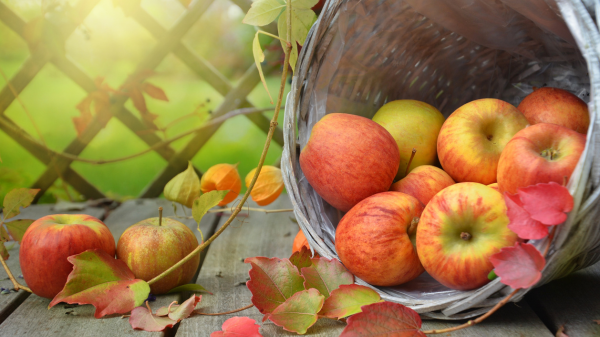
It was crunch time in Chelm. Or at least, it was supposed to be. Rosh Hashanah was scheduled to arrive early that fall, and the townspeople feared: what if the new crop of apples would not be ready for the holiday? How would they dip apples in honey for a sweet year?

The Chelmites arrived at what they considered a wise solution: to store apples from the previous fall in their root cellars. “We will certainly be blessed with ample apples for the New Year!” they thought.

But when the Chelmites went to their cellars on the eve of Rosh Hashanah, to their dismay they discovered that the stored apples had turned to mush. They had plenty of honey. But there was not an apple fit to be eaten in all of Chelm — only beets and potatoes and, as everyone knows, it would never do to dip those in honey.

The whole town was in a panic. “Yucky, mushy apples!” the children cried. “This will be a terrible, horrible, no good year!” Everyone ran to consult with the town’s foolish but brilliant rabbi, Reb Ashira Chaya, who sat drinking tea calmly in her study.

“Rebbe,” cried the whole town, “we have no apples for the New Year! Rosh Hashanah is so early, we knew the new apples on the trees would not be ready! But the apples we saved are mushy – and if we don’t have apples and honey, this will surely be a terrible year in Chelm!”

“My friends, don’t worry!” replied Reb Ashira. “Do you really think the Holy One of Blessing would let us begin the year without appropriate apples? Heaven forbid! Come with me - tonight, let us begin the New Year praying outside, in the apple orchard itself!”

With that, the rebbe led everyone out to the apple orchard of Chelm. The sunset was magnificent. The first sliver of the New Moon of Tishrei was rising. The stars were emerging. The air was clean and fresh and cool.

“Now,” said the rebbe. “Let’s slow down and just breathe together. Take a minute right now. Stop speaking; start listening. Place your hand over your heart. Remember how much God loves you. Breath that in. Embrace yourself.”

Everyone did so. They stopped. They breathed. They fell silent. Each Chelmite placed a hand over their heart and offered themselves the love they imagined coming towards them from the Holy One. Not a sound could be heard; just a breeze moving through the orchard. In the silence, in the stillness, they felt loved. They felt renewed.

“And now,” instructed the rebbe, “honestly ask yourself: how did I do as a human being this past year? How many mitzvot did I do for others? How many times could I have been more generous? Could have said the right thing? Could have stood up for others, tried to make peace, set things right?”

Each person took a moment to think of how they had missed the mark this past year, how they might have done better. Everyone felt a deep, palpable sadness and regret - and a desire to do things differently.

“Now,” she said, “take one more minute. Whisper to yourself: ‘I wish I had done better this year. I am sorry for anything I did that hurt another person. This year, may I be the best me as I can possibly be. May I be guided to do the right thing. May I do teshuvah, may the Holy One help me change my ways.’”

And everyone did as the rebbe said. Each and every Chelmite went over to someone they had hurt and said they were sorry and they would try to do better this year.

“Now,” said Reb Ashira Chaya, “take a look around.”

And to everyone’s shock, all the apples on the trees of the orchard — the very same apples which until that moment had looked too green and too small to eat -- had turned beautiful. They were shiny, full, perfect for picking and eating. Everyone was amazed at what was, indeed, a Rosh Hashanah miracle.

“My friends,” said Reb Ashira Chaya, “everyone knows it’s impossible to keep apples crisp all year. They just keep getting mushier until we can’t even call them apples anymore. But even apples can turn. And when Rosh Hashanah comes, it’s crunch time! Tonight, we remember that we all have a chance to start over again, to have a fresh start. And suddenly the apples are hard and crisp, and when you take a bite, there’s a crunch.”

“These apples are a lot like we are tonight: crispy and crunchy. When we start a new year, on Rosh Hashanah, we try hard to be the best person we can be. But when the holidays are over, it's tough to keep that going. We slip back into bad habits. Our best intentions, our clear ideas about who and how we want to be, begin to get a little bit softer. We start making mistakes. Just like the apples, we begin to get mushier.

“But the Holy One knows that we’re just human beings,” she said. “None of us is perfect. We all make mistakes. We already know that we'll probably do some things this year that we'll be apologizing for when Rosh Hashanah comes around a year from now. But tonight, let’s try to keep our promises to God as long as possible – let’s be as crisp and crunchy as we can, for as long as we can.

“Now, everyone, pick an apple, and take some honey. Let’s lift up our fresh apples, and our fresh promises, and let's pray together that we can take the crispness, the firmness of our resolve and carry it into the New Year as best as we possibly can. May we in our humble village, may our people everywhere, may the whole world be blessed with a year of sweetness, of healing, of justice, of shalom!”

On the Daily Sit Kaddish and the Persistent Sound of Jewish Community

On the Daily Sit Kaddish and the Persistent Sound of Jewish Community

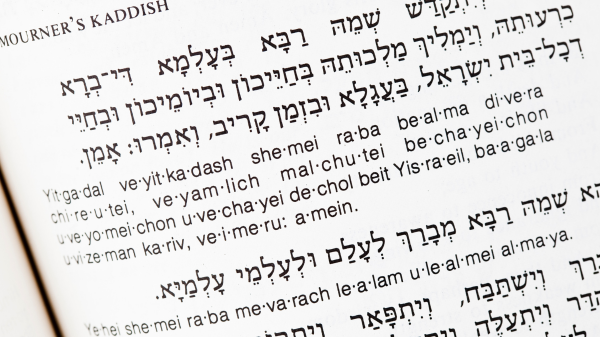
Every weekday, the Institute for Jewish Spirituality brings together a hundreds-strong community for half an hour of Jewish meditation on Zoom, called the Daily Sit. This summer, as an intern at IJS, I held the tech space for these Daily Sits. Each Daily Sit offers many powerful teachings, but the practice that has most stayed in my heart is the Mourner’s Kaddish prayer, which marks the close of each IJS meditation.

Rabbis in the 13th century originally recited the Aramaic text of the Kaddish to conclude sessions of Torah learning. IJS likewise closes each Daily Sit by inviting mourners and those who wish to join them to unmute themselves and chant the Kaddish line by line, to which the community’s hundreds of voices chant back, “Amen.” A special sound rises from the conglomeration of these multiple individual Kaddishes. Voices pour in from across the United States and beyond, singing the same words in different accents, rhythms, and registers. The voices of the community overlap and stagger out of sync as names of dearly missed loved ones fill the Zoom chatbox. The voices pass over and under one another in a tapestry of Aramaic words and human lives, all punctuated by amens. An outside listener might describe the sound as a cacophony, but musicologists call this kind of sound “heterophony,” the texture of multiple voices singing variations of the same melodic line all at once. It is a unique sound, and one might assume that this heterophony is just an artifact of the new Zoom medium, where it’s not yet possible to be totally together in time.

As such, when I heard the heterophonic Zoom Kaddish at the end of my first Daily Sit, I was surprised to find the sound familiar and even nostalgic—in fact, it brought back forgotten memories. In the Modern Orthodox synagogue of my childhood, while most of the prayer service was led by the prayer leader or sung by the whole community simultaneously, the Mourner’s Kaddish was unique. This prayer was led by a few individuals spread out across the sanctuary: just those members of the community who were in mourning on that given day. Different mourners chanted the Kaddish at different paces, and the sound of this prayer—scattered voices, communal amens, and all—became one of layered heterophony. I had always assumed that this lack of unison was simply an uncomfortable side effect of the fact that Mourner’s Kaddish was led by multiple laypeople and not by one central leader. However, hearing the IJS Kaddish at the Daily Sit made me wonder if the unique sound of this age-old practice had a meaning of its own.

At the height of the pandemic, I sometimes walked past my synagogue’s padlocked doors and searched in the windows for the light of the eternal lamp burning inside. I wondered when Jewish practice and community would return, and what it would look like in a changed world.

The Daily Sit itself was conceived as a response to the isolation of the pandemic, though it has now outgrown the circumstances of its creation.

From my perspective, as communities begin to look and function radically differently than they did in centuries past, the heterophony of Mourner’s Kaddish carries onward the comfort and complexity of the Jewish collective. No one person can carry all of a community’s loss or its connection to the world of yesterday. Rather, each community member chants in their time, leading the collective with personality and vulnerability. This is the heterophony of the Mourner’s Kaddish. We each draw close to and away from grief, losing and rebuilding our complicated relationships with those who came before us. Community means that when our time comes to mourn, we will be met with staggered amens and when we pass, scattered voices will rise in our memory. I’m grateful to have joined the Daily Sit community this summer as one of many voices chanting out overlapping amens.

Max Bamberger was an Intern at IJS this past summer. He is currently a junior at Yale University, majoring in Film and Media Studies.

Rosh Hashanah 5784: Homeward Bound

Rosh Hashanah 5784: Homeward Bound

Dear friends,

My Elul practices for the last decade or so have included listening to an album recorded by the poet David Whyte called Solace: The Art of Asking the Beautiful Question (also available here on iTunes). I generally listen to 10 or 15 minutes at a time as I walk the dog in the morning after I drop off my youngest son at the bus. Listening to Whyte's beautiful and penetrating language, recited in his unique English-Irish brogue, has become one of my favorite parts of Elul.

Over the years I've become familiar with the album and the poems and stories Whyte recites and tells. Yet, like a good work of Torah that one revisits year after year, I find that on each listening a different part emerges to speak to me. Without fail, each year there's a point at which I have to stop because I'm struck by a passage and by the need to note the time on the recording so I can come back to it.

This year, that happened when I listened to this little bit:

One of the great tenets of a beautiful question is that it brings you to ground in your life as it is now. And in some ways, along with the amnesia of what we've forgotten, we step into a sense of having forgotten something which needs to be remembered and which is foundational to our future. And one of the remarkable things, I think, about being human, one of the incredible things about being human is, you only have to articulate exactly the measure of your exile, exactly the way you feel far from yourself, exactly the way you feel as if you don't belong—and as soon as you've said it, exactly as it feels, you're on your way home. You've started the journey back, just by describing the way you feel imprisoned, or the way you feel far from yourself, or far from life.

The closing Torah portions of Deuteronomy—which is to say, the closing Torah portions of the Torah—are suffused with the language of exile and homecoming. Here is one characteristic passage from last week's Torah portion:

When all these things befall you—the blessing and the curse that I have set before you—and you take them to heart amidst the various nations to which YHVH your God has banished you, and you return to YHVH your God, and you and your children heed God’s command with all your heart and soul, just as I enjoin upon you this day, then YHVH your God will return with you and take you back in love. [God] will bring you together again from all the peoples where YHVH your God has scattered you. Even if your outcasts are at the ends of the world, from there YHVH your God will gather you, from there [God] will fetch you. And YHVH your God will bring you to the land that your ancestors possessed, and you shall possess it; and [God] will make you more prosperous and more numerous than your ancestors. Then YHVH your God will open up your heart and the hearts of your offspring—to love YHVH your God with all your heart and soul, in order that you may live. (Deut. 30:1-6)

One of the remarkable things about this passage is the way it fuses teshuva, spiritual returning and renewal, with the end of bodily and political exile. In this passage, to be far from the Divine is to be far from not only our spiritual sense of at-homeness, but also from the more literal sense of at-homeness in the land where our ancestors lived. Yet the vast majority of Jewish history has been lived in a state of political and geographic exile. Thus Rashi, quoting the Rabbis of the Talmud, parses verse 3: "Our Rabbis learned from this that, if one can say so of the Holy One, the Divine presence dwells with Israel in all the misery of their exile, so that when they are redeemed, the Ineffable makes Scripture write 'Redemption' of Godself that the Divine will return with them."

There is a paradox here: The Divine is with us in exile and estrangement, even as our returning to home—in all its senses, physical and spiritual—is also a returning to the Holy One. All, it seems, we have to do is make an internal move—in David Whyte's language, articulate exactly the measure of our exile—and we're on our way home. Yet that "all we have to do" is, of course, no simple thing. Again, Rashi: "The day of the gathering of the exiles is so important and is attended with such difficulty that it is as though the Holy One must actually seize hold of each individual’s hands dragging them from their place."

There is a reason we read these Torah portions in the weeks before Rosh Hashanah. Confronting the reality of our various exiles—whether they take the form of estrangement from our own bodies, our identities, our families, communities, societies, geographies—is the work of this season. Wherever we are this New Year, in any of these dimensions, the sound of the shofar beckons us to wake up and see, courageously and clearly, who we are and where we stand right now, in the totality of our wholeness and our brokenness. It invites us to gaze, with genuine honesty, within ourselves and discover that access to the Creator is not in heaven or across the sea, but on our lips and in our hearts. And in that recognition, we might experience that we are already on the way home.

Shanah tovah, Blessings for a sweet and joyous New Year,
Rabbi Josh Feigelson, PhD
President & CEO

Return to the Land of Your Soul: Nitzavim-Vayelekh 5783

I recently went on a wonderful five-day silent meditation retreat in the Pacific Northwest. On the final morning, I found myself with about 45 minutes of unscheduled time. It was after breakfast and before our final session, and the light drizzle that had sprinkled the landscape had given way to a patchy sunshine. As I discerned where my feet would take me, I found myself walking—mindfully, with awareness—toward the forest. There was a short trail there I had hiked each day after lunch. And there was a particular spot I knew I wanted to go to—a spot where I really just wanted to say thank you and goodbye.

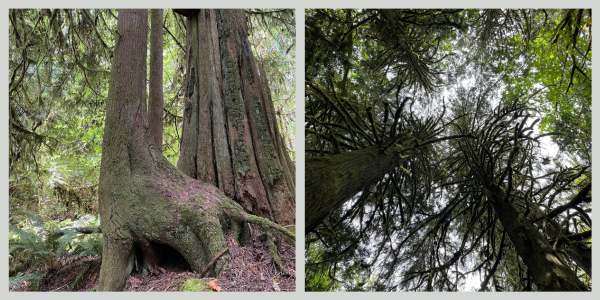
My destination was a part of the trail dominated by a cluster of five great Western Cedars. These are enormous, ancient conifers that shoot up 150 feet or more in the sky. Their trunks are massive. They tell you, with a great quiet majesty, that they’ve been around a lot longer than you have. And in a number of cases, they have formed in such a way that parts of their enormous roots are visible above the land, almost as though they’ve grown a neck. (One of them, pictured above, reminded me of a giant giraffe.) These trees grow on the edge of a babbling brook, standing watch over the maples and birches, the ferns and the mosses, that grow beneath them.

What led me to this spot? I’m not entirely sure. But at the end of five days of silence, filled with sitting and walking meditation and silent meals in this vibrant ecosystem, I could discern something tugging at me to go here and connect with its vitality, its quiet, its timelessness. I stood there for a while in silent meditation, and then found myself slowly and lovingly singing Shlomo Carlebach’s song for this season of Elul:

Return again
Return again
Return to the land of your soul

Return to who you are
Return to what you are
Return to where you are born and reborn again

I said goodbye to the trees and headed back towards the meditation hall. And then something amazing happened: I encountered three banana slugs on the trail. I had been told that these creatures were a special feature of this landscape, but only now, with barely an hour left in the retreat, did I find them—a blessing brought about by the rains that had softened up the ground overnight.

If you’ve never seen a banana slug, you should look one up on google. They’re not big (in this case, they were more the size of a small pickle than a banana). They’re gooey and slimy. But most notably, they move verrrry slooowwwly. I mean, really, really slow. And here, after five days and a resultant slowness and fluidity in my own breath and being, I found myself enraptured at these tiny little creatures who embody taking your time. Our instructor on the retreat saw me squatting down to behold them and aptly said, “I think you’ve found your teacher.” I stayed there for about fifteen minutes just marveling at them and keeping them off the path (so as not to get squashed by people).

I think of the trees and the slugs as I contemplate the opening words of Parashat Nitzavim: “You stand this day, all of you, before YHVH your God”—from the chiefs to the water-drawers. No matter our station, whether the mightiest of the trees or the lowliest of the slugs, we stand in the midst of YHVH—the breath of life, the source of being, the animating force of the universe. We are all interconnected, made of the same stardust, here for a brief flicker in the span of cosmic time. And we, humans, are blessed with the gift of awareness, the capacity to be conscious of that interconnection—and thus the ability and responsibility “to work it and steward it,” in the words of Genesis.

Rosh Hashanah is nearly upon us, the day on which we commemorate the sixth day of Creation, when we humans were formed and placed amidst all these other creatures. In this week before that moment of renewal, I’d like to encourage you to deepen your own practice. In the midst of the cooking and cleaning and all the other preparations, make time for spiritual preparation too. Most importantly: Slow. Down. Spend some time meditating this week. Spend some moments in the natural world. Take the time to reconnect with the world, with yourself, with your breath, with the source of life. In doing so, we have the opportunity to return again to who and what we are, to where we are born and reborn again.

Gently Welcoming Ourselves as We Are

Gently Welcoming Ourselves as We Are

As we enter the month of Elul, we are invited to enter into a practice of cheshbon hanefesh, soul accounting. As we engage in this practice and reflect on the past year, we ask ourselves - Are our actions in alignment with our intentions? Are we awake to our lives?

Cheshbon hanefesh is part of a broader practice of teshuva, a returning to our essential nature, to who we really are. The month of Elul is enveloped in the power of love throughout this process of soul accounting and returning. We invite you to join Rebecca Schisler in a practice to help us soften and gently welcome ourselves fully as we are.

Looking with the Eyes of Our Hearts

Looking with the Eyes of Our Hearts

The first word of the Torah portion we read as Elul begins is “Look!”--”Re’eh!” Look, really see, that before you today, this day, is a blessing and a curse. Choose life!, we are told in this parasha (Torah portion). It is right here before you, in the life you are living now.

The core practice this month is to practice looking with the eyes of our hearts at what is before us and inside us, this life in its complexities and contradictions, its messiness and its authenticity.

Rabbi Alan Lew of blessed memory writes in This is Real and You are Completely Unprepared: “Pay attention to your life. Every moment in it is profoundly mixed. Every moment contains a blessing and a curse. Everything depends on our beholding our lives with clear eyes, seeing the potential blessing in each moment as well as the potential curse, choosing the former, forswearing the latter.”

Elul calls to us with daily shofar blasts to help us wake up, to hear and behold ourselves more clearly, to engage in the practice of cheshbon hanefesh–a spiritual accounting–in order to help us better discern how to make choices that are life-affirming blessings.

It's not necessarily obvious how you and I are to do this work of looking deeply and open-heartedly into the life we have been living, or not living, this year, in order to choose the life-giving path of blessing going forward. Alan Lew suggests three practices to help us to see ourselves more clearly and with greater perspective: prayer, meditation, and/or, focusing on one thing.

Prayer:
Lew writes that “the Hebrew word for prayer is tefilah. The infinitive form of this verb is l’hitpalel-to pray-a reflexive form denoting action that one performs on oneself”, and in this way, it can be a way we come to know ourselves more deeply and clearly. For me, prayer is a need that my soul has. Just as my body has the need to drink in order to hydrate, the soul within has a need to pray for spiritual hydration, for being nourished by reaching inward and outward to the Ineffable Mystery by which I am born into each new moment. The practice of praying–liturgically or otherwise–can help you return to the Self of your self, to touch the deep core of your existence, and perhaps in that way to loosen the grips that shame, bias, doubt and the like might have upon you and enable you to get down to the work of teshuva that Elul is about.

Meditation:
During Elul, you can set an intention to devote time each day to rest in the quiet awareness of breath and sensation. You can choose a focal point for your attention, such as breath, or sound, or a visual anchor like a candle flame or a flower. Let yourself drop into the present moment, and pay attention to all that arises and passes in your awareness. Saturating your attention in the present moment of your life, Lew writes, can help you see yourself more clearly. Meditation can help you to “see that [you] are something larger than yourself. This is an essential aspect of Rosh HaShanah–seeing [yourself] as not just a discrete ego, but as part of a great flow of being.”

Focus on one thing:
Truth be told, for some of us, prayer and meditation may not be helpful tools; the resistance to engaging them is too great. Lew writes that many of us “will never get over finding the daily prayer service tedious and opaque. Many others will always either be frightened to death or bored to tears by the prospect of meditation.” For some of us who have experienced trauma (including religious trauma), prayer and meditation may for now harm more than help. The simple practice of focusing on one thing in your life may be a more helpful way to see your life more clearly.

You can choose to practice focusing on just one thing for this month of Elul. Lew suggests that you focus on one fundamental and simple aspect of your life, and “commit yourself to being totally conscious and honest about it for the thirty days of Elul”. Since everything we do is an expression of the entire truth of our lives, paying attention to one thing–like when we go to sleep, or eating, or how we engage on our cell phones through the day–we can begin to see our patterns, aversions, desires, and the like more clearly. Focusing on one thing in our life this month can help us see ourselves more clearly and help us wake up.

Lew writes, “So we can pray, we can meditate. Or we can simply choose one thing in our life and live that one small aspect in truth, and then watch in amazement as the larger truth of our life begins to emerge. The truth is, every moment of our life carries with it the possibility of a great blessing and a great curse, a blessing if we live in truth, a curse if we do not…All that’s required of you is to see what’s in front of your face and to choose the blessing in it.”

May you choose blessing in your life as this year begins to draw to a close, and may we together know the blessing of wise discernments and loving hearts.

When the Walls Crumble: A Teaching and Practice for Tisha B’Av

When the Walls Crumble: A Teaching and Practice for Tisha B’Av

Tisha B’Av is a day when we turn courageously to face the truth of the fragility, unpredictability, and groundlessness of our lives. You might wonder, then, what is required of us on this day? We invite you to dedicate a couple of moments to practice as we face the truth of impermanence, and discover an inner refuge that can help us to remain loving, calm, open hearted, and compassionate even in the midst of change and difficulty.

Practice: Holding our Broken Hearts with Love

Practice: Holding our Broken Hearts with Love

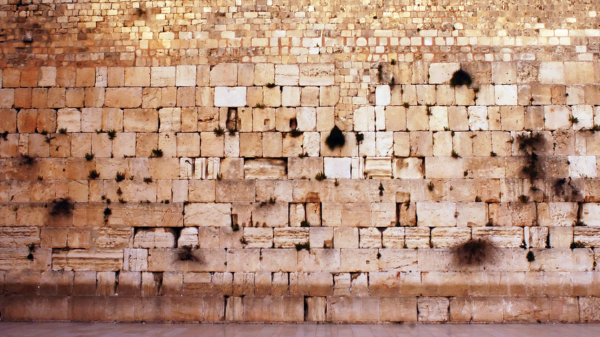
As we enter the month of Av this week, our spiritual task in this period is to grow in awareness of the brokenness in ourselves, our people, and our world – to allow the walls of our own hearts to crack open, allowing ourselves to become vulnerable to pain.

The Hasidic master Rabbi Nachman of Bratzlov contended that rather than avoiding or shutting out that which is painful, we must truly face and enter into it (Likutei Moharan I, 65). "Sometimes, when people don't want to suffer a little," Rabbi Nachman taught, "they end up suffering a lot.” (Siach Sarfey Kodesh I, 6). 

Rabbi Nachman notes that when experiencing pain, our natural human reflex is to close our eyes, which enables us to avoid external distractions and witness more clearly the underlying interconnectedness of life, thereby transcending one's finite selfhood. The poet Robert Frost expressed this succinctly: “The best way out is through” (a line from his poem "A Servant to Servants," in North of Boston, 1914).

In “The Guest House,” the Sufi poet Rumi similarly advises us to set an intention to accept everything that arises as ultimately serving a role in a larger purpose, if we allow it to pass fully through our “system” and “do its work:”

This being human is a guest house.
Every morning a new arrival.
A joy, a depression, a meanness,
some momentary awareness comes
as an unexpected visitor.
Welcome and entertain them all!
Even if they are a crowd of sorrows,
who violently sweep your house
empty of its furniture,
still, treat each guest honorably.
He may be clearing you out
for some new delight.
The dark thought, the shame, the malice.
meet them at the door laughing and invite them in.
Be grateful for whatever comes.
because each has been sent
as a guide from beyond.

In mindfulness practice, we observe aversion to unpleasant thoughts, feelings, and sensations – and welcome them all as honored “guests.” As we wake up, we see more clearly the option of holding our broken heart with tenderness, rather than fleeing from unpleasant or painful thoughts and feelings. In that moment, we are better able to choose to bear that which seemed unbearable, freeing the energy in our brokenness to flow towards healing and wholeness.

A simple meditation practice for entering the month of Av:

  • Pause and receive three deep breaths into your belly, allowing the breath to arise and fall away at its own pace, with as little effort as possible.
  • Place one (or both) hands over your heart-space.
  • Consider: 
    • What heartbreak is present for you right now, behind the inner walls protecting you from pain and grief?
  • Holding your heart tenderly, with love and support:
    • Can you lower the walls enough to allow the pain of your broken heart to be present and move through you? 
    • Can you feel the presence of others who similarly are holding their own heartbreak with compassion and tenderness?
  • Allow the pain and grief to move through you – to “check out” of your inner “guest house.”
  • Come back to the breath. Hold your heart with strength and love. 
  • Call to mind or whisper to yourself the words of Psalm 147:3:

 
הָרֹפֵא לִשְׁבוּרֵי לֵב וּמְחַבֵּשׁ לְעַצְּבוֹת
HaRofeh Lish’vurei Lev, um’chbesh l’atzvotam
God heals the broken-hearted, and binds up their wounds

Remembering Rabbi Jonathan Omer-Man (z’l)

Remembering Rabbi Jonathan Omer-Man (z’l)

We mourn the loss of our dear friend and teacher, Rabbi Jonathan Omer-Man, who died earlier this month.

We honor Jonathan as a key founder and founding faculty member of the Institute for Jewish Spirituality. However, before reflecting on his role with the Institute, please know this:

“For 26 years Jonathan lived in Israel, where he worked as a farmer, until he contracted polio, and subsequently embarked on a career in publishing. He served as deputy chief editor of the Israel Program for Scientific Translations, revising editor at the Encyclopedia Judaica, chief editor of Israel Universities Press, and editor of the Shefa Quarterly. In 1981 he moved to Los Angeles, where he founded Metivta: a center for contemplative Judaism, an academy dedicated to the renewal of the Jewish wisdom tradition and to the deepening of personal religious quest.

He has lectured at universities, colleges, seminaries and monasteries throughout the United States. His publications include numerous essays, some short fiction and verse. In 1990 he visited the Dalai Lama in India, a journey that was described in Rodger Kamenetz’ The Jew in the Lotus.”

Jonathan was a true contemplative and a bold pioneer. When he came to Los Angeles, after years of exploring Jewish mystical texts and practices himself, he made outreach to disaffected young Jews on college campuses, many of whom were exploring Eastern traditions, and showed them authentic Jewish paths to meditation and the inner life. But in addition to outreach, he also was dedicated to in-reach. Judaism, he felt, needed to grow. When he founded Metivta, he told me in his wonderfully wry way, he hoped his efforts would “help make Judaism safe for contemplatives.” I remember one story he told about a meeting he had with Reb Zalman Schachter-Shalomi, explaining to him in a dejected manner that he felt he was failing as a Jewish renewal person; try as he might, he just couldn’t get into all the singing and extroverted emotion. Reb Zalman took his hand, looked him in the eye and said, “Oh Jonathan! You have it all wrong. You’re not a failed ecstatic; you’re a brilliantly successful contemplative.” Relating that story made Jonathan’s bright eyes twinkle yet more brightly.

I met Jonathan in the mid ‘90s through Rabbi Rachel Cowan, who was supporting Jonathan’s work through the Nathan Cummings Foundation (of which Rachel was the Jewish Life Program Officer). Jonathan had a dream to take the mission of Metivta to a national stage. The three of us began talking. And then Rachel invited us, along with Arthur Green, Sheila Weinberg, Larry Kushner, and Charlie Halpern to meet at the Nathan Cummings Foundation office on November 5, 1996 for a day-long brainstorming session. That was the beginning of what eventually became a new national project, incubated at Metivta, called, “The Spirituality Institute at Metivta.” We ran our first rabbinic cohort retreat program under Metivta’s auspices, where Jonathan was one of the three founding teachers (along with Arthur Green and Sylvia Boorstein). We grew the project at Metivta for several years, before becoming incorporated as our own 501(c)(3): The Institute for Jewish Spirituality.

Jonathan was very proud of what became The Institute for Jewish Spirituality, and happy with the role he played in setting it all in motion. He blessed us all with his brilliant vision, humor, honesty and humility. May his soul be bound up in the bonds of eternal life.

For those who would like a taste of Jonathan’s unique wit and sensibility, here is one of his wonderful poems:

fabian rappaport´s other dinner party

his problem with praying he began to explain
but they silenced him
with guffaws and insolent scoffing
no they said
tell us first why you don´t eat
pork or prawns or lobsters or shrimps
or german blood sausage and do you really think
god hates people who eat oysters and frogs´ legs
and creamy beef stroganoff
no they said
tell us first about the origin of evil
about who made hitler and pol pot
and were there quarks in the garden
of eden
my problem with praying he tried once again
but still they scoffed
my problem with praying
he finally shouted
is that there is too much noise
everywhere

Jonathan Omer-Man ©

A Conversation with Rabbi Michael Strassfeld

A Conversation with Rabbi Michael Strassfeld

We are grateful to Best-Selling Author, Rabbi Michael Strassfeld, for speaking with IJS President & CEO, Rabbi Josh Feigelson! Please enjoy the conversation recording below.

Rabbi Michael Strassfeld is one of the editors of the Jewish Catalog (1973), a guide to do-it-yourself Judaism that sold over 300,000 copies. He edited the Second and Third Jewish Catalogs (1975,1979), authored The Jewish Holidays (1985), co-authored A Night of Questions: A Passover Haggadah (1999) with his wife Rabbi Joy Levitt, and authored A Book of Life: Embracing Judaism as a Spiritual Practice (2002). His new book Judaism Disrupted: A Spiritual Manifesto for the 21st Century is published by Ben Yehuda Press. He edits a free weekly newsletter about Judaism (subscribe at michaelstrassfeld.com).

A Conversation with Yossi Klein-Halevi

A Conversation with Yossi Klein-Halevi

We are grateful to Award-Winning Journalist & Best-Selling Author, Yossi Klein-Halevi, for speaking with IJS President & CEO, Rabbi Josh Feigelson! Please enjoy the conversation recording below.

In his decades of writing from and about Israel, New York Times bestselling author Yossi Klein-Halevi has earned a reputation as a leading interpreter of contemporary Israel and Jewish life for American audiences. In addition to his work as a Senior Fellow at the Shalom Hartman Institute, where he co-directs the Institute’s Muslim Leadership Initiative, Yossi has also been deeply involved in the intersection of Jewish and Eastern religious practices in Israel for many years. In this conversation, IJS President & CEO Rabbi Josh Feigelson talks with Yossi about his own journey, and the history and current trends in Jewish spiritual life.

Josh’s Book Launch: Eternal Questions

Rabbi Josh Feigelson's book launch and conversation with Abigail Pogrebin took place on Wednesday, October 26, 2022. The recording of the event is now available below. Feel free to share with friends and family who may be interested. We hope you find this to be a meaningful discussion.

Josh's book, Eternal Questions, is now available for purchase.

Rabbi Josh Feigelson is the President and CEO of IJS. He received ordination from Yeshivat Chovevei Torah Rabbinical School in 2005, and served for six years as the Hillel Rabbi at Northwestern University, where he also earned a PhD in Religious Studies. In 2011, Josh helped found and served as Executive Director of Ask Big Questions, an initiative of Hillel International, which won the inaugural Lippman-Kanfer Prize for Applied Jewish Wisdom. Most recently he served as Dean of Students at the University of Chicago Divinity School. Eternal Questions is his first book.

Abigail Pogrebin is the author of three books, including My Jewish Year: 18 Holidays; One Wondering Jew, which was a finalist for the 2018 National Jewish Book Award. She was an Emmy-nominated producer for Mike Wallace at 60 Minutes, and before that produced for Bill Moyers at PBS. She has moderated conversations at The Streicker Center, The JCC in Manhattan, UJA Federation, and the Shalom Hartman Institute. She served as President of Central Synagogue from 2015-18, and was Director of Jewish Outreach for Michael Bloomberg’s 2020 presidential campaign. She served as President of Central Synagogue from 2015-18, and is a member of IJS’s Advisory Council. To learn more about Abigail Pogrebin, please visit her website.

Introducing IJS’s First Faculty Fellow: Kohenet Keshira haLev Fife

Introducing IJS’s First Faculty Fellow: Kohenet Keshira haLev Fife

IJS is delighted to announce that Kohenet Keshira haLev Fife has joined its faculty as a Faculty Fellow. The fellowship, which runs from 2022-24, is the first of its kind at the Institute. It is designed to identify and nurture exceptional spiritual leaders who can contribute new skills and perspective to IJS’s teaching and programs, while also developing greater expertise in Jewish mindfulness, IJS pedagogy, and core practices.

As a Faculty Fellow, Keshira will bring her Kohenet training, Earth-based spirituality, and unique warmth and wisdom to a host of IJS programs, including a week-long daily sit intensive in February 2023. Additionally, Keshira will join Program Director Rabbi Marc Margolius and a diverse set of consultants in redesigning and teaching Awareness in Action: Cultivating Character through Mindfulness and Middot this year.

Keshira will also continue to lead IJS’s affinity group work with Jews of color, in partnership with Yoshi Silverstein of Mitsui Collective, and work with IJS faculty in staff in making all of our offerings more accessible and inclusive of Jews with historically marginalized identities. As part of the fellowship experience, Keshira will also be participating in IJS’s landmark Clergy Leadership Program, an 18 month cohort-based professional development program, as well as its upcoming training in Spiritual Direction.

“As someone who has grown through participating in IJS programs, and who has great admiration for the IJS team, I am especially excited by the invitation to weave my lived experience and background into some of IJS’ programs,” says Keshira. “In the spirit of tikkun middot, and finding a balanced way, the opportunity to contribute to a host of IJS’ offerings, while simultaneously deepening my own practice, already has me dreaming about what blessings might unfold from this new partnership. I pray that all of our work together will make mindfulness and integrated Jewish practice even more accessible to the Jewish world and beyond.”

Beyond IJS, Keshira sprinkles sparkles, disrupts expectations, and offers blessings wherever she goes. She serves as Oreget Kehilah (Executive Director) of the Kohenet Hebrew Priestess Institute, Founding Kohenet of Kesher Pittsburgh and Program Director of the ALEPH Kesher Fellowship and also enjoys working with Keshet and Beloved Builders. Additionally, she delights in serving as a davennatrix (shlichat tzibbur), life spiral ceremony/ritual creatrix, teacher, facilitator, liturgist and songstress. Her work in these realms is informed by her lived experience as a queer, bi-racial, Jewish Woman, her belief that Book, Body and Earth are equal sources of wisdom, and the quandries she encounters as a scholar of the Orphan Wisdom School. Keshira received Kohenet smicha in 2017 and earned her BS 2000 and MS 2001 at Carnegie Mellon University. (After many years of traveling and living in Australia, she and her beloved once again make their home on Osage and Haudenosaunee land, also called Pittsburgh, PA.) You can learn more about Keshira at her website, www.keshirahalev.com.

A Conversation with Rabbi Danya Ruttenberg

A Conversation with Rabbi Danya Ruttenberg

We are grateful to Rabbi Danya Ruttenberg for speaking with us about Repentance and Repair! Please enjoy the conversation recording below.

Rabbi Danya Ruttenberg is an award-winning author and serves as Scholar in Residence at the National Council of Jewish Women (NCJW). She was named by Newsweek as a “rabbi to watch,” as a “faith leader to watch” by the Center for American Progress, has been a Washington Post Sunday crossword clue (83 Down) and called a “wunderkind of Jewish feminism” by Publishers Weekly. She has written for The New York Times, The Washington Post, The Atlantic, Salon, Time, and many other publications. She is the author of eight books; her newest is On Repentance and Repair: Making Amends in an Unapologetic World.

Richard Schwartz: “To be a presence that can possibly bring some healing [is] an incredible gift.”

Richard Schwartz: “To be a presence that can possibly bring some healing [is] an incredible gift.”

Our recent Evening of Gratitude was a valuable opportunity to recognize Jewish spiritual leaders of all kinds and their incredible impact on the people and communities they serve. We are so grateful for all they bring to our world, and so proud to be part of their stories.

In one of the evening’s spotlights, IJS alum Cantor Richard Schwartz shared how pastoral care, mindfulness practice, and Jewish tradition have intertwined in his life-long journey towards personal peace and intentionality. Richard has brought this mindset to his current work in chaplaincy at Stanford Health Care. In reflecting on his role, Richard shared the following:


“To be a presence that can possibly bring some healing [is] an incredible gift.”

We hope you are inspired by Richard’s story and will consider a gift to support our work.

Alison Kur: “Spirituality is about nurturing my soul and giving my soul to others”

Alison Kur: “Spirituality is about nurturing my soul and giving my soul to others”

Hundreds of IJS supporters joined us on Tuesday, June 7, 2022 for our Evening of Gratitude, honoring and thanking Jewish spiritual leaders. We are eager to share one of the highlights of the celebration, and we hope that you will consider making a donation to support our work.

Alison Kur, Executive Director of Jewish Living at Temple Beth Elohim in Wellesley, MA, was one of the evening’s featured leaders. She spoke about the warm mutual support fostered by her IJS community, providing emotional sustenance in a difficult year. She also emphasized the critical importance of spiritual practice in allowing congregants to know and be known by one another:

“Spirituality is about nurturing my soul and giving my soul to others”


Learn more about Alison's story:

Of Black Swans and Sabbatical Years

Of Black Swans and Sabbatical Years

If you haven’t seen it yet, take a minute to watch the finish from this year’s Kentucky Derby. It’s a sight to behold.

The two leading horses are racing neck-and-neck (literally), jockeying for position (again, literally), as they make the final turn of the one-and-a-quarter-mile track at Churchill Downs. Slowly and then suddenly, Rich Strike, a horse no one even expected to be in the race, comes out of nowhere to win. It’s shocking on every level: Rich Strike had 80-1 odds of winning, the second-highest odds in the history of the 148-year old race. He only became eligible for the Derby a day earlier due to another horse being scratched from the race with 30 seconds to spare before the registration deadline. And then, to top it off, he comes out of nowhere to win the biggest event in horse racing. Someone in Hollywood is surely working on a script already.

The day after the Derby, the writer and climate activist Rebecca Solnit posted a link to the race video on Facebook, calling attention to Rich Strike’s win as a “black swan event.” The term, popularized two decades ago by Nassim Nicholas Taleb, refers to an event that most people assumed simply couldn’t happen—and that, therefore, whole ways of thinking became devoted to assuming it couldn’t happen either. That is, it wasn’t simply an objective question of whether or not something was possible; it was also a psychological question: If my/our worldview depends on the impossibility of this idea, how could I entertain the notion that it might occur? My/our whole world would unravel! So we tend to treat black swan events as not just logical impossibilities; rather, we become emotionally invested in verifying the narrative of their impossibility.

As a climate activist, Solnit encounters this phenomenon a lot. If we read the news, we have good reason to feel like solving the problem of climate change is a black swan. The odds seem increasingly remote that we will keep global temperatures from rising past 2 degrees Celsius. The polar ice sheets are already melting. The invasion of Ukraine isn’t helping. It is totally understandable that a lot of us feel pretty grim about the future. And when we start telling ourselves that narrative, our human tendency toward confirmation bias leads us to reject news that might counter it and embrace news that reinforces it.

But, as Solnit has been doggedly pointing out on her Facebook page for months, there’s a lot of good climate news! Most significantly, advances in battery storage, solar, and wind technology are causing the price of renewables to drop quickly and, correspondingly, their use to increase rapidly. And, while the odds remain quite long, Solnit seems committed to helping the rest of us see the possibility of a black swan. Epicenter and Zandon, the two favorite horses at the Derby this year, had odds of 7-2 and 3-1, respectively. They were the horses racing neck-and-neck to win. The race was playing out precisely the way the math told us it would. Until it didn’t. The lesson for climate? While it’s still a major league longshot, we might, just might, be able to get it together for greener forms of energy to come out of the back of the pack and win the climate derby. (Likewise, Donald Trump was projected as having a 7 percent chance of being elected president in 2016. Black swans don’t take sides; they just describe longshots.)

On the Jewish calendar, we are deep into a Sabbatical year, a year of shemitah. The Torah’s expectations for this year, and for the larger Jubilee cycle in which it occurs, might strike us as fanciful, preposterous even. We are commanded not to farm the land, but only to live off whatever naturally grows. We are expected to forgive debts and release indentured servants. Every 49 years, we are expected to return the land to its ancestral owners. In short, we are, it seems, expected to overthrow the economic table and start anew. It is nothing short of a radical resetting, a recalibration of society.

If this might have seemed difficult to imagine two or three thousand years ago, it feels even more so now. Yet the Torah is not alone in deploying sacred ritual to reconfigure the social order. As David Graeber and David Wengrow demonstrate in their book The Dawn of Everything, societies the world over have done similar things throughout human history. From Native American communities to Neolithic Europe and Mesopotamia and beyond, human beings have shown a remarkable propensity to order our societies in many different ways—and to consciously reorder them when necessary and desirable.

Contra Rousseau, there is no “state of nature,” according to Graeber and Wengrow. Rather, there are innumerable different ways humans have configured social and political life. “If something did go terribly wrong in human history—and given the current state of the world, it’s hard to deny something did,” they write, “then perhaps it began to go wrong precisely when people started losing that freedom to imagine and enact other forms of social existence, to such a degree that some now feel this particular type of freedom hardly even existed, or was barely exercised, for the greater part of human history.”

That, perhaps, is the greatest challenge we face: that we accept that this is the way things are and will be—whatever that way is. We are so invested in the current scheme of things that we discount the possibility that anything could be otherwise. We lose imagination, we lose freedom, we become fatalists.

The Torah, like other wisdom traditions, invites us to practice a different way of being, the touchstone of which is yetziat mitzrayim, the Exodus from Egypt. What was is not what must be. What seems inevitable is not destiny. Just because life seems good right now doesn’t mean it’s going to remain that way; just because life looks horrible right now doesn’t mean it will always be so. When we cut ourselves off from the unfolding nature of the world, when we become so invested in a particular way of encountering it, we practice a kind of idolatry, we drive the Divine presence from the world.

Our calling and mission is to do the opposite: to live with mindful presence, aware of the contingency and ongoing becoming of a world which is constantly recreated anew, aware of our interconnection with all other beings, with the earth, with life itself. That is the practice of Shemitah, the practice of Shabbat. It is the practice that enables us to resist our confirmation bias, our fatalism about climate, and to remain open to the possibility—however long a shot it is—that the unexpected might just come about.


This piece was published in the Times of Israel on May 12, 2022.

A Conversation with Rabbi Danya Ruttenberg

A Conversation with Joy Ladin, PhD and Rabbi Dr. Erin Leib Smokler

We are grateful to Joy Ladin, PhD and Rabbi Dr. Erin Leib Smokler for sharing their insights with us! Please enjoy the conversation recording below.

Joy Ladin, PhD is a teacher, widely published essayist and poet, literary scholar, and nationally known speaker on transgender issues. She is the author of twelve books, including 2021 National Jewish Book Award winner, The Book of Anna, newly published Shekhinah Speaks, and 2018’s The Soul of the Stranger: Reading God and Torah from a Transgender Perspective. She has a PhD in English Literature from Princeton and an MFA in Creative Writing from the University of Massachusetts. Since 2003, Joy has held the David and Ruth Gottesman Chair in English at Stern College of Yeshiva University.

Rabbi Dr. Erin Leib Smokler is the Dean of Students and Director of Spiritual Development at Yeshivat Maharat, where she teaches Hasidism and Pastoral Torah. She is also a faculty fellow of the Shalom Hartman Institute of North America. Rabbi Dr. Leib Smokler is the editor of the recently published volume, Torah in a Time of Plague: Historical and Contemporary Jewish Reflections (Ben Yehudah Press 2021), which received a 2021 National Jewish Book Award. She earned her PhD and MA from the University of Chicago’s Committee on Social Thought and her AB from Harvard University. She received ordination from Yeshivat Maharat.

Purim and the Pursuit of Wisdom

Purim and the Pursuit of Wisdom

"Look again at that dot. That's here. That's home. That's us. On it everyone you love, everyone you know, everyone you ever heard of, every human being who ever was, lived out their lives. The aggregate of our joy and suffering, thousands of confident religions, ideologies, and economic doctrines, every hunter and forager, every hero and coward, every creator and destroyer of civilization, every king and peasant, every couple in love, every mother and father, hopeful child, inventor and explorer, every teacher of morals, every corrupt politician, every "superstar," every "supreme leader," every saint and sinner in the history of our species lived there--on a mote of dust suspended in a sunbeam.

The Earth is a very small stage in a vast cosmic arena. Think of the rivers of blood spilled by all those generals and emperors so that, in glory and triumph, they could become the momentary masters of a fraction of a dot. Think of the endless cruelties visited by the inhabitants of one corner of this pixel on the scarcely distinguishable inhabitants of some other corner, how frequent their misunderstandings, how eager they are to kill one another, how fervent their hatreds.

Our posturings, our imagined self-importance, the delusion that we have some privileged position in the Universe, are challenged by this point of pale light. Our planet is a lonely speck in the great enveloping cosmic dark. In our obscurity, in all this vastness, there is no hint that help will come from elsewhere to save us from ourselves.

The Earth is the only world known so far to harbor life. There is nowhere else, at least in the near future, to which our species could migrate. Visit, yes. Settle, not yet. Like it or not, for the moment the Earth is where we make our stand.

It has been said that astronomy is a humbling and character-building experience. There is perhaps no better demonstration of the folly of human conceits than this distant image of our tiny world. To me, it underscores our responsibility to deal more kindly with one another, and to preserve and cherish the pale blue dot, the only home we've ever known."
— Carl Sagan, Pale Blue Dot, 1994

Writing at Purim time, during the continued unfolding of Russia's brutal invasion of Ukraine, the carnage only mounts. When we mark the holiday we think of the rivers of Jewish blood Haman would have spilled had he not been thwarted by Mordechai and Esther. Today we think of the rivers of Ukrainian blood being spilled by Vladimir Putin. Both of these tyrants are united across the ages in their wish to visit endless cruelty upon the inhabitants of a tiny corner of a fraction of a dot. Both are united in their utter delusion. When viewed through Sagan’s reflections on our one and only pale blue dot, all this violence and cruelty seems so utterly senseless, meaningless, and foolish.

Though it may not be readily apparent on the face of things, behind all this folly lies that most basic human impulse–the desire for happiness. Haman thought he would be happy if he annihilated the people who threatened his honor. Instead he brought about his own ruin and the destruction of his entire family. Putin believes he’ll be happy if he takes Ukraine and replaces its government with a puppet regime. But he won’t. His cruelty and greed will eat him alive as he becomes a pariah to the world and brings ruin upon his own people. As we are witnessing in real time on a grand scale, the impulse to pursue happiness can lead to horrible, disastrous consequences if it isn’t coupled with wisdom.

Mindfulness is our tool for cultivating wisdom. It works by peeling away misleading external appearances and obstructing masks to reveal the deeper nature or true face of things. With mindfulness, we recognize that happiness that depends on ephemeral external conditions can’t be sustained in the long run; to be truly lasting, our contentment and well-being need to be generated from within. When our desire for happiness is married to wisdom, we know how interconnected we all are, and operate with an awareness that to inflict harm upon another being or part of this planet for our own gain is an act of self-harm. And with mindfulness, tyrants might come to recognize that pinning their glory on their claim to a tiny part of an infinitesimally small blue dot is an exercise in folly.

At this moment in the evolution of Western culture, the pursuit of happiness as an end in itself has run its course as we careen toward growing conflict, division, mistrust, the collapse of democracy, and the destruction of our planet. What we need now as a species is a collective turning toward the pursuit of wisdom, which might then reveal the true conditions that lead to mutual happiness and well-being for all. That’s why we practice.

We at IJS are proud to be part of the burgeoning movement toward that turning as we broadly teach Jewish spiritual practices grounded in mindfulness. Such practices foster our ability to discern a wise path to human flourishing, one grounded in a deep recognition of our evanescence and frailty and the immense preciousness and interconnection of life and our planet. One that leads us beyond the folly, caprice, and lustfulness of the ego toward a deep sense of mutuality, interdependence, abundance, and shared responsibility. One where we triumph “not by might nor by power but by spirit alone” (Zechariah 4:6).

A Conversation with Rabbi Irving “Yitz” Greenberg

A Conversation with Rabbi Irving “Yitz” Greenberg

We are grateful to Rabbi Irving "Yitz" Greenberg for sharing his wisdom with us. Please enjoy the conversation recording below.

Rabbi Irving "Yitz" Greenberg is one of the most influential Jewish thinkers and institution-builders of our time. Currently president of the J.J. Greenberg Institute for the Advancement of Jewish Life (JJGI) and Senior Scholar in Residence at Hadar, Rabbi Greenberg’s distinguished career includes service as the founding director of CLAL: the National Jewish Center for Learning and Leadership, founding president of Jewish Life Network/Steinhardt Foundation, professor of Jewish History at Yeshiva University and City University of New York, and director of the President’s Commission on the Holocaust, and Chair of the United States Holocaust Memorial and Museum.

Over his long career, Rabbi Greenberg has taught tens of thousands of Jewish leaders in hundreds of communities across North America and around the world. He has written extensively on post-Holocaust Jewish religious thought, Jewish-Christian relations, pluralism, and the ethics of Jewish power. He was a member of the delegation of Jewish leaders who traveled to Dharamshala, India for an historic encounter with the Dalai Lama, which was later discussed in Rodger Kamenetz’s book The Jew in the Lotus.

In addition to his role as Executive Director at IJS, Rabbi Josh Feigelson is a leading scholar of Rabbi Greenberg’s thought. In this conversation, Rabbi Feigelson and Rabbi Greenberg will reflect on Rabbi Greenberg’s own training in and practice of Musar and experiencing Jewish life as a form of spiritual practice. Rabbi Greenberg will also discuss themes from his forthcoming book, The Triumph of Life.

Introducing IJS’s First Faculty Fellow: Kohenet Keshira haLev Fife

A Reflection on Jewish Mindfulness and Habits of the Heart

It often feels these days that we’re living through a Great Unraveling. Institutions, those deposits of trust that enable things to be—or at least seem to be—settled, are coming apart. News media, public health, elections, representative government, the weather, the forests, the shoreline, truth, language itself: In so many places, things I took to be more or less stable are revealing themselves to be far shakier than I could have imagined.

I find my mind racing with questions I could scarcely have contemplated asking even a couple of years ago: Is the person standing next to me in the grocery store vaccinated? Is the man at the post office carrying a concealed weapon? Writing in the shadow of the anniversary of the January 6 insurrection, those questions include ones like, Will a mob storm the Capitol? Will a state legislature overturn an election?

Like all shadows, this Great Unraveling has its brighter side too. Much of it is driven by the democratization of media. Where Twitter and Facebook and Snapchat and TikTok seem to lead us to collectively ever-shorter attention spans, they also give opportunities for far more people to have a voice, for more of us to expand our awareness of people and issues than would have been in our view otherwise.

Whether we view it as an invitation or an externally-imposed compulsion, it seems to me that this moment calls each of us to deeper personal responsibility and agency: the responsibility to be vaccinated, to engage in democracy non-violently, to practice speech that is mindful, wise, and courageous. And when I reflect on that, I realize that, though it may feel more intense today, that is really our calling all the time: to be vessels for the Divine presence; to reflect and enhance the image of God in the world; to free and help every image of God to be present.

In his bestselling classic The Jew in the Lotus, Rodger Kamenetz describes how one of IJS’s founders, Rabbi Jonathan Omer-Man, summed up his personal spiritual path, which he referred to as keter malchut, or the crown of sovereignty, to the Dalai Lama: “To be a sovereign human being, to be a king, to be not reactive, but active, to know one’s place in the world, to be conscious. And it is extremely hard work. The ego always gets in the way, all the needs get in the way; it is a long, long path. But the path is very specific” (196).

In a democracy, as opposed to a monarchy, each and every citizen is a part of the sovereign; each of us wears a part of the crown. Thus Jonathan’s description of this spiritual work—to become a sovereign human being, a sovereign image of God—is, to my mind, the core of the “habits of the heart” about which Alexis de Tocqueville wrote nearly 200 years ago as being essential to the democratic project. At root, this heart work is about the most basic questions: How do we become aware of yet not beholden to the thoughts and emotions that arise in us—the results of our conditioning—when we encounter beings other than ourselves? How do we hold space for difference? How do we live together? How do we trust each other?

Nurturing and sustaining trust is the name of the game. It is essential to the infant who must trust adults to feed, clothe, shelter, and bathe them; it is essential to coworkers who must trust one another to work together; it is essential to neighbors and fellow citizens and residents who must trust that the people they encounter do not seek their harm; it is essential to voters who must trust that elected officials will act with honor and not for personal power or enrichment. Trust, Emunah, is essential for a life lived in relationship with the Divine. And, “In God We Trust”—our trusting both reflects and generates the possibility for the Divine presence to be visible. It is, on the most fundamental level, essential for democratic life.

That mutually supportive web of trust begins and is sustained by our continual work on our hearts—avodah shebalev, what the Talmud refers to as prayer and what we might expand to include the spiritual practices of democracy. I don’t know whether those practices by themselves are enough to calm the baser forces of fear, anger, and resentment that seem to be fueling this Great Unraveling. But I know they are essential for me—perhaps for you, too—to live through it. And I have a strong sense that they offer us a way through. May we support one another in cultivating them.

How Spiritual Practices Impacted my Bearing Witness Outside the Glynn County, GA Courthouse

How Spiritual Practices Impacted my Bearing Witness Outside the Glynn County, GA Courthouse

On Thursday November 18, 2021 I traveled to Brunswick, GA along with eleven other Jewish clergy to bear witness and offer support to the Black pastors, the community and family members gathering at the Glynn County courthouse during the trial for the killing of Ahmaud Arbery. Arbery, 25, was shot while going for a run in a suburban neighborhood. The chase and shooting were caught on video footage. Local rabbi and IJS Hevraya (alumni) member Rachael Bregman invited Jewish clergy to join her in Brunswick to bring spiritual comfort, solidarity, and to support the local community.

When I heard the call, my immediate response was YES. I don’t live there now, but I grew up in Georgia. While there are many parts of my upbringing in the South that I appreciate, I also find that when I walk on Georgia earth, I feel horror that any large tree I see might have borne “strange fruit”, a phrase referring to the 1937 song likening the many Black people lynched in the south to fruits hanging from trees. When I learned of the killing of Ahmaud Arbery, I became nauseous. The same nausea I feel when the stirrings of “strange fruit” move through my body when I am on Georgia soil.

Reflecting now, I ask myself: what motivated my discernment to participate in this action? What enabled me to stand with others for the long hot hours, awaiting Reverend Sharpton’s arrival for the prayers and calls for justice? And what inspires me now, looking ahead? I noted several things.

First, years of regular spiritual practice have shaped my heart, mind, and my nervous system so that my soul and my body could move in sync throughout this journey after my initial response was to participate.

Additionally, years of contemplative daily prayer have forged in me the language for feeling myself part of something larger than my individual body and ego mind. The injustice around me is an affront to the God Who lives in me and in all of us. There is no difference between me and another human soul. This clarity strengthened my conviction to study and learn about the history and prevalence of racism in the USA, and further forged in me the clarity that I cannot stand idly by and look away from the suffering around me.

Likewise, regular mindfulness meditation practice helps me pay attention to emotions, thoughts, sensations, be they pleasant or unpleasant, and bear witness to them with less reactivity. No doubt, the years sitting in meditation helped me stand steady and more open, as strong emotions such as grief, rage, and the physical discomforts of thirst and heat were blazing all around on the courthouse lawn and steps.

Years of yoga and somatic practices enabled me to stay grounded in my body, and to center my attention on the bodies around me. When I noticed that many Black pastors and others crowding together in the hot sun, were sweating and seemed to be suffering in the heat, I registered that in my consciousness--rather than pass over that recognition as I focused on “important” matters. Because I noticed, I could enlist colleagues and together we located cartons of water bottles (that would have been discarded), and carried them to the courthouse steps where we distributed the hydration to Arbery family members, Rev. Jesse Jackson, and others. Had I not been transformed through years of body-centered spiritual practice, I would not likely have paid attention and been able to help serve those I prayed to be of support to on that day.

Lastly, twenty years of practice in spiritual direction have formed in me the desire to look for God’s presence in whatever is unfolding around and inside me. Pausing to listen for the sacred in the chants or see the sacred in the signage or in the faces of those I looked upon, and to listen to the stirrings in my own spirit as I moved through the day, I could better sustain an intention of remembrance: remember I am bearing witness to God’s presence here today, in every human being I encounter. Seeking the face of the divine, my heart remained more open and less at the mercy of my own preferences, judgments and opinions in that volatile and fractured situation.

Looking ahead, though I am wary about the implications of this and other trials, I believe even more strongly that spiritual practices can help bring clarity, insight, and strength as well as the capacity to remain soft and open, willing, more hopeful, and to bear witness from loving intention. The practices also cultivate the potential to stand our ground, and to notice where suffering might be attended to. Perhaps you, too, might take stock of how your spiritual practices equip you to meet the present moments in your life when you might feel called to respond and engage.

May we each be empowered through our practices to meet what is ours to meet, so that together we might bring blessing and love, advocacy and change, right where, when, and how it is needed most.

Resilient Writers Fellowship Feature Articles

Resilient Writers Fellowship Feature Articles

I will pour out My spirit on all flesh
Your children shall prophesy
Your old shall dream dreams
And your youth shall see visions.

These words from the prophet Joel (made even more famous by Debbie Friedman) are a perfect introduction to the essays in the enclosed booklet, which are the product of the Resilient Writers Fellowship, a joint project of IJS and New Voices Magazine. Over the course of eight weeks in the winter and spring of 2021, this group of college students and recent graduates gathered online to explore the intersection of Torah, spiritual practice, creativity, and embodiment. These incredible essays are the fruits of their labor.

At a time when many young people were and are struggling -- wrestling with social isolation, anxiety, depression, a global pandemic, political turmoil, and an uncertain future -- this fellowship offered these outstanding young Jewish writers an opportunity to develop a personal set of practices to both navigate the emotions and spiritual challenges of an ailing world and maintain their creative work in a way that is sustainable and Jewishly rooted.

Co-facilitated by IJS Senior Program Director Rabbi Myriam Klotz and New Voices Editor Rena Yehuda Newman, the fellowship began with a three-hour opening online retreat, fostering a sense of community and connection between fellows, and gathered via Zoom each subsequent week on Thursday evenings for themed, 90-minute sessions where fellows learned, shared, and created Torah together. Throughout the fellowship, each fellow was responsible for writing a feature article on a topic of their choosing. Between sessions, fellows were encouraged to try an assortment of embodied and mindfulness practices, keyed to the weekly themes, to support their creative process.

As you will see in the essays in this booklet, these fellows come from an extraordinarily diverse, thoughtful, and provocative range of perspectives. They touch on issues ranging from Shabbat and time to body image and living through this extraordinary time of pandemic.

How Spiritual Practices Impacted my Bearing Witness Outside the Glynn County, GA Courthouse

To Prevent a Crisis of Clergy Burnout, Help Them Cultivate Their Inner Lives

As a spate of recent articles have proclaimed, clergy face a crisis. In his recent piece in eJewishPhilanthropy, Rabbi Lewis Kamrass, President of the Central Conference of American Rabbis (CCAR), warned of the real possibility of an exodus of rabbis from congregational life, due to the extreme additional emotional and professional burdens imposed upon them by the pandemic. He urges congregational lay leaders to mitigate this trend by acknowledging these additional burdens, expressing appreciation, increasing compensation, offering scheduling flexibility and time off, and being forgiving and generous towards clergy.

All of these are excellent, tangible steps institutions can take to address the symptoms of “clergy burnout” -- a constant vocational hazard for rabbis across the denominational spectrum, which is greatly exacerbated by the extraordinary demands placed upon clergy in these pandemic times. External expression of empathy, gratitude, and tangible support from congregational leaders can, to some extent, ameliorate the heavy load clergy are bearing. But by themselves, these are band aids which can cover, but not heal, the underlying source of the problem.

To address the root causes of burnout, Jewish clergy themselves—liberal, Orthodox, and of every stripe—need spiritual practices and resources to help them navigate periods of “full catastrophe living” (in the phrase popularized by mindfulness teacher Jon Kabat-Zinn) with grace, resilience, and wisdom. This has, in fact, been our approach to working with over 500 clergy across denominations over the last two decades at the Institute for Jewish Spirituality. As part of our Clergy Leadership Program, we bring rabbis and cantors on retreat and engage them in spiritual practices including mindfulness meditation, contemplative study and prayer. We do this not so that they “take time out” or gulp down some oxygen in order to then get “back in the race”, but rather that they become more able to experience all moments of their work and life as opportunities for witnessing and lifting up awareness of the Divine.

This approach is analogous to the ritual of inhaling the sweetness of the spices at the conclusion of each Shabbat. The aroma of the spices reminds us (among other things) to infuse the six days of the week with the restorative quality of Shabbat. The rhythm of Jewish living is not sprinting for six days, catching our breath on the seventh day, and then returning to the track. Rather, we immerse in practices which help us cultivate a sense of Divine Presence on Shabbat, so that we might be better able to infuse all of our moments during the week with an awareness of that Presence.

Using this far more sustainable model, we immerse clergy in spiritual practice on retreats every six months, and in the interim periods between retreats, so they can learn skills for infusing their daily lives with breath and with a sense of Presence. We seek to help them experience their professional challenges not simply as burdens to be borne until they can set them down and breathe again, but as opportunities to engage in -- and to model for others -- spiritual practice and cultivate awareness of the sacred dimension of life.

The results of this approach are striking. Even years after their participation in our Clergy Leadership Program, 99% of alumni report that, because of their spiritual practice, they are able to be more fully present (56% of which report "to a great extent") and 94% have greater emotional resilience (42% "to a great extent"). Amazingly, fully 87% of participants report that developing a spiritual practice increased their connection to their Jewishness.

This approach to Jewish mindfulness practices empowers clergy so that in times of stress they are better able to remain present in body, mind, and spirit -- present for their congregants, themselves, and the Divine. Through their practice, clergy learn to exercise self-compassion rather than berating themselves for not being able to “do it all” and do it “perfectly.” By becoming more tender and compassionate towards themselves, they also learn to be more compassionate with those they serve.

It is easy in this period for clergy to imagine they need to be heroic figures, that they are being “tested”. But here we might learn from a 19th century Hasidic commentator, the Tiferet Shlomo (R. Shlomo Hakohen Rabinowitz of Radomsk, 1803-1866) who taught that the Hebrew word for the verb “test” -- “nisa” -- can be understood as a reverse acronym for the Hebrew expression “someikh noflim”, “uplifting the fallen”, a descriptor of God found in our liturgy. On the basis of this approach, that which appears to us as a “test” may actually be an opportunity instead to simply be present, to respond hineini, “I am here”, and notice a Divine source of strength buoying and uplifting us, rather than waiting to see if we will “pass” or “fail”.

Rabbi Kamrass is correct: particularly in these times, Jewish clergy need empathy and material support from their lay partners in congregational life and from the community at large. At the same time, more than ever they need spiritual tools, resources and community which can serve as somkhei noflim, supporting them in the midst of their efforts “in the field.” If we are to stem the tide of burnout and an exodus from the pulpit, we must support Jewish clergy to help them transform the “test” of these times into ongoing moments of spiritual uplift and awareness of the Divine Presence.

Rabbi Marc Margolius is a Senior Program Director at the Institute for Jewish Spirituality.


[1] With gratitude to my teacher and friend Rabbi Dorothy Richman (a member of the IJS Rabbis 2 cohort) who offered this teaching on the IJS Daily Meditation on October 21, 2021.

A Conversation with Dr. Lisa Miller

A Conversation with Dr. Lisa Miller

We are grateful to Dr. Lisa Miller for joining us on Tuesday, October 5, 2021 for a special evening.
In conversation with Rabbi Josh Feigelson, Dr. Miller shared her insights and research on the new science of spirituality.

Lisa Miller, PhD, is a professor in the Clinical Psychology Program at Teachers College, Columbia University. She is the Founder and Director of the Spirituality Mind Body Institute, and the author of The Spiritual Child. To learn more and order The Awakened Brain, visit https://www.lisamillerphd.com.

An Evening of Music with Joey Weisenberg

We are grateful to Joey Weisenberg for joining us on Tuesday, July 20, 2021 for a special evening. In conversation with Rabbi Josh Feigelson, Joey shared his music and insights.

Joey Weisenberg is a virtuosic multi-instrumental musician, composer and teacher. He is the Founder and Director of Hadar’s Rising Song Institute, cultivating grassroots musical-spiritual creativity in Jewish community. He has released seven albums with the Hadar Ensemble and is the author of The Torah of Music (2017 winner of the National Jewish Book Award).