
Jul 26, 2024 | Blog, Rabbi Josh Feigelson, PhD, President & CEO, Institute for Jewish Spirituality
I will admit that I wasn’t prepared for the emotional response I experienced upon reading President Biden’s letter announcing his decision to turn down renomination this week. I was really moved. Upon reflection, what touched me most was the rarity of witnessing the most politically powerful person in the world acknowledge his limitations and, after some reluctance, ultimately volunteer an act of profound sacrifice for what he perceived to be the greater good. While I’m used to stories of sacrifice from soldiers, first responders, and even everyday people, this kind of story isn’t one most of us encounter frequently.
“Of all the rituals relevant to democracy, sacrifice is preeminent,” writes the contemporary political theorist Danielle Allen. “No democratic citizen, adult or child, escapes the necessity of losing out at some point in a public decision.” (Talking to Strangers: Anxieties of Citizenship since Brown v. Board of Education, 28) Allen notes that while it is essential that sacrifice be distributed equitably—that is, that one or a few groups not bear a disproportionate share of the burden of sacrifice—at bedrock, democratic life depends upon the willingness and capacity of every citizen, from the most humble to the most powerful, to be able to sacrifice their desires for the greater good. It happens every time the losing minority concedes a vote in a legislature or an election (something we have learned cannot be taken for granted). That, it seems to me, is one of the things Alexis de Tocqueville meant when he wrote about the habits of the heart necessary for democracy.
Such habits are fundamentally spiritual things. As the list of communal sacrifices in Parshat Pinchas reminds us (Numbers 28), sacrifice is central to the spiritual life described in the Torah. And while we do not bring animal sacrifices anymore, the gesture of sacrifice itself—the willingness to give up something we own, want, or even love for the sake of a greater good—remains central to our spiritual life today. It is what we practice through mindfully surrendering our workday lives over Shabbat, our wealth through tzedakah, our dietary desires through kashrut. The point of so many of the mitzvot is to condition us to the awareness that we are indeed part of something much larger than ourselves—and, by practicing them, to nurture within our hearts the ability to sacrifice for a greater good.
Just before the list of sacrifices, the Torah tells the story of the Jewish people’s first transition of power. “YHVH said to Moses, ‘Ascend these heights of Avarim and view the land the at I have given to the Israelite people. When you have seen it, you too shall be gathered to your kin, just as your brother Aaron.” Moses pleads with God to appoint a new leader, someone who “will go out before them and come in before them, who will take them out and bring them in.” God tells Moses to take Joshua and place his hands on him in front of all the people, and in doing so, to invest him with authority. And that’s what they do.
Commenting on Moses’s description of the leader as one who goes out before the people, Rashi, quoting the Midrash, elaborates: “Not as is the way of kings who sit at home and send their armies to battle, but as I, Moses, have done,” leading the people personally, with my own body on the line. At this profound moment of transition, Moses grounds the function and authority of leadership in the willingness of a leader to sacrifice through personal example—and, in so doing, to inspire meaningful, life-affirming sacrifice among their flock.
President Biden would probably be the first to say, “Don’t compare me to Moses.” I don’t mean to make him a saint (in any case, that’s the business of the Catholic Church). And I don’t mean to offer a political endorsement (in any case, he has taken himself out of the race). But in my lifetime, this is one of the more remarkable moments of leadership and sacrifice I have witnessed. No matter our political persuasions, I hope it can inspire in all of us an appreciation of the importance of the spiritual habits of the heart, and help renew within us the capacity and willingness to sacrifice for the greater good.

Jul 18, 2024 | Blog, Rabbi Josh Feigelson, PhD, President & CEO, Institute for Jewish Spirituality
A couple of friends sent me David Brooks’s column in the New York Times last Friday. While the headline made it seem that the column was about “Trump’s enduring appeal,” the column itself might more accurately be summarized as a reflection on, as Brooks put it, “the deeper roots of our current dysfunction.” As one of my friends said, they thought I might resonate with Brooks’s analysis, and especially his conclusion, that the “work of cultural repair will be done by religious progressives, by a new generation of leaders who will build a modern social gospel around love of neighbor and hospitality for the marginalized.”
They were right. I do like a lot about Brooks’s analysis, and I do resonate with his conclusion. I think that in many ways the work we do here at IJS is about laying the spiritual foundations, in both thought and practice, for “a Judaism we can believe in” (with apologies to Barack Obama), one that helps us to hold and navigate the tensions of self and other, neighbor and stranger, such that, as Parker Palmer puts it, our hearts break open rather than apart.
Last week I wrote about some of the anxieties I have been experiencing this summer in the current political climate, and about how I’ve been trying to both be aware of their roots within me and respond to them mindfully. The response to that reflection was unusually voluminous. It seemed to have struck a chord. And that was before the former president escaped assassination by a hair’s breadth. The anxiety has only increased.
What I find myself coming back to, what I think Brooks helpfully named, is that the challenge and the crisis is not something that will be solved quickly. It is generational. It is structural. Regardless of who the President is on January 20, the deeper challenges will remain. Brooks identifies two: 1) developing and agreeing on systems of government to provide meaningful representation in a postmodern era of technology and communication; and 2) filling the “void of meaning… a shared sense of right and wrong, a sense of purpose,” as he puts it. He leaves out some other biggies: Developing approaches to economic livelihood that do not depend on extracting and depleting natural resources; adapting to a less-hospitable climate; coming to some shared understanding about race and whether and how we want to continue to redress America’s original sin of slavery; continuing big questions about gender and sexuality; there are more.
These are not short-term projects, of course, and Brooks, it should go without saying, is not the first to talk about them. In the short-term, it seems a good bet that we will experience more collective turbulence, more emphasis on identity politics on both right and left, and more verbal and physical violence–especially at those who are perceived by a large group as “other” and therefore seem to impede calls for “unity.” (Jews know from this.) These tensions will continue to animate American political life, and American Jewish life too.
One of the reasons I believe our Torah at IJS is so potentially helpful for this moment is that it draws much of its inspiration from Hasidism. As I like to point out–and it still blows my own mind–Hasidism is an Enlightenment-era project. The Ba’al Shem Tov (1698-1760) and Benjamin Franklin (1706-1790) were contemporaries. Yes, Hasidism happened in Eastern Europe, and thus wasn’t directly in the conversation about democracy happening in the West. But Hasidism responds to some similar questions as Enlightenment thinkers. The Enlightenment asked: How do we understand and organize our political lives when sovereignty is not exclusively concentrated in a king or emperor, but is instead shared among all citizens? Hasidism asked: How do we understand and organize our religious and spiritual lives when divinity is not exclusively concentrated in a Maimonidean unknowable unmoved mover, but is instead shared among all images of God and all of Creation?
Those questions led the Hasidic masters to articulate a theology that emphasizes the inherent dignity, uniqueness, and interconnection between all created beings. And they led Hasidism to develop both ecstatic and contemplative forms of spiritual practice, so that these ideas weren’t only intellectual assertions but actual ways of being in the world. (Unlike some Protestant traditions, however, they did not lead to democratic forms of deliberation and decision-making.) Our founders here at IJS were, thankfully, wise enough to recognize how much good such an approach can do in the world today.
This coming Tuesday on the Jewish calendar marks the Seventeenth of Tammuz, the beginning of the three week period leading to Tisha b’Av, known as bein hameitzarim, or the time of constriction. Over that span we become increasingly pulled into the orbit of despair that characterizes the saddest day of the year, the day when the Temple was destroyed and the Divine went into exile along with the Jewish people. Yet Jewish history is nothing if not the story, told again and again, of resilience and renewal in the face of hardship. As we enter into that orbit this year, I find myself breathing deeply–not only in an effort to stay calm and open, but also to tap into the deep spiritual roots of our people and our tradition. It is the sorcerer Balaam who, in this week’s Torah portion, reminds us that we have everything we need: “How good are your tents, O Jacob, your divine dwelling places, O Israel.” (Num. 24:5)
It is a long journey. It always has been. And we are still on it together.

Jul 11, 2024 | Blog, Rabbi Josh Feigelson, PhD, President & CEO, Institute for Jewish Spirituality
This isn’t a political space and I don’t intend to make it one here. But I also feel a need to talk about politics this week. Wish me luck.
For the last couple of weeks I’ve been experiencing a deep feeling of unease. I have found it hard to focus. I’m more easily distracted than usual. My sleep hasn’t been as good. And it’s not about anything in my personal life–everyone is more or less okay, thank God–or even, at this point, having to do with the situation in the Middle East, which we’ve been living with for too many months.
No, the source of my anxiety is pretty clearly the combined effect of some enormously significant Supreme Court rulings at the end of June and the national conversation that has erupted in the last two weeks around President Biden’s aging and his fitness as both a candidate and holder of his office.
When I sit with it, I find that my anxiety seems to be primarily rooted in both the instability of this moment itself, the prospect of instability in the future, and the powerlessness I experience of living with that instability. It feels like the earth is quaking beneath my feet and there is precious little I can do about it.
The thing is, of course, that that’s not really news–certainly not for many people in the world. While I happen to have been born into a set of conditions that has allowed me to presume a lot of stability (privileges both earned and, probably more often, unearned), so many other people have had a different, more precarious, experience. But this is happening to me now. So here I am, living with my experience.
Again, when I sit with it, I find that what I first really seem to want is just that basic stability. It was so much easier when I felt like I could rely on the idea that some things were settled, that there were big rocks to stand on. In the absence of those big rocks, I sense an impulse–a perfectly natural impulse–to find some other terra firma on which to rest. My mind starts spinning stories about what will happen. Even if they’re unhappy, negative stories, at least they’re rocks.
Chukat is a Torah portion about death and transition. In this Torah portion we read of the deaths of Miriam and Aaron and the transition of the High Priesthood to Aaron’s son, Elazar. Moses, likewise, learns that he will not enter the Promised Land, even as the Israelites make their way to its borders. The times, they are a-changin’: big rocks crumble, uncertainty abounds.
A counterpoint to that uncertainty is the opening section of Chukat, the law of the red heifer, which responds to the destabilizing reality of death through purification. “This is the ritual law that YHVH has commanded,” the Torah says: “Instruct the Israelite people to bring you a red cow without blemish, in which there is no defect and on which no yoke has been laid.”
Why a counterpoint to instability? On one level, because of its simple assertion: As the midrash notes, this is a “chok,” a law without reason (unlike, for instance, the commandment not to steal). Performing it is thus an expression of faith, an affirmation that we do some things because of our commitment.
But I think it’s deeper than that. Rashi, based on the Midrash, suggests that the entire ritual is tikkun, a repair, for the sin of the Golden Calf: “Since they became impure by a calf, let its mother (a cow) come and atone for the calf.” And the impulse to erect the Golden Calf was itself rooted in the dis-ease of living with the unknown: “Come, make us a god who shall go before us,” the people said, “for that fellow Moses—the man who brought us from the land of Egypt—we do not know what has happened to him” (Exodus 32:1). The people’s discomfort at not knowing, their fear of living with uncertainty, prompts them to yearn for something solid: an idol.
We do not perform the ritual of the Red Heifer today, we only read about it. Yet I find that it speaks to me at moments of profound uncertainty, like this one. For me, it’s a reminder to be mindful of how I respond to the very human impulse for stability, to be careful in where I invest that yearning, to be wary of seductive solutions. Because in truth, instability is ever-present. The sands are always shifting beneath our feet–sometimes quicker and more visibly, sometimes slower and less obviously. The Red Heifer is an invitation to live with awareness of that instability, and to respond to it with wisdom, expansiveness, and compassion.

Jun 27, 2024 | Blog, Rabbi Josh Feigelson, PhD, President & CEO, Institute for Jewish Spirituality
In the weeks before he left for camp, my youngest son, Toby, and I started watching the sitcom “Modern Family” together. It has been a delight to rediscover this show that I remember being stupendously funny the first time around and to share it with my kid now. (It’s also really interesting to see which parts of the show hold up 15 years later and which ones could use a rewrite.)
Like any good family-oriented sitcom, one of the things that makes “Modern Family” work is the way it reflects the real-life dynamics of so many families. And indeed that’s kind of the main point of the show: Parent-child relationships–of both little kids and grown children–seem to have some predictable characteristics across families no matter how they’re configured. So many people from so many different backgrounds could watch “Modern Family” and find themselves laughing because they could see themselves reflected in what they saw on the screen.
There’s a particular episode from one of the early seasons in which one of the sets of parents, Phil and Claire, find a burn mark on the couch just before Christmas. Because it’s about the width of a cigarette, they immediately conclude that one of their children must have been smoking. They sit the kids down and Phil rushes into an ultimatum: Confess, or we’re not having Christmas this year. None the kids owns up, and Phil, in a way that skirts the bounds between firmness and violence, starts dismantling the Christmas tree.
The episode continues from there, with the parents ratcheting up the pressure and the kids trying to figure out whether to confess to a crime that it increasingly becomes clear they didn’t commit. For me as a parent, what was so painfully recognizable was the conversation between Phil and Claire in which they acknowledge they (well, really Phil) moved too quickly to DEFCON 1–but then wonder about whether to back down. Their basic calculus is this: “If we back down now, the kids will never believe any threat of consequences again in the future.” So they stick to their guns despite their better judgment. (If you want the spoiler to the mystery: It turns out, of course, that it wasn’t a cigarette burn at all but rather a burn caused by the sun refracted through the star on top of the Christmas tree.)
I hear echoes of this all-too-familiar dynamic in Moses’s dialogue with God after the incident of the spies. In this case, of course, the kids really did mess up: after the spies return their worrisome report about the Promised Land, the people’s deflation turns to rebelliousness, despite the encouragement of Joshua and Caleb. God’s instinct is to start over: “I will strike them with pestilence and disown them, and I will make of you a nation far more numerous than they!” (Num. 14:12) But Moses, as he did previously after the sin of the Golden Calf, reminds God that there’s a political dimension to this conversation: The Egyptians will hear that, despite all of God’s great power, God still couldn’t manage to get the Israelites safely to Canaan. So wiping them out would be a bad move.
But Moses, acting here, as it were, as God’s rabbi, also recognizes the bind that God is in–and points God to an off-ramp. He reminds God of God’s own words: God’s attributes of mercy, patience, and forgiveness that the Holy One originally proclaimed during the Golden Calf episode. And he invites the Holy One to live up to that greatness: “And now, let your power be great… pardon the iniquity of this people, according to the greatness of your loving kindness, just as you have been bearing it for this people from Egypt until now.” (Num. 14:17-19)
God, of course, relents and comes up with a different solution–perhaps the solution that needed to be invoked all along: more time. This generation simply wasn’t ready to manage the transition from Egypt to Canaan. God’s expectations were simply too high. So, change plans: the people will need to wander in the desert for 40 years until a new generation can arise, one that is in better condition to enter the Promised Land.
There are, of course, potential lessons to be inferred about wars and politics from this episode. (Several years ago I published an article, drawn from my dissertation research, about Rabbi Yitz Greenberg’s testimony to the Senate Foreign Relations committee regarding the war in Vietnam. The lessons he draws are evocative of this story.)
But we encounter the truth of this story on a day to day and even moment to moment level: certainly for those of us who are parents, but truly for all of us who are in any kind of relationship that experiences hope and expectation, the subversion of those hopes or expectations, and the choice we confront of what to do about it. One of the things the Torah seems to be saying here is that all of us, even the Holy Blessed One, experience frustration, anger, resentment. And all of us can make rash decisions and proclamations on the basis of those strong emotions. Those decisions are rarely the best ones, but we can wind up in what feels like a cul-de-sac looking for a way out.
The good news, the Torah teaches us, is that, like the Divine, we images of the divine also have the power of hesed within us. We, too, can activate that power. Likely that activation will be aided by the help of a friend, a coach, a clergyperson. But we have the power within us to act in ways that are more loving, generous, and forgiving. From prayer to Torah study to Shabbat to Yom Kippur–which re-enacts the forgiveness after the Golden Calf and this forgiveness after the spies–our spiritual practices are regular opportunities to develop and strengthen these muscles of hesed.
Jun 20, 2024 | Blog, Rabbi Josh Feigelson, PhD, President & CEO, Institute for Jewish Spirituality
A memory came up on Facebook the other day: a picture of a note from our youngest child three years ago after he arrived on the bus for his first experience as a camper at Camp Ramah in Wisconsin. It was brief, but it made my heart melt: “I’m having so much fun! Toby.”
Summer camp is a multigenerational through line in my family history. My grandfather went to Camp Tonkawa with the Boy Scouts in Minnesota a century ago. My parents met while working on staff at Camp Tamarack in southeastern Michigan. I went to Camp Ramah in Canada, Interlochen Arts Camp, and Wright’s Lake Scout Camp as a kid. And beginning when our first-born was old enough to attend as a camper, Natalie and/or I have sung for our supper by working on the staff at Camp Ramah in Wisconsin–and our older kids have gone on to be counselors there too. Camp is a basic fact of life for us.
So this week marked something of our annual celebration, as the kids went off to camp again.
The report from our middle child, serving his first full summer on staff, is that the initial couple of days were hard–storming, norming, forming, as the old saying goes–but that his cabin is coming together. Because, of course, there is so much that goes into creating this community every year. Every camper and every staff member arrives at camp with a world of expectations, hopes, fears, joys, and anxieties, and they ultimately have to find a way to live together.
And what we witness year after year is that eventually, most of the time, they do. With patience, openness, honesty, care, love–and with shared projects to work on, shared songs to sing, shared dances to dance together, shared natural beauty to bask in–a disparate group of hundreds of young people becomes a community. For so many people, camp is a place where, as much as anywhere on earth, they experience not just community, but an awareness of the shechina, the divine presence.
There’s a short passage in Parashat Behaalotcha that has always fascinated me, Numbers 9:15-23. In poetic and, for the Torah, repetitious language, it describes how the attunement between the Israelites and the divine presence. It could be summarized simply by verse 18: “At YHVH’s command the Israelites broke camp, and at YHVH’s command they made camp: they remained encamped as long as the cloud dwelled over the mishkan.”
Among the many meaningful elements of this short passage is the repeated use of the words yachanu, “they camped,” and yishkon, “God dwelled.” By my count, camping is referenced six times (and mirrored by linsoa, journeying–the opposite of camping) while dwelling is mentioned ten times, including the mentions of the mishkan itself, the place of divine indwelling. Given that the Torah is normally quite economical in its prose, an efflorescence like this is an invitation to interpret.
Perhaps an interpretation can be found in another phrase that recurs in this passage over and over: “al pi YHVH,” by the word of the Ineffable One. During their time in the wilderness, the Israelites would break camp and make camp repeatedly. And according to this passage, each time they made camp, the divine presence would come to rest in their midst–until the divine gestured to them that it was time to move again. What the passage describes is a profound attunement–between the collective, its constituent individuals, and the divine presence.
It is, perhaps, an ideal (notably, the first time the root SH-K-N is used in the Torah comes in Genesis 3:24: “the Divine stationed [vayashken] two cherubs east of Eden” after human beings were sent out from the Garden of Eden). And it may feel particularly far away these days, this vision of sacred attunement on not only a personal, but a collective level.
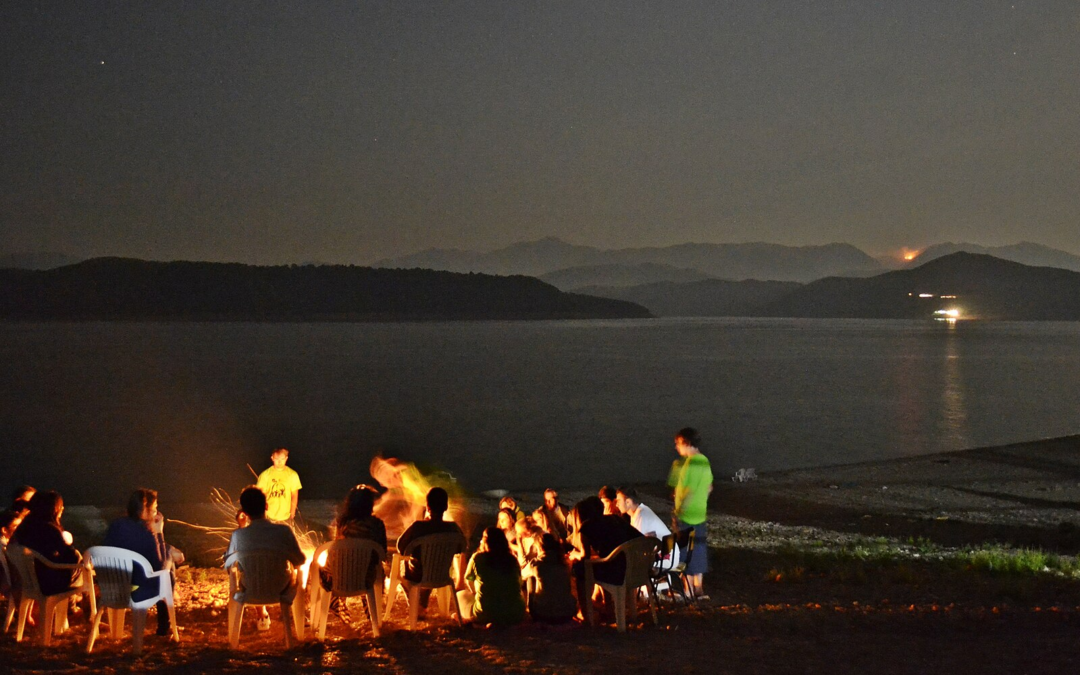
Yet I think there’s a reason why so many Jews keep coming back to camp year after year. It isn’t only because, as my young son wrote, camp is so much fun. As anyone who has been to camp knows, camp isn’t always fun. But the process of making a community, of living in greater harmony with the rhythms of nature and the rhythms of Jewish life, of singing and praying and studying and dancing together, of negotiating relationships and learning how to live peacefully in community with one another–in all of that messy and beautiful work of making camp, we make a space to recognize the divine presence. For many people, camp is a place where we experience the attunement that is always possible–but that is uniquely available under the trees, by the lake, and around the campfire.

Jun 6, 2024 | Blog, Rabbi Josh Feigelson, PhD, President & CEO, Institute for Jewish Spirituality
Peter Salovey, who is stepping down this month as president of my alma mater, Yale University, was my freshman psychology teacher thirty years ago. The course was popular. Hundreds of students took it.
Salovey was always quick with a joke. Before the final, I remember him telling us the story of a huge lecture hall full of students writing their exams, much like the one we were about to take. As time is winding down, a handful of students are finishing up. “Ten minutes left,” the professor calls out. A few finish and hand in their exam books. “Five minutes.” More finish. “One minute.” At this point, a single student is the last one writing–and he’s still going at a feverish pace.
“Time’s up, pencils down,” the professor calls. The student is still writing.
The professor shrugs, picks up the pile of exam books, and starts heading to the door. As she passes the student she says, “Last chance.” Still writing. The professor walks to the door of the lecture hall and the student races up to her. “Sorry,” she says, “you missed your chance.”
“Do you know who I am?” the student asks.
“What do you mean, do you know who I am?” the professor responds. “You went beyond time.”
“Do you know who I am?” the student asks again, more stridently.
“Look kid, I don’t care who your parents are or how important you think you are–the same rules apply to everyone.”
“Do you know who I am?” the student asks one more time.
“No,” she says.
At that, the student lifts up the pile of exam books in the professor’s arms, stuffs his in the middle of it, and races out of the room before she can figure out which exam book was his.
Professor Salovey told this story to ease some tension in the room before our final exam, but of course it reflects a deeper truth: We can often find ourselves in big, bureaucratic systems that render us nameless and faceless. And while those systems can sometimes provide advantages, they can also come at a cost. The advantages can include economies of scale, providing many more people access to valuable knowledge and experiences at an affordable rate. The disadvantages can include a lack of intimacy, a thinning of communal bonds, and ultimately both the capacity for and willingness to engage in abuse of the system.
The Book of Numbers, which we begin reading this week, marks an inflection point in the Torah. It is a book of generational transition, as the generation of the exodus dies out and the next generations come of age. And, with its multiple countings of the Israelites, the feeling tone of the more intimate stories of Genesis and at least early Exodus finally and fully gives way to a much larger, more corporate sense of a nation ready to assume the responsibilities of self-governance in the promised land.
Instructing Moses to take a census, the Holy One uses a fascinating phrase: Moses is not to count the people simply according to their number, but instead b’mispar shemot, the “number of their names” (Num. 1:2). The 16th century Italian commentator Rabbi Ovadiah Sforno observes that this unusual formulation suggests “the names of the individuals reflected their specific individuality, in recognition of their individual virtues.” This census simultaneously took cognizance of both the numerical scope of the people and each person’s uniqueness–an unusual kind of counting.
There would seem to be a connection between this kind of counting and the counting we do in mindfulness practice: Not simply logging minutes of practice, but aiming to be aware and attentive in each moment as it arises, present to the uniqueness of this particular time, place, and experience. That kind of practice can help us see our lives and those of other beings more fully. It can help us to humanize other people, avoid instrumentalizing them or relating to them as numbers without names–but instead to live with the awareness that every person has a name and a story. As so many forces in our world push us toward namelessness, facelessness, and dehumanization, this is a teaching we need to learn and practice again and again.
