Open Your Hand (Re’eh 5784)
There’s a neighborhood grocery store two blocks from my house. It’s called Village Marketplace and, to many of us who reside in Skokie, it’s one of the best things about living here. It’s not a big chain, it’s independently owned, and best of all, I can walk there and back in 5 minutes when we need a dozen eggs.
Occasionally there are folks standing outside Village Market (locals drop the “place” in the name; in our family we refer to it as VMart in an homage to the great Detroit Tigers switch-hitting DH from the early 2010s, Victor Martinez): young women selling Girl Scout cookies or people selling “StreetWise,” the magazine written and produced by homeless people around Chicago.
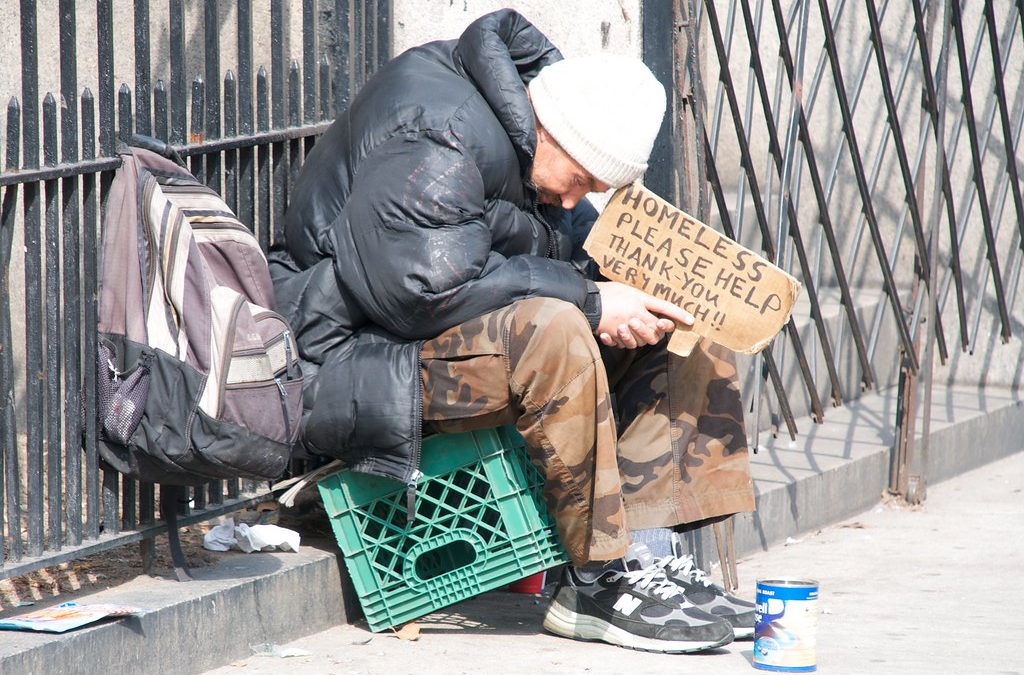
But in recent years the folks standing outside have more often been migrant families holding cardboard signs asking for donations, a local reminder of a national and global challenge. We can see these migrants, refugees, in what feels like virtually every shopping center parking lot, at major street intersections, outside sporting events.
Like most people, when I’m in my car I drive right past them. But when they’re standing in front of me as I pass the entrance to the grocery store, that’s harder to ignore. Which doesn’t mean I don’t ignore them–it just means that doing so weighs more heavily on my conscience. While I often give them money, just as frequently I don’t have cash, and their cardboard sign doesn’t have a QR code to Venmo them. So I go into the store and exit it with a little aversion of my gaze, my modest attempt to diminish the pain of both internalizing their situation and my own moral self-judgment. (If my Spanish were better, I might ask them what they need from inside and buy it for them.)
Part of the mental story I tell myself during such moments is precisely that these people in front of me are manifestations of much larger systemic problems: our immigration and asylum systems, failed governments in far away places, foreign policy choices, climate change. My inaction toward them thus becomes justifiable: What good does helping one person do in the face of challenges that are many orders of magnitude larger than me or them? It’s like trying to boil the ocean–so I can just go on with my day. Perhaps this resonates with you, too.
There’s an article that’s been circulating on my social media feed this week by a writer named Rachel Cohen. She explores her own attitudes towards volunteering, and thoughtfully places them in the context of larger social trends and ideas of the last 25 years–Robert Putnam’s Bowling Alone, Occupy Wall Street, climate activism. What she concludes is that many of us have been told, and now tell ourselves, that we should focus on systemic solutions, and that emphasizing individual actions is actually a distraction from doing so, i.e. we’re not going to recycle our way out of climate change. Yet Cohen thoughtfully interrogates this set of assumptions, and ultimately suggests that our individual actions–she starts donating blood regularly–are important not only for the actions themselves, but for the well-being and sense of connection they foster within and between us.
Among the commandments that are restated or elaborated in Parashat Re’eh are the laws of the sabbatical year. The Torah here addresses us as both individuals and as a collective, envisioning a society that sees and cares for those on the margins. “If there is a needy person among you, one of your kindred in any of your settlements in the land that YHVH your God is giving you, do not harden your heart and shut your hand against your needy kindred. Rather, you must open your hand and lend whatever is sufficient to meet the need” (Deut. 15:7-8). Rashi, quoting the midrash, observes: “There are people who painfully deliberate whether they should give or not, therefore Scripture states, ‘you shall not harden your heart’; and there are people who stretch their hand forth but then close it, therefore it is written, ‘you shall not close your hand.'”
I certainly have been that person the Torah is talking about. Perhaps, like me, you’ve had a momentary deliberation about whether to give to the person in need standing in front of you. Perhaps, like me, you can recognize yourself in those brief moments of hesitation Rashi describes. So, first and foremost, I would just say: Let’s listen to the Torah, which plainly understands how our minds and motivations work, and seeks to help us respond to our own inclinations through mindful attention.
Beyond that, I would add that I think it’s helpful to think of the systemic as related to–not necessarily defined by, but related to–a sum of individual actions. “Don’t harden your heart” is clearly connected to the “listening heart” King Solomon asks for at the beginning of his reign, the same listening heart I frequently suggest is what we seek to cultivate as members of democratic societies. The king’s actions are rooted in his heart, and in a democracy all of us are kings–we all hold responsibility for the state of society, whether through our votes or through our actions in front of the neighborhood grocery store.
Politics (Ekev 5784)
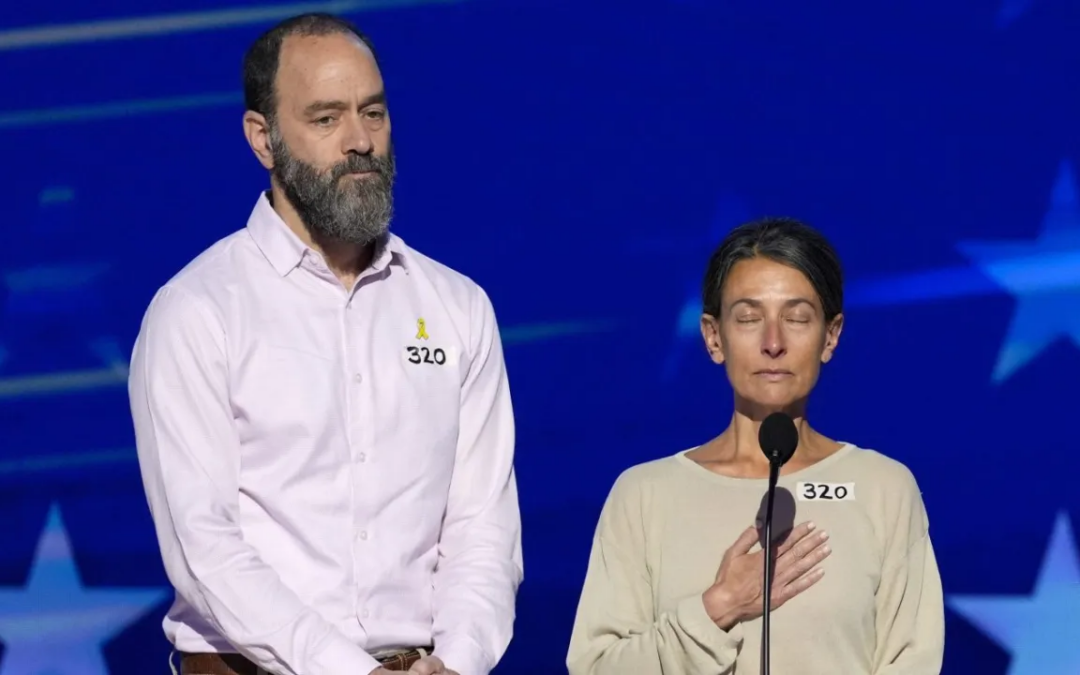
Like many of you reading this, I expect, the most powerful moment of this week’s Democratic National Convention for me was the speech of Jon Polin and Rachel Goldberg, the parents of Hersh Goldberg-Polin, one of the 109 remaining hostages held by Hamas in Gaza. Jon, and especially Rachel, have tragically become the most recognizable spokespeople for the hostage families. Seeing the tears in their eyes and the warmth of the reception for them from the 50,000 people at the United Center in Chicago, just a few miles from my home, was a profoundly moving moment.
“This is a political convention,” Jon said, “but needing our only son and the cherished hostages home is not a political issue. It is a humanitarian issue.” I have been thinking about that line a lot. Because while the cause of the hostages is certainly a humanitarian issue, I find that the question of whether or not it’s a political issue highlights a different question: What do we mean when we call something “political”?
I think what Jon meant by “political” here is that this isn’t an issue that can or should be politicized, i.e. used as a tool to score points or advantages, to accrue political capital, for a party or an individual. The hostages are civilians, and they should never have been taken in the first place–so they should be released immediately, on humanitarian grounds.
Yet the very fact that Jon and Rachel spoke at the convention, like Ronen and Orna Neutra, the parents of Omer, who spoke at the Republican National Convention earlier this summer, reflects that there is a political dimension to the issue–in a different sense of the word. This sense is more along the lines of another dictionary definition: “Relating to the government or the public affairs of a country.”
In that sense, securing the release of the hostages is certainly a political issue: absent a miraculous unilateral decision by their Hamas captors or a similarly miraculous rescue operation by the IDF, the way the hostages will come home is through governmental decision-making and negotiation; i.e. political action. That is why both these families spoke at these conventions; it is why so many in Israel have been organizing to apply political pressure on the government for months.
This week on my podcast, Soulful Jewish Living, we began a five-part series exploring some of the spiritual “habits of the heart” about which Alexis de Tocqueville wrote 200 years ago, and that I think Oprah Winfrey had in mind when she talked about the “heart work of democracy” during her speech at the DNC. The five we’re looking at come by way of Parker Palmer’s book, The Heart of Democracy. They include: Remembering that we’re all in this together; valuing and embracing otherness; holding tension in life-giving ways; finding our personal voice and agency; and nurturing a capacity to create community. I hope you’ll listen and let me know what you think.
For this week, however, I feel a need to highlight the ways in which so many of these habits find expression in the Torah–and in Parashat Ekev (Deut. 7:12–11:25), that we read this week. Ekev is when Moses seems to hit his rhetorical stride in his valedictory address to the people before they enter the land and begin their exercise in self-government. It is full of grand, sweeping evocations to love God and do God’s ways. But it is also all about the work of the heart, perhaps no more centrally than in this series of verses:
Cut away, therefore, the thickening about your hearts and stiffen your necks no more. For YHVH your God is God supreme and Sovereign supreme, the great, the mighty, and the awesome God, who shows no favor and takes no bribe, but upholds the cause of the orphan and the widow, and befriends the stranger, providing food and clothing. You too must befriend the stranger, for you were strangers in the land of Egypt. (Deut. 10:16-19)
Totally Awesome (Vaetchanan 5784)
One of the inside jokes my wife Natalie and I have shared over 23 years of marriage is what we lovingly call the “Really, you needed research to tell you that?” phenomenon. You might be familiar with it yourself. In our experience, it most regularly occurs reading articles in The New York Times in which scientific research demonstrates something that it seems like someone with common sense could have figured out on their own. “Having friends contributes to lower levels of loneliness” “More sleep helps you feel more rested.” “People who have more birthdays live longer.” That kind of thing.
That’s not to knock the scientists who do this work (okay, the last one was genuinely tongue in cheek). Studies into phenomena we intuitively know to be true are, in my experience, very valuable. They usually uncover dimensions we didn’t previously understand. They give us ways to quantify and talk about aspects of our lives that have previously been a little mushy. And they often offer ways in which science and religion can speak to one another.
One truly excellent contribution to this genre is Berkeley social psychologist Dacher Keltner’s recent work on awe and wonder. Keltner defines awe as “the feeling of being in the presence of something vast that transcends your current understanding of the world.” He and his team show that awe is a very deep emotion that serves a number of psychological, physiological, and social functions. I learned a tremendous amount reading his book.
It turns out that awe, like meditation, stimulates the vagus nerve, which helps to reduce inflammation in the body and in the processes that regulate our emotions. And so experiencing even a few minutes of awe regularly can help us be more humble and altruistic, feel more connected to community and the natural world, and see the world as less polarized. That, in turn, can help us alleviate multiple crises we’re experiencing: in mental and physical health, the epidemic of loneliness (about which the U.S. Surgeon General has issued a warning), political polarization, even climate change.
If you’re the kind of person who’s reading a Shabbat reflection from a rabbi who leads the Institute for Jewish Spirituality, you may well be hearing that little voice in your head I described at the top: Really, I needed a study to tell me that awe is a good thing? I know that from my own experience. True. And I’ll still highly encourage you to read the book and watch Keltner’s Ted talk, because you’ll probably learn things you didn’t know (I certainly did), including ways to experience awe you might not have thought of. And of course, it may be particularly useful for having a conversation with people in your life who don’t intuitively buy the argument.
Tuesday was the Ninth of Av, the lowest point on the Jewish calendar. Beginning this Shabbat and continuing for the next seven weeks, the haftarah, or portion of the Prophets we read liturgically, is drawn from the Book of Isaiah. Collectively these seven haftarot are known as the shiva d’nechemta, the seven haftarot of consolation.
This week’s haftarah is marked by an abundance of nature imagery: deserts, mountains, hills and valleys. “Who measured the waters with a hand’s hollow, and gauged the skies with a span, and meted earth’s dust with a measure, and weighed the mountains with a scale, and the hills with a balance?” (40:12-13). All of this, it would seem, is in service of reawakening within us a sensation of awe, helping us sense that we are part of something much larger than ourselves.
The haftarah concludes with the memorable verse, “Lift high your eyes and see: Who (in Hebrew: Mi) created these (eleh)? The One who sends out their host by count, who calls them each by name. Given such great might and vast power, not a single one fails to appear” (40:26). The Hasidic master Rabbi Menachem Nachum of Chernobyl comments that the act “lifting up our eyes” is a spiritual act, whereby we connect the mi (who) with the eleh (these), thus producing the letters that spell out elohim, the Creator.
The lesson would seem to be that a trailhead on the path of healing is re-grounding in awe. Our brokenness can lead us to places of constriction and isolation. But contemplating the vastness and majesty of creation–of which we are an amazing and yet infinitesimally small part–helps awaken with our bodies, hearts, and minds the sources of our own renewal.
In this, Isaiah would seem to be a precursor to Mary Oliver’s poem “Wild Geese,” which memorably concludes,
Whoever you are, no matter how lonely,
the world offers itself to your imagination,
calls to you like the wild geese, harsh and exciting–
over and over announcing your place
in the family of things.
Alone, Together: Devarim 5784
I was blessed to spend this week at the Chautauqua Institution in upstate New York, during its 150th anniversary season. When I’ve had to explain what Chautauqua is to friends and loved ones, I’ve described it as some combination of Brigadoon, Mackinac Island, and adult summer camp for people who listen to National Public Radio. There are lectures and classes and cultural events galore, families that have been coming for generations, and an aspirationally utopian spirit about the place.
With thanks to IJS board member Bill Klingensmith (a fourth-generation Chautauquan), I was invited to give a talk as part of the summer-long interfaith lecture series, which is held at 2 pm every afternoon in the Hall of Philosophy, an outdoor amphitheater with doric columns (that also gives you some idea of the flavor–picture is of me speaking there). I took the opportunity to talk about some new work we’re developing at IJS around responding mindfully to antisemitism, particularly through an approach grounded in the intergenerational nature of Jewish trauma. I encourage you to watch the lecture and the Q&A and let us know what you think. (There’s a paywall, but I can tell you the $2.99 subscription is more than worth it.)
A particularly special element of this visit was that I was housed in a small B&B with the other Religion Department speakers for the week. And thus, by design, every day I had breakfast and spent time with an amazing group: Rev. Michael Curry, the head of the Episcopal Church (you may remember his famous sermon at the wedding of Meghan Markle and Prince Harry); Dr. Sunita Puri, a palliative care physician who draws on her Hindu background to write powerfully about death, dying, and living; Rev. Amy Butler, a pioneering Baptist minister who is leading a revolution in how Christians think about the work of the church. And we spent time with friends of theirs, with the staff at Chautauqua, and with regular folks who would just walk up, introduce themselves, and ask questions–all of which expanded the circle of conversation.
I found these conversations and these new friendships to be truly nourishing, and I think the same was true for the rest of the group. There was a lot of laughter as we identified the many realities and challenges we share across lines of faith and religion. And there was plenty of learning–about those realities and challenges, about the particular contours of each of our work. I had the advantage of speaking midweek, so I had more time to refine my talk–and those conversations caused me to make some adjustments (which were, hopefully, improvements).
Parashat Devarim (Deut. 1:1-3:22) is always read immediately before the Ninth of Av, our day of deepest sadness and shattering. On that day, we read the Book of Lamentations, Eicha in Hebrew, the opening line of which is, “Eicha – Alas, lonely sits the city once great with people!” In a linguistic preview, Moses utters similar words at the beginning of Deuteronomy: “Eicha – How can I bear alone the trouble of you, and the burden, and the bickering” (Deut. 1:12).
While our attention is drawn to the opening word of both verses–Eicha: “alas,” or “how”–the third word of both verses is also shared: Badad (alone) and l’vadi (by myself). I would suggest that parallelism invites us to some reflection. For me, it immediately evokes God’s words upon creating Adam: “It is not good for Adam to be alone” (Gen. 2:18). While solitude, the capacity to be happy in our own company, is essential for our well-being, it is ultimately a precondition for being in relationship with others–as intimate partners, yes, but also as friends, neighbors, and fellow images of the Divine in creation.
What we allow ourselves to experience on Tisha b’Av, then, is a profound loneliness, disconnection, isolation. This is a gift of the Jewish calendar, to concentrate that feeling in one day. We do need to feel it, to experience it. But then we emerge from it as we begin a seven-week journey of repair and renewal, en route to Rosh Hashanah–not alone, but together with friends and community.
One of the stories we justifiably tell ourselves about Jewish suffering is that we are alone. “None came to help her,” cries the prophet (Lamentations 1:7). Yet by making that the primary or only narrative we tell ourselves, we risk creating a self-fulfilling prophecy: no one has ever been our friend and no one ever will, so we have to go it alone. And I would suggest that, ultimately, that is not a healthy narrative to tell ourselves and it is not a healthy way to live. Moses himself shows us as much. Immediately after he wonders how he could possibly lead the people on his own, he and God agree on a plan to recruit more leaders (Deut. 1:13-14). He is no longer on his own; he has partners to share the burden. He is not, in fact, alone.
On reflection, I have found that my time at Chautauqua, and especially my many conversations with friends new and old, have helped me to recalibrate my settings in this zone between solitude and loneliness. It seems to me that’s what Jewish history and Jewish life have long demanded of us. And while I believe we need to remain clear-eyed about the real threats to Jews and Jewish life today–they are very real, and they are very dangerous–I also hope we can nurture our capacity to trust good people from beyond our community, to imagine a shared future together, to sense that we all can be at home. To me, that is a required stop on the road to redemption.
Only Connect (Matot-Masei 5784)
In the past month I’ve had two really troubling conversations with young adults. One was with someone I know in their 20s. We were talking about the presidential campaign. And this very intelligent, caring person said, “Honestly, I just can’t get excited about politics. The damage we have done to the planet is irreversible, and it feels like we only have a few years left no matter who’s in power. It just doesn’t matter.”
In another conversation, I was talking with an Israeli woman in her early 30s. Again, supremely intelligent, a committed Zionist and IDF veteran, a caring and compassionate person. She has two young children. And she told me that she’s been actively looking at places to live outside of Israel because she just can’t see how the country, and its Jewish population, will survive for many more years. She was totally serious.
Both of these conversations caused me to lose sleep. It isn’t as though they were telling me things I wasn’t aware of. In just the last couple of weeks we have experienced day after day of “the hottest global temperature on record.” We are living with the realities of climate change, and absent some messianic shift those realities are going to worsen in the coming years. Likewise, Israel lives with instability and very serious threats on every one of its borders–not to mention the profound challenges it faces within them.
Yet somehow, knowing those realities hasn’t led me to the place of fatalism I heard in the voices of these young adults. That could simply be my naivete. It could be a form of optimism functioning as spiritual bypass: I can acknowledge it but, because the possibility of it being true is just too shattering to contemplate, I kind of put the knowledge aside and function as though everything is normal. But hearing people younger than me articulate so honestly and powerfully how they felt–it was really jarring. As, frankly, it should be.
I recently started listening to a podcast called We Are the Great Turning. It features a series of interviews with the legendary activist and Buddhist teacher Joanna Macy, conducted by Jessica Serrante and produced by Anya Kamenetz. In addition to the interviews, the series also includes practices–meditative, conversational–to do. The overall point of the series is to help us not to look away at what’s happening, but instead respond with connection, care, and compassion.
Jess and Joanna don’t waste any time. There are tears in the first episode. At one point, Joanna describes her awakening to the global climate crisis half a century ago, and the long months of depression and silence it produced in her: “There’s the loneliness of the unheard witness of what’s befalling our planet. You’ve been holding it back because you don’t want others to know how bad it is. You don’t want others to know how great is the grief. I didn’t want my family to know how much pain I was in. I didn’t want them to know my own suffering because it was enough to drive you mad to think that we were heading over the brink as a species, to bring this sense of anguish and isolation to my beloveds.”
Eventually, however, Joanna came to understand that even, or perhaps precisely amidst, that pain and grief, relationship and connection were more important than ever. Finding ways to share the grief, and finding ways to help others respond to the crisis while not sugar-coating reality–that has more or less been her life’s work since then.
Towards the end of Parshat Matot-Masei, close to the conclusion of the Book of Numbers, we encounter this verse in the Torah: “You shall not defile the land in which you live, in which I Myself abide, for I YHVH abide among the Israelite people” (35:34). It’s an evocation of the words God uses to describe the building of the Mishkan: “Make me a sanctuary, that I may dwell among them” (Exodus 25:2). The Holy One reaffirms that It dwells in our midst.
But we already knew that. So what does this verse come to add? Rashi, quoting the Midrash, tells us: “even when the Israelites are ritually impure, my presence remains amongst them.” This is a larger theme, of course. As we approach the 9th of Av, we recall the teaching that even when we are in exile, the Holy One is with us. It’s as if the tradition is coming to remind us, again and again, that Divinity does not reside only in one holy, perfect place. Rather, the loving life force of the universe is constantly present, constantly available, constantly beckoning us to reconnect–even when we are lonely, even when we are in pain, even when we feel totally cut off.
Like so many things, that is easier said than done. And it is certainly easier to try to look past the genuine suffering in the world and just insist that everything will be all right. It might, and it very well might not. But as Joanna Macy teaches, as our own tradition and our ancestors teach us, even in the midst of that suffering there is still a great deal of love and goodness and even possibility to be nurtured. May we support one another in experiencing it.