
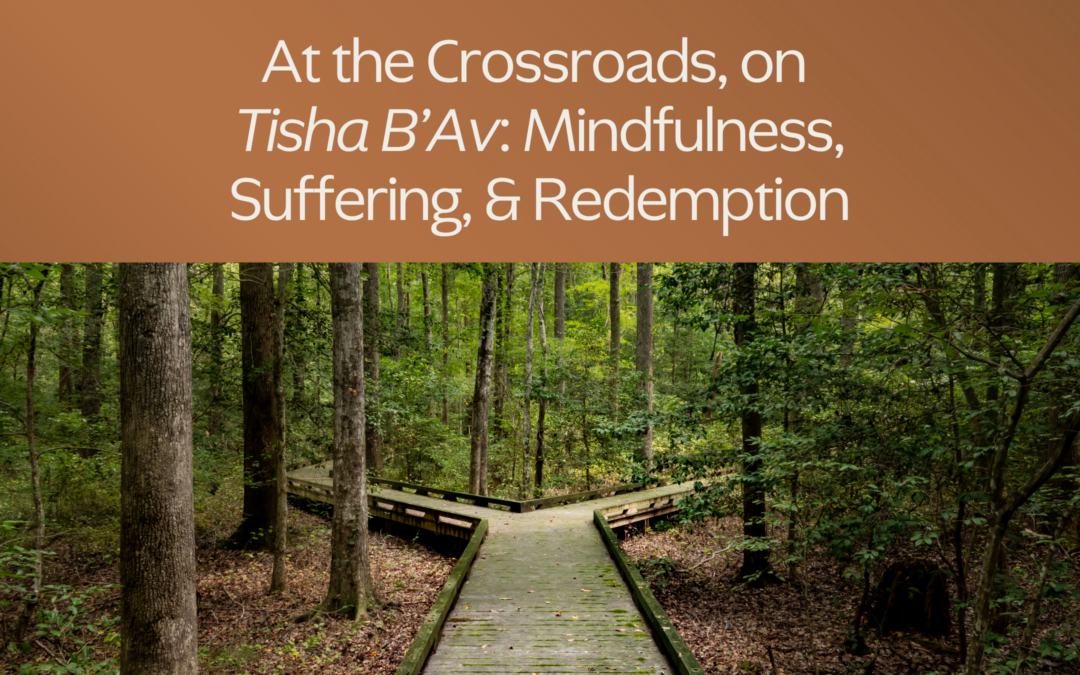
At the Crossroads, on Tisha B’Av: Mindfulness, Suffering, & Redemption
As we move in the Jewish year towards Tisha b’Av, the nadir of the Jewish year, how shall we confront the reality of pain and suffering spiritually? Given the cataclysms of our world, where is there any space to allow for the real possibility of redemption or repentance? Where is there room for empathic, mindful practice in a harsh world that seems so utterly distant from it all?
Commenting on the concluding verse of the Book of Lamentations, the great Hasidic teacher Rabbi Levi Yitzhak of Berdichev offers a mesmerizing take:
Another explanation for “take us back, YHVH, to You, and we will return; renew our days as of old.”¹ What is the explanation of the words, “of old,” in the context of this verse?. . . Every person in Israel is required to believe with full faith that in each and every moment, they receive vitality from the Blessed Creator, as the Rabbis expound: “Each soul (neshama) will praise Yah – each and every breath (neshima) will praise Yah.”² For each moment, the vitality desires to leave a person, and the Blessed Holy One sends back new vitality. We find that it is according to this principle that repentance (teshuvah) works for every single human being.
When a human being engages in repentance, they demonstrate belief that they are, at that moment, an entirely new creation, and Hashem, may God be Blessed, in God’s abundant mercy, doesn’t recall the prior sins. But if, God forbid, a person does not believe in this, then repentance won’t work, God forbid. This is the explanation of the midrash, “every mention of the word ‘now’ [עתה] in the Torah] denotes repentance.”
Since a person believes that they are now a new person, repentance operates successfully. This is the explanation of the verse, “take us back, YHVH, to You, and we will return”… How will a person return? By having their days renewed like old. This explains the [cryptic] passage of Talmud, “when are you [the messiah] coming? He replied, today. ‘Today, if you heed His voice.’”³ – when you live with this quality that each day you are an entirely new creation.⁴
There is a two-step move here. First, how can we repent or change individually? By renewing our days as of old. But wait! Are the days new, and we’re meant to put the past behind us, or are we supposed to yearn for a supposedly more innocent past? In the past, says Rabbi Levi Yitzhak, the spiritual masters practiced mindfulness, living in the present, and not the past. It’s a paradox. Repentance is fundamentally rooted in a practice of now/עתה, of being mindfully attuned to the present situation and having enough awareness of this reality to escape the accumulated anxiety and trauma that inhibits real change.
Secondly, the ramifications are not localized, because all of reality is an interconnected unity. In the Talmudic passage cited, the Messiah is distinguished for bandaging only one individual at a time; others treat many patients at once. The Messiah is a healer fully engrossed in practicing local acts of empathy, wholly attuned to the pain of individuals. Our global problems are not served by quickly scaling up, but rather by harnessing empathic awareness and healing fully. This is what it means to “listen” to the voice of the Creator. By attuning ourselves to the newness of each present moment with connection and empathy for the suffering of others, we transcend churban/destruction together.
This teaching for Tisha B’Av by Rabbi Barry Dolinger (CLP1) originally appeared in Torah Without End: Neo-Hasidic Teachings and Practices in Honor of Rabbi Jonathan Slater, edited by Rabbi Michael Strassfeld (2002).
Rabbi Dolinger is an alumnus of the IJS Clergy Leadership Program. He received ordination from the Rabbi Isaac Elchanan Theological Seminary of Yeshiva University, and serves as spiritual leader of Congregation Beth Sholom in Providence, RI. Rabbi Dolinger co-founded Mitzvah Matzos, a non-profit Passover matzo bakery that donates all profits to fight human trafficking, and serves as the Executive Director and Menahel of the International Beit Din.
¹ Lamentations 5:21: הֲשִׁיבֵנוּ ה’ אֵלֶיךָ (ונשוב) [וְנָשׁוּבָה] חַדֵּשׁ יָמֵינוּ כְּקֶדֶם, Take us back, Eternal One, to Yourself, and let us return/Renew our days as of old.
² Bereishit Rabbah 14:9
³ Babylonian Talmud Sanhedrin 98a
⁴ Kedushat Levi. Megillat Eicha 16a