Remembering the Small Jars

Remembering the Small Jars

How might we kindle an inner light during this dark, traumatic time for our people?

Many of us will gather this Hanukkah to light the menorah as the days grow shorter and darkness prevails. On the surface, this act continues to affirm, as it did during the time of the Hasmoneans more than two thousand years ago, that even as our people are enveloped in the darkness of persecution at the hand of those who would annihilate us we can hold fast to the light of our faith. Certainly, kindling the lights for all to see will take on a heightened level of immediacy and power this year as we affirm that we stand strong in our Jewish values and refuse to cower in the shadows of our fear in the face of rising antisemitism.

But the Hanukkah lights point to something subtler too. According to the kabbalistic tradition there’s a link between the story of Jacob – who wrestled with an adversary throughout the night and emerged victorious, earning the name Israel – and the Hanukkah story, a link that suggests how we might kindle an inner light.

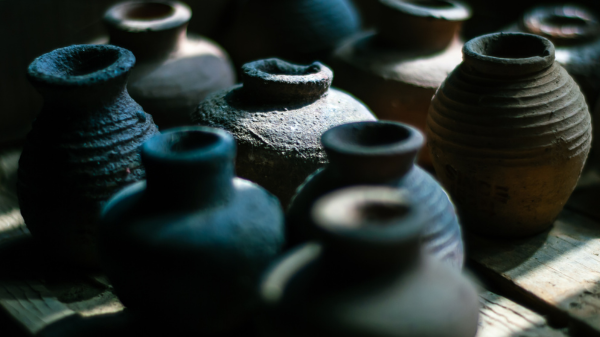
According to the biblical narrative of Genesis 32, after making preparations for battle against his brother Esau and sending his whole encampment ahead beyond the Western side of the Jabbok river, Jacob remained alone on the Eastern banks. Paraphrasing a teaching offered in the Talmud (Hullin 91a), the 11th century French commentator Rashi explains why Jacob remained alone: “He had forgotten some small jars and he returned for them” (on Genesis 32:25).

The Galician hasidic teacher Naftali of Ropshitz (1760-1827) cites the kabbalistic tradition that teaches that the jar of oil that the Hasmoneans would use hundreds of years later to rekindle the Menorah after defeating the Syrian Greeks was among the small jars Jacob had forgotten:

It is written in the mystical books regarding the verse “Jacob remained alone” that the very jug of oil from the Hanukkah story was among the small jars [that Jacob had forgotten]…He specifically went back for those small jars in order to draw down blessing (Zera Kodesh, Homilies for the Festivals, Hanukkah).

Why did the Kabbalists see fit to link Jacob’s small jars with the cruz of oil used by the Hasmoneans to rekindle the lights in the Temple? Perhaps they were trying to convey that during times of great struggle and darkness when our people are under attack, we tend to forget the power of the smallest and simplest of vessels as sources of immense blessing and strength. In the frenzy of trying to manage our fear, anxiety, grief, trauma, and hypervigilance, we may completely forget the subtle sources of light that lie within waiting to be magnified and enhanced so they might shine brighter than we may have ever imagined possible.

Our practice reminds us that it doesn’t take much to kindle an inner light to fortify ourselves for the dark night ahead. Becoming aware of the sensations of our feet firmly planted on solid ground; taking a few deep, mindful breaths; placing a hand on our heart and lovingly affirming, “Sweetheart, in this moment you’re safe”; bringing those who are suffering to mind and wishing them ease and well-being; recognizing the fragility and preciousness of this human life and being more present and grateful with those we love; reaching out to our family and friends in Israel and letting them know that we care – all of these are small vessels that, when opened regularly, contain the fuel with which to kindle a great light within, one that can nurture our courage, wisdom, compassion, resilience, and responsiveness during this painful, dark time and beyond.

 

When the Walls Crumble: A Teaching and Practice for Tisha B’Av

When the Walls Crumble: A Teaching and Practice for Tisha B’Av

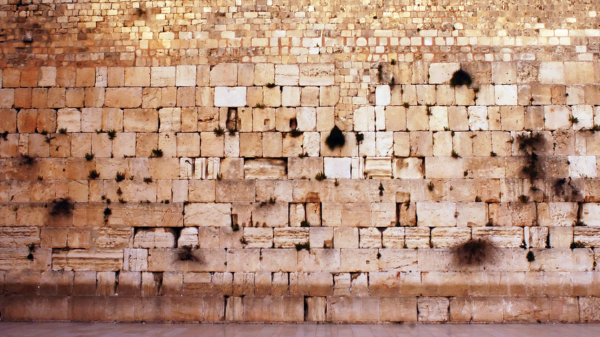
Tisha B’Av is a day when we turn courageously to face the truth of the fragility, unpredictability, and groundlessness of our lives. You might wonder, then, what is required of us on this day? We invite you to dedicate a couple of moments to practice as we face the truth of impermanence, and discover an inner refuge that can help us to remain loving, calm, open hearted, and compassionate even in the midst of change and difficulty.

Purim and the Pursuit of Wisdom

Purim and the Pursuit of Wisdom

“Look again at that dot. That’s here. That’s home. That’s us. On it everyone you love, everyone you know, everyone you ever heard of, every human being who ever was, lived out their lives. The aggregate of our joy and suffering, thousands of confident religions, ideologies, and economic doctrines, every hunter and forager, every hero and coward, every creator and destroyer of civilization, every king and peasant, every couple in love, every mother and father, hopeful child, inventor and explorer, every teacher of morals, every corrupt politician, every “superstar,” every “supreme leader,” every saint and sinner in the history of our species lived there–on a mote of dust suspended in a sunbeam.

The Earth is a very small stage in a vast cosmic arena. Think of the rivers of blood spilled by all those generals and emperors so that, in glory and triumph, they could become the momentary masters of a fraction of a dot. Think of the endless cruelties visited by the inhabitants of one corner of this pixel on the scarcely distinguishable inhabitants of some other corner, how frequent their misunderstandings, how eager they are to kill one another, how fervent their hatreds.

Our posturings, our imagined self-importance, the delusion that we have some privileged position in the Universe, are challenged by this point of pale light. Our planet is a lonely speck in the great enveloping cosmic dark. In our obscurity, in all this vastness, there is no hint that help will come from elsewhere to save us from ourselves.

The Earth is the only world known so far to harbor life. There is nowhere else, at least in the near future, to which our species could migrate. Visit, yes. Settle, not yet. Like it or not, for the moment the Earth is where we make our stand.

It has been said that astronomy is a humbling and character-building experience. There is perhaps no better demonstration of the folly of human conceits than this distant image of our tiny world. To me, it underscores our responsibility to deal more kindly with one another, and to preserve and cherish the pale blue dot, the only home we’ve ever known.”
— Carl Sagan, Pale Blue Dot, 1994

Writing at Purim time, during the continued unfolding of Russia’s brutal invasion of Ukraine, the carnage only mounts. When we mark the holiday we think of the rivers of Jewish blood Haman would have spilled had he not been thwarted by Mordechai and Esther. Today we think of the rivers of Ukrainian blood being spilled by Vladimir Putin. Both of these tyrants are united across the ages in their wish to visit endless cruelty upon the inhabitants of a tiny corner of a fraction of a dot. Both are united in their utter delusion. When viewed through Sagan’s reflections on our one and only pale blue dot, all this violence and cruelty seems so utterly senseless, meaningless, and foolish.

Though it may not be readily apparent on the face of things, behind all this folly lies that most basic human impulse–the desire for happiness. Haman thought he would be happy if he annihilated the people who threatened his honor. Instead he brought about his own ruin and the destruction of his entire family. Putin believes he’ll be happy if he takes Ukraine and replaces its government with a puppet regime. But he won’t. His cruelty and greed will eat him alive as he becomes a pariah to the world and brings ruin upon his own people. As we are witnessing in real time on a grand scale, the impulse to pursue happiness can lead to horrible, disastrous consequences if it isn’t coupled with wisdom.

Mindfulness is our tool for cultivating wisdom. It works by peeling away misleading external appearances and obstructing masks to reveal the deeper nature or true face of things. With mindfulness, we recognize that happiness that depends on ephemeral external conditions can’t be sustained in the long run; to be truly lasting, our contentment and well-being need to be generated from within. When our desire for happiness is married to wisdom, we know how interconnected we all are, and operate with an awareness that to inflict harm upon another being or part of this planet for our own gain is an act of self-harm. And with mindfulness, tyrants might come to recognize that pinning their glory on their claim to a tiny part of an infinitesimally small blue dot is an exercise in folly.

At this moment in the evolution of Western culture, the pursuit of happiness as an end in itself has run its course as we careen toward growing conflict, division, mistrust, the collapse of democracy, and the destruction of our planet. What we need now as a species is a collective turning toward the pursuit of wisdom, which might then reveal the true conditions that lead to mutual happiness and well-being for all. That’s why we practice.

We at IJS are proud to be part of the burgeoning movement toward that turning as we broadly teach Jewish spiritual practices grounded in mindfulness. Such practices foster our ability to discern a wise path to human flourishing, one grounded in a deep recognition of our evanescence and frailty and the immense preciousness and interconnection of life and our planet. One that leads us beyond the folly, caprice, and lustfulness of the ego toward a deep sense of mutuality, interdependence, abundance, and shared responsibility. One where we triumph “not by might nor by power but by spirit alone” (Zechariah 4:6).

Prayers to Recite Before Voting

Prayers to Recite Before Voting

Below we offer three prayers for you to choose from, to be recited before voting. We recommend reciting your prayer(s) of choice immediately before casting your ballot as a way to ground your kavvanah (intention) for voting. The first was written by Rabbi Sam Feinsmith of the Institute for Jewish Spirituality. The second, an improvised variation on the Kaddish, was composed by the beloved eighteenth-century Hasidic teacher Rabbi Levi Yitzchak of Berdichev as a protest against the Czar. The third is a prayer for peace composed by Rabbi Nachman of Breslov, another influential Hasidic teacher and a contemporary of Rabbi Levi Yitzchak. If the length of the first prayer is a hindrance, you may choose as your prayer a few paragraphs that speak to your heart.

Read the three prayers