
Reflections on Shehecheyanu and Getting Creative by Alison Cohen
Reflections on Shehecheyanu
Baruch atah, Adonai Eloheinu, Melech haolam, shehecheyanu, v’kiy’manu, v’higiyanu laz’man hazeh. Blessed are You, the Ineffable One, who has kept us alive, sustained us, and brought us to this moment.
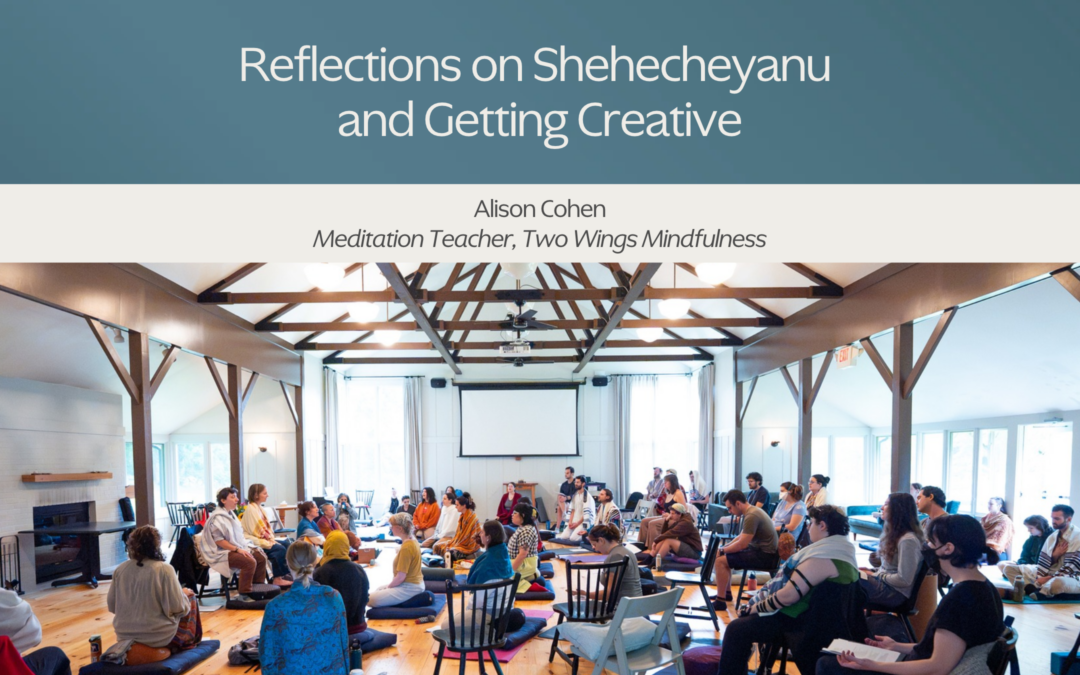
Last month, members of IJS’s Young Adult Mindfulness Community, Shevet, came together for an online daylong retreat. It was such a blessing to teach it – that’s an understatement – and as we meditated together, sang together, and compassionately listened to each other’s reflections, most if not all of us realized that this was the first Jewish mindfulness retreat that we were experiencing in this new year of 5787. So we recited Shehecheyanu as a community in our sacred Zoom meditation hall. It was such a gift to accompany each other throughout the day, buoying one another’s hearts, and then there was this additional tender layer of savoring the experience through this ancient act of verbal gratitude.
Another fan of the Shehecheyanu was the remarkable Ilana Schatz, zichrona livracha, may her memory be for a blessing, the founding director of Fair Trade Judaica. In a beautiful Ritualwell piece entitled “Bittersweet Shehekheyanu: A Revised Blessing for Gratitude and Loss,” which Ilana wrote after receiving a devastating diagnosis, she explains that she didn’t want to stop saying the Shehecheyanu because it was so close to her heart as a way of expressing gratitude. But she associated the Shehecheyanu with moments of celebration, and in light of her new circumstances, she no longer felt called to say the closing phrase, “v’higiyanu lazman hazeh,” meaning “and brought us to this moment.” So she created a list of alternate, bittersweet, honest options for the ending of the blessing – here they are:
Who has eased our way – v’hinikhanu
Who has provided support – u’t’mikhanu
Who reminds us that we’re not alone – v’holekh imanu
Who dwells with us – v’shokhen imanu ba’zman ha-zeh
Who has not abandoned us
Who has comforted us – v’nikhamanu
I’m so grateful to Ilana for sharing about her process, because it’s a gentle reminder that Jewish wisdom and how we apply it to the nooks and crannies of our complex human lives – this is an ever-evolving project, a project that invites us, encourages us, maybe even demands of us, to get creative.
May each of us find ways to express gratitude that feel aligned with the truths of our lives, whatever those flavors may be.