A Conversation with Rabbi Sharon Brous

A Conversation with Rabbi Sharon Brous

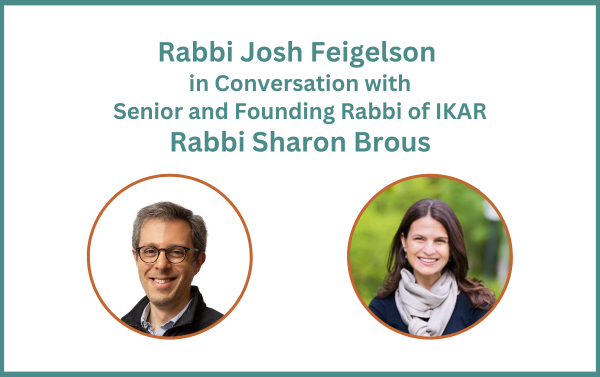
We are grateful to  Rabbi Sharon Brous for speaking with IJS President & CEO, Rabbi Josh Feigelson! Please enjoy the conversation recording below.

Rabbi Sharon Brous is the senior and founding rabbi of IKAR, a Jewish community that launched in 2004 to reinvigorate Jewish practice and inspire people of faith to reclaim a soulful, justice-driven voice. Her 2016 TED talk, “Reclaiming Religion,” has been viewed by more than 1.5 million people. In 2013, Brous blessed President Obama and Vice President Biden at the Inaugural National Prayer Service, and in 2021 returned to bless President Biden and Vice President Harris, and then led the White House Passover Seder with Second Gentleman Doug Emhoff. She was named #1 on the Newsweek/The Daily Beast list of most influential Rabbis in America, and has been recognized by The Forward and Jerusalem Post as one of the fifty most influential Jews. Brous is in the inaugural cohort of Auburn Seminary‘s Senior Fellows program, sits on the faculty of REBOOT, and serves on the International Council of the New Israel Fund and national steering committee for the Poor People’s Campaign.

Her new book, The Amen Effect: Ancient Wisdom to Heal Our Hearts and Mend Our Broken World, is out now from Penguin Random House. A graduate of Columbia University, she was ordained by the Jewish Theological Seminary and lives in Los Angeles with her husband and three children.

Moments of Presence (Emor 5784)

Moments of Presence (Emor 5784)

I want to tell you about my amazing Shabbat last week.

It came on the third day of a five-day retreat we held for about 25 members of our IJS Sustainers Circle, a group composed of former board members, alumni of our Kivvun program, and major donors. The retreat was full of meditation sessions, rich and musical prayer tefilah (prayer), mindful movement, mindful eating, and a lot of love.

But Shabbos took it to a whole different level.

And there was one moment that stood out in particular. It came as we were starting Shabbat dinner on Friday night. My dear friend and colleague, Rabbi Miriam Margles, reminded us all that this time is traditionally one of bracha, blessing. In my own home, as in many others, it’s a moment when parents offer blessings to their children. So Miriam invited us into this opportunity for blessing, but–this was an IJS retreat, so, of course–to do it perhaps a little differently than we usually do. We were to turn to a neighbor and look into their face. Each of us would share, honestly and from the heart, the blessing we needed just then. Our partner would listen attentively and then offer that blessing to us.

My partner was another member of the retreat faculty, the wonderful Rabbi Jonathan Kligler. And in this moment, I was able to look at Jonathan, be held by the embrace of his face, and share with him very openly the bracha I felt like I needed in that moment. Jonathan took my hand and offered exactly that blessing. And then I did the same for him. I know we weren’t the only pair in which tears were shed. It was a deeply moving experience.

It is always a profound thing to be seen and heard deeply like this. Being fully present with someone else, offering and receiving blessing–it felt as if, for that moment, we were like the two keruvim, the two cherubs that faced one another atop the holy ark. The Divine presence was revealed within us and between us. And that was happening all around the room.

But what also enabled that moment to be so meaningful was its ritual element: It took place at Shabbos dinner. It drew power from our mutual submission to and upholding of the rhythms of Jewish time. While in theory this showing up for one another, this “presencing,” could have taken place anywhere and anytime, in practice our ritual made it both more accessible and richer than it would have been otherwise.

Parashat Emor (Leviticus 21-24) details the holiday calendar: “These are My fixed times, the fixed times of YHVH, that you shall proclaim as sacred occasions” (Lev. 23:2). Beginning with Shabbat, the parasha goes on to enumerate the pilgrimage festivals of Passover, Shavuot, and Sukkot, the counting of the Omer, and the holidays of Rosh Hashanah and Yom Kippur.

Opening his commentary on this passage, the 13th century Spanish commentator Ramban (Nachmanides) observes that, while much of Leviticus is directed specifically to the priests, this passage is meant to be shared with the entire people. Why? “The priests have no greater duties with regard to the festivals than the Israelites, therefore the Holy One did not admonish Aaron and his sons in this section, but the children of Israel, a term which includes all of them together.” All of us, Ramban suggests, regardless of background or station, have a share in these times; all of us can access them; all of us uphold them. These are not special rites of professional ritualists; they are the inheritance and responsibility of the entire Jewish people.

There’s no rocket science in that, of course, just a rearticulation of a basic truth. The challenge–for me, anyway, and perhaps for you too–is that they can become ritualized and, in the process, lose some of what the ritual is supposed to help us do. Our moadim, our sacred times, are invitations to deeper awareness, a richer encounter with the Divine within ourselves and one another. Every week on Shabbat, and then throughout the other special moments of our holiday calendar, we can step into an opportunity for blessing, pause and rest through which we recognize the presence of the Shechina within, between, and among us. What an incredible gift, what an astonishing inheritance.

Josh’s Friday Reflections
FREE

Every Friday morning, IJS President & CEO Rabbi Josh Feigelson shares a short reflection on the week in preparation for Shabbat. Josh weaves together personal experience, mindfulness practice, and teachings from the weekly Torah portion in a uniquely accessible and powerful way. Sign up to receive Josh’s weekly reflections here.

  • This field is for validation purposes and should be left unchanged.
Being a “Tent Peg” by Practicing Emunah, Steadfastness

Being a “Tent Peg” by Practicing Emunah, Steadfastness

Written by Rabbi Lisa Goldstein, from the IJS Awareness in Action Program

When we look for an example of emunah (the soul trait of trustworthiness or steadfastness) in Jewish tradition, we return to Moses, the trustworthy leader of the Israelites, during their 40 years of wandering in the wilderness.

In fact, God comments on Moses’ trustworthiness, comparing Moses to other prophets. God communicates with other prophets through dreams or visions. But according to Numbers 12, verse 7, “Not so with My servant Moses; he is trusted (ne’eman) throughout my household.”

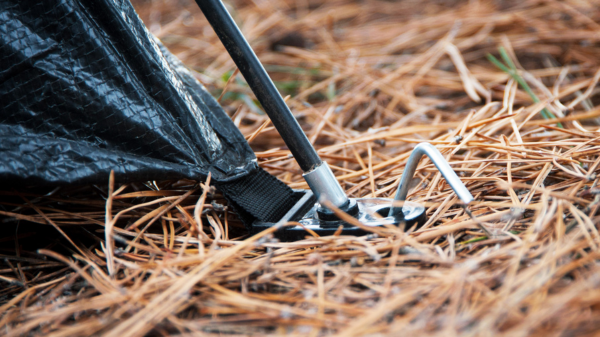
The 11th-century French Rabbi, Shlomo ben Meir (Rashbam, the grandson of Rashi), looked at this verse and provided us with a beautiful image we might hold in mind about what it might look like for us to practice emunah, to be trustworthy, and what the results may be for the confidence we engender in our relationships. He said, “Trusted, ne’eman, in the verse, means steadfast and rooted every moment of the day. As the prophet Isaiah says (Isaiah 22:23), ‘I will affix him as a peg in a secure place – b’makom ne’eman.’ The peg stuck in strong ground will not easily fall.”

Our practice of emunah, meeting our commitments, showing up for others even when it is hard, unpleasant, or inconvenient, really being there for the people who need us, helps us be like a tent peg planted in firm ground, rooted, solid, unflagging, steadfast.

This image of a tent peg is instructive, for the peg moves with the soil even as it keeps the tent from toppling over. Far from conveying stubborn inflexibility, emunah entails being responsive to the terrain of our lives and relationships, in a way that holds us and others up. We may not be able to show up in this way every moment of the day, as Moses did. Day after day, providing the people with water and food, a new structure for their society through the Torah, a sense of safety, and an ongoing sense of God’s presence.

In our mindfulness practice, we can apply hitlamdut, non-judgmental curiosity, and grow more aware of the habits of heart and mind that hinder our ability to show up for others and for ourselves. We can notice our bechirah, our capacity and opportunity to choose a wise response informed by our innate emunah, trustworthiness. And we can allow the godly faithfulness to flow more easily through us, so that we show up more consistently, day by day.

Compassion (Kedoshim 5784)

Compassion (Kedoshim 5784)

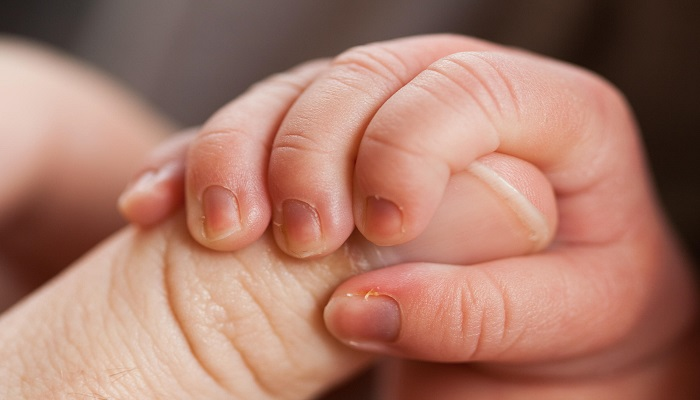
My sons never knew their maternal grandfather. I never knew him either. He died of a brain tumor while my wife Natalie was in college, which was before we met.

By all accounts Peter was a wonderful person. He loved chess and theater and active life outdoors. He loved his daughters and, no doubt, would have doted on his grandchildren. He was beloved by his extended family.

While all of that is good in and of itself, what makes it more remarkable is that my father-in-law was born in the Ukrainian forest in 1942 while his parents fought the Nazis in a brigade of Partisans. At one point, as an infant, he was hidden, found by the Germans, and left to die—only to survive miraculously when the soldiers either had compassion or didn’t want to waste a bullet on him. His father took the baby to a non-Jewish farmer and, at gunpoint, made him pledge to care for the child until after the war, which he did.

The family eventually made its way to Canada, where Peter grew up and made a life and met Natalie’s mother, whose parents found refuge in Israel following their own stories of imprisonment by the Russians during the war before eventually moving to Canada as well. Today Natalie, among other things, helps run a graduate degree program in Israel education. (Not to be outdone, her younger sister is currently the Canadian ambassador to Croatia, which during World War II was a puppet state of Nazi Germany and a collaborator in the Holocaust. Take that, Hitler.)

My own ancestors immigrated to the United States before the Shoah, and thus it was not the presence in my life growing up that it was for Natalie (and for many Canadian Jews of her generation). Israel, however, was and has remained a major part of my family’s story: my parents lived for a year in Israel with my older brothers before I was born; my eldest brother made aliyah after college and has been blessed with five children and two grandchildren; and I lived there for two years as a student, the latter of which was with Natalie when our eldest son was an infant.

This week, which began with Yom HaShoah (Holocaust Remembrance Day) and concludes with Yom HaZikaron (Israeli Memorial Day) and Yom HaAtzmaut (Israel Independence Day), is thus an important and meaningful one in my own life and that of my family, if for no other reason than that our own personal stories are so wrapped up in their larger narratives. A hair’s breadth, a single bullet, separates the existence of my wife and my three children from non-existence. For us, that miracle is on a level of the action of Pharaoh’s daughter to save the baby Moses from the Nile. One who saves one life saves, creates, sustains an entire world, entire worlds: a miracle.

I thus frequently wonder about that moment, when the Nazi soldiers stood over my father-in-law’s infant body: What was going through their minds? Was there an argument? Did some tiny modicum of compassion swim its way from their hearts to their heads to their hands? Did a still, small voice of the Divine speak into their ears and lead them to lower their weapons? I want to believe that some element of rachamim, some kind of mercy, was present in that instant—rachamim which is rechem, the womb in which life in all its manifold possibilities gestates and grows, even in a speck of an instant in the Ukrainian forest.

I do not have a political point with this message. If this story needs a point (does it?), perhaps it’s no more and no less than a call to compassion. As my wonderful French-Israeli colleague Rabba Mira Weil shared on our Daily Sit on Yom HaShoah this week (see especially her comments after the sit), compassion has been hard for many to feel in the wake of October 7 and the painful, devastating months that have followed. And it feels like so many hearts are only getting harder, the polarities growing stronger, the shouting getting louder, the space for rachamim—between Jews and other Jews, between Jews and Palestinians, between Jews and the rest of the world—shrinking and shrinking.

Parashat Kedoshim (Leviticus 19:1-20:27) that we read this week is the Torah’s clarion call to holiness, and so much of it is centered on awareness of and compassion for those who lack power and agency: not putting a stumbling block before the blind; not oppressing the stranger; leaving the gleanings of the harvest on the ground for the poor to take. These are all, in their way, expressions of rachamim, gestures of compassion that are the wellspring of holiness. In the words of a contemporary commentary on the Torah portion’s most famous line: “Love your neighbor as yourself—even when your neighbor isn’t like yourself” (which of course invites the question: who is really like or unlike any of us, and how do we make that judgment?).

This is the essence of a life of holiness, a life of Torah, and I would suggest it applies even when it’s hard—even, that is, when we need to have compassion on ourselves for not mustering as much compassion as we feel like we should. That’s where the Torah asks us to dig deeper, to try a little more, to yes treat ourselves with compassion—but also to not let ourselves off the hook from seeking to be compassionate. As Moses’s story illustrates, as my own family’s story illustrates, the entire world depends on it.

Josh’s Friday Reflections
FREE

Every Friday morning, IJS President & CEO Rabbi Josh Feigelson shares a short reflection on the week in preparation for Shabbat. Josh weaves together personal experience, mindfulness practice, and teachings from the weekly Torah portion in a uniquely accessible and powerful way. Sign up to receive Josh’s weekly reflections here.

  • This field is for validation purposes and should be left unchanged.
Camping Trip: Acharei Mot 5784

Camping Trip: Acharei Mot 5784

In recent days I feel like I’ve been living in a world suffused with the word camp. The encampments on college campuses, which are themselves reflective of ideological and political camps, have occupied our collective attention. As the parent of one student in college and another about to graduate high school, I have been following events with concern. As a scholar of the history of Jews and universities, I have been following them with keen interest. As an American Jew, I have been following them with a not inconsiderable dose of anxiety and worry.

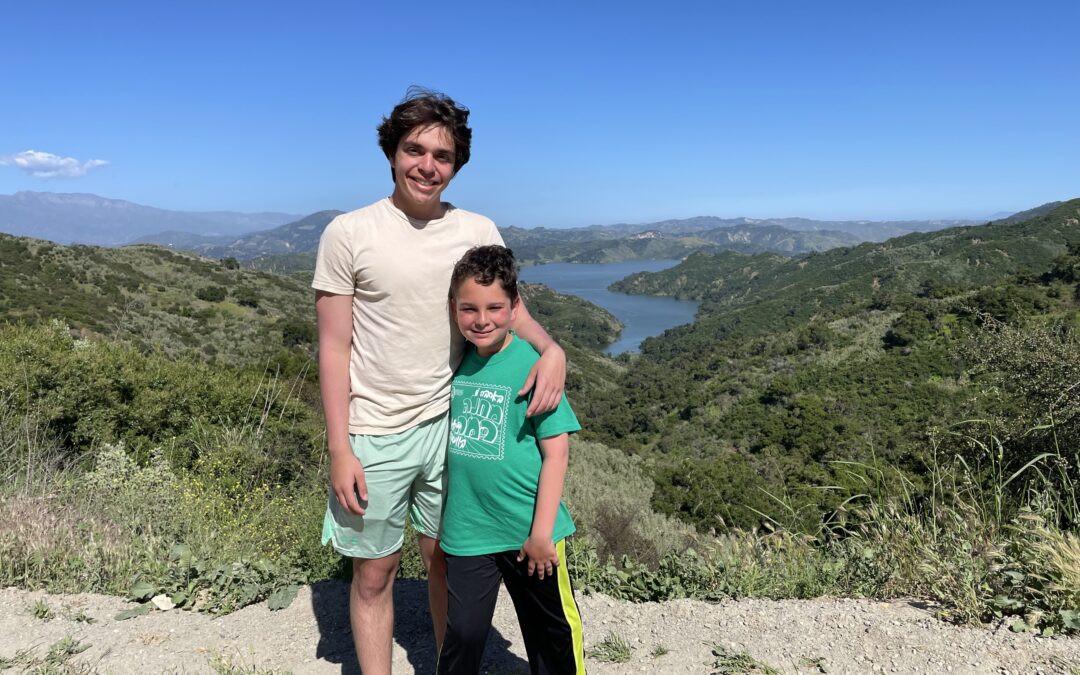
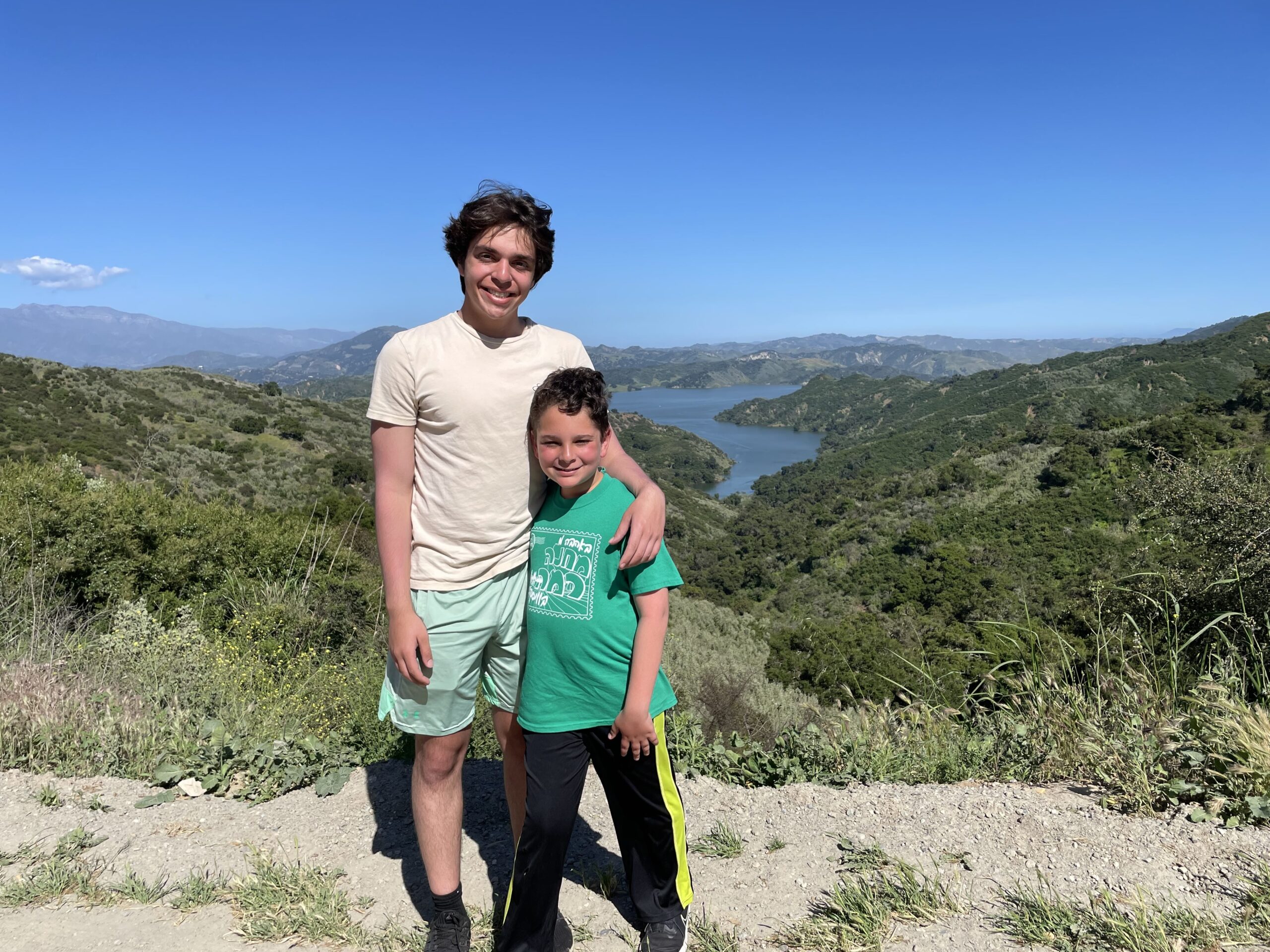
Yet, in what I’m choosing to believe is a not coincidental twist, the drama on so many campuses played out while my family and I were at a different kind of camp, namely the annual Passover experience at Camp Ramah in Ojai, California. For ten days, from the day before the holiday to the morning after it concluded, we ate and talked, prayed and sang, celebrated and studied with a wonderful group of nearly 200 Jews young and old in the sunny, warm, and breathtakingly beautiful setting of the mountains north of Ventura. In the spirit of Passover, I felt like I was liberating myself from email, social media, and news feeds as I reconnected with family, friends, the Jewish people, the natural world, and the Creator. It was an incredible blessing. (Picture is of my two younger sons overlooking Lake Casitas.)

Still, many of the sessions that I and other faculty members taught inevitably focused on the questions of the day: In Israel and Gaza, of course, but also the college campuses which have become so central to American Jewish life, and the more familiar terrain of our communities and our own minds and hearts. In particular, a question that seemed to pervade the whole week was some version of, How can we stay sane in this world that is enduring so much suffering? And how can we be mindful in the face of this constant firehose of information–some of which is true, much of which is false, and the totality of which is overwhelming?

Those questions offered me an opportunity to talk about the Jewish mindfulness practices I use in my own life to try to help, which include meditation, intentional consumption of media, Tikkun Middot practice when it comes to social media posting, setting app limits, and meeting sensations of judgment with curiosity rather than conviction (“Be curious, not furious,” as one participant put it). Our practices are designed for moments like these. They can help us sustain the habits of the heart we need to live and participate wisely and mindfully as members of a diverse democracy.

Because this year is a leap year on the Jewish calendar, we encounter the somewhat unusual situation in which the Torah portion for this week that immediately follows Passover is Acharei Mot, which is about Yom Kippur. We have barely put away the matzah and our attention is turned toward the opposite end of the year and our people’s other most important holiday.

The Torah describes Yom Kippur as a “Shabbat Shabbaton,” a day of complete rest (Lev. 16:31). Commenting on this verse, Rabbi Mordechai Yosef Leiner observes that the aim of the restrictions of Yom Kippur is to help us cultivate a profound sense of yishuv hada’at, a settled and clear mind, which is the essence of Shabbat. When we can do so, he writes, the flow (shefa) of the Holy One can fill us completely, without any limitation. We can be fully present–and can be vessels for the Divine Presence.

Of course, Yom Kippur represents this dynamic at its peak–a day on which we can be particularly and especially suffused with the presence of the Holy One. Yet the kind of presence and awareness–the yishuv hada’at, the settled and clear mind at its core–is available to us every week on Shabbat, and in every moment in the form of “Shabbat Mind.” It is reflected and embodied in speech and action that is full and mindful, not empty and reactive.

These qualities, of mindful presence and expansiveness, are also related to the central theme of Passover, the exodus from Egypt–the place of narrowness and constriction. Which suggests that, though these holidays are on opposite ends of our calendar, they are profoundly connected. Political freedom is not complete without spiritual freedom, and spiritual freedom is not whole without political freedom. As we continue to witness and engage in discussion, debate, and activism centered on political camps and encampments, my humble observation is that such work, wherever we stand in relation to it, will only benefit from greater yishuv hada’at–the spiritual practices of mind and heart that weave together our larger camp that exists within, between, and among us.

Josh’s Friday Reflections
FREE

Every Friday morning, IJS President & CEO Rabbi Josh Feigelson shares a short reflection on the week in preparation for Shabbat. Josh weaves together personal experience, mindfulness practice, and teachings from the weekly Torah portion in a uniquely accessible and powerful way. Sign up to receive Josh’s weekly reflections here.

  • This field is for validation purposes and should be left unchanged.