Jun 20, 2024 | Blog, Rabbi Josh Feigelson, PhD, President & CEO, Institute for Jewish Spirituality
A memory came up on Facebook the other day: a picture of a note from our youngest child three years ago after he arrived on the bus for his first experience as a camper at Camp Ramah in Wisconsin. It was brief, but it made my heart melt: “I’m having so much fun! Toby.”
Summer camp is a multigenerational through line in my family history. My grandfather went to Camp Tonkawa with the Boy Scouts in Minnesota a century ago. My parents met while working on staff at Camp Tamarack in southeastern Michigan. I went to Camp Ramah in Canada, Interlochen Arts Camp, and Wright’s Lake Scout Camp as a kid. And beginning when our first-born was old enough to attend as a camper, Natalie and/or I have sung for our supper by working on the staff at Camp Ramah in Wisconsin–and our older kids have gone on to be counselors there too. Camp is a basic fact of life for us.
So this week marked something of our annual celebration, as the kids went off to camp again.
The report from our middle child, serving his first full summer on staff, is that the initial couple of days were hard–storming, norming, forming, as the old saying goes–but that his cabin is coming together. Because, of course, there is so much that goes into creating this community every year. Every camper and every staff member arrives at camp with a world of expectations, hopes, fears, joys, and anxieties, and they ultimately have to find a way to live together.
And what we witness year after year is that eventually, most of the time, they do. With patience, openness, honesty, care, love–and with shared projects to work on, shared songs to sing, shared dances to dance together, shared natural beauty to bask in–a disparate group of hundreds of young people becomes a community. For so many people, camp is a place where, as much as anywhere on earth, they experience not just community, but an awareness of the shechina, the divine presence.
There’s a short passage in Parashat Behaalotcha that has always fascinated me, Numbers 9:15-23. In poetic and, for the Torah, repetitious language, it describes how the attunement between the Israelites and the divine presence. It could be summarized simply by verse 18: “At YHVH’s command the Israelites broke camp, and at YHVH’s command they made camp: they remained encamped as long as the cloud dwelled over the mishkan.”
Among the many meaningful elements of this short passage is the repeated use of the words yachanu, “they camped,” and yishkon, “God dwelled.” By my count, camping is referenced six times (and mirrored by linsoa, journeying–the opposite of camping) while dwelling is mentioned ten times, including the mentions of the mishkan itself, the place of divine indwelling. Given that the Torah is normally quite economical in its prose, an efflorescence like this is an invitation to interpret.
Perhaps an interpretation can be found in another phrase that recurs in this passage over and over: “al pi YHVH,” by the word of the Ineffable One. During their time in the wilderness, the Israelites would break camp and make camp repeatedly. And according to this passage, each time they made camp, the divine presence would come to rest in their midst–until the divine gestured to them that it was time to move again. What the passage describes is a profound attunement–between the collective, its constituent individuals, and the divine presence.
It is, perhaps, an ideal (notably, the first time the root SH-K-N is used in the Torah comes in Genesis 3:24: “the Divine stationed [vayashken] two cherubs east of Eden” after human beings were sent out from the Garden of Eden). And it may feel particularly far away these days, this vision of sacred attunement on not only a personal, but a collective level.
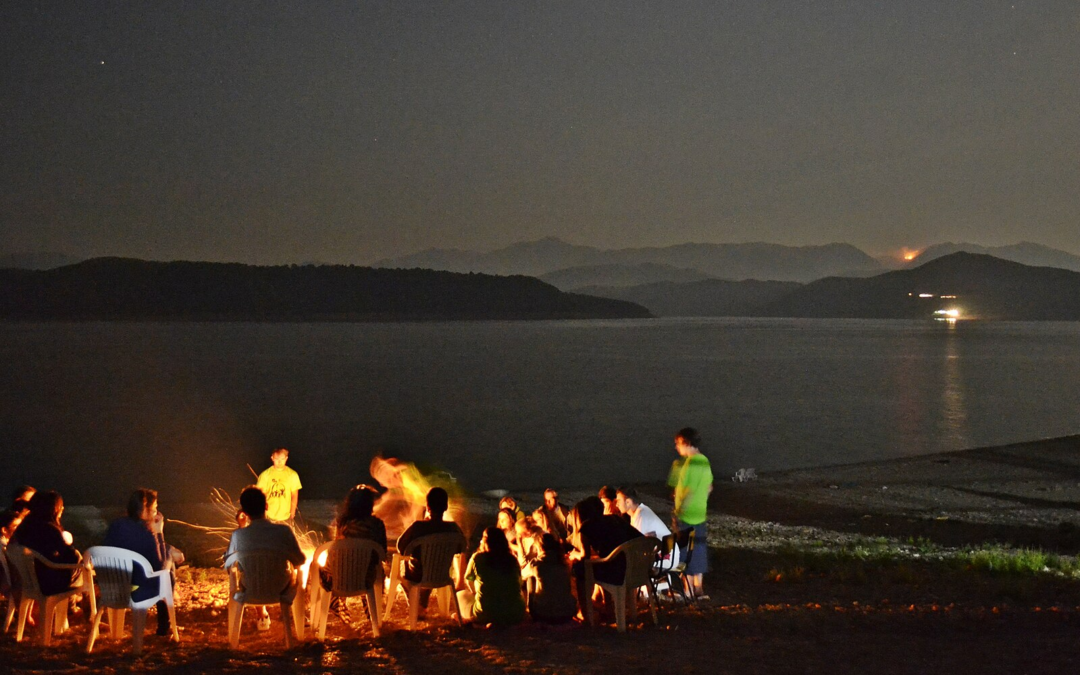
Yet I think there’s a reason why so many Jews keep coming back to camp year after year. It isn’t only because, as my young son wrote, camp is so much fun. As anyone who has been to camp knows, camp isn’t always fun. But the process of making a community, of living in greater harmony with the rhythms of nature and the rhythms of Jewish life, of singing and praying and studying and dancing together, of negotiating relationships and learning how to live peacefully in community with one another–in all of that messy and beautiful work of making camp, we make a space to recognize the divine presence. For many people, camp is a place where we experience the attunement that is always possible–but that is uniquely available under the trees, by the lake, and around the campfire.

Jun 11, 2024 | Blog, by Rabbi Miriam Margles, Senior Core Faculty, Institute for Jewish Spirituality
Each time we take the Torah out of the ark in synagogue, chanting its verses in community, we are reenacting revelation at Mount Sinai. Though not nearly as dramatic as the Torah’s description of fire and smoke, thunder and lightning, a quaking mountain and a shofar blast growing louder and louder, our rituals of standing up on our feet as the ark is opened, witnessing as the scrolls are revealed, and bringing the Torah from the “mountain” of the raised bimah into the midst of all those gathered, enable us to evoke Sinai in the present moment.
On Shavuot (the festival celebrating the giving of the Torah, which begins this year in the evening of June 11th), we seek to inhabit the experience of Sinai even more fully as the very scene of revelation is read from the Torah, surrounding us with the images of flashing fire and the voice of God rumbling through the chanted Ten Commandments. On Shavuot, we seek to be present not only as witnesses to the powerful experience of the giving of the Torah, but to join our ancient Israelite kin in actively receiving Torah and opening ourselves to receive Divine Presence.
But in the biblical description of Matan Torah (the giving of the Torah) there is a disruption in the Israelites’ receptivity. Although they collectively call out “All that YHVH has spoken we shall do!”, actively taking hold of the commitment to live their lives in alignment with Divine will and sacred practice, at the very moment of direct Divine encounter, the Israelites sever connection. They become so gripped by fear, afraid that they will die if they remain present to the unfolding revelation, that they ‘stand at a distance.’ They plead with Moses to interrupt this intimate intensity and ask him to be their flesh and blood, familiar, human-scale intermediary.
I feel the loss that this reaction created. In the face of such potent, available closeness, the Israelites created distance. With Shavuot’s invitation to embody revelation, an approach of mindful spiritual practice invites us to both inhabit the deepest wisdom of our ancestors’ experience, as well as learning from and bringing tikkun/repair to our ancestors’ limitations. We can turn our attention to explore the question for ourselves – when does fear cause you to distance yourself from that which is intimate, sacred, powerful and true?
Revelation in its varied forms can be unsettling and stir fear. As Rabbi Gordon Tucker writes the embodiment of revelation “should cause us to tremble.” It “should penetrate one’s entire person, one’s entire body.” Whether in the close, revealing presence of another person, in a breathless, awe-opening moment in nature, in an unmasking and emptying experience of solitude or in prayerful surrender, the ego-gripped self can’t help but loosen. In such experiences, we get a glimpse of Divine reality – more vast and far more intimate in its awareness than the small self that we know, tethered to the comfort, stability and safety of its self-enclosure. It can be frightening to release the protective grasp on our sense of self. It can be frightening to feel all that this demands of us – holding us in the commitment to show up again and again – enlivened, open and connected – not retreating back into a contracted way of being, not going back to sleep.
In the liturgy of the Torah service, there is guidance to practice meeting the fears that revelation’s intimacy stirs. And while these words are part of every Torah service, I want to engage with them as a practice particularly for Shavuot:
Just before Torah reading begins, as the first person is called up to the Torah for an aliyah, the gabbai recites, “May Divine Presence help, protect and save all who trust in You…” And the community responds – “Ve’atem ha’dvekim b’YHVH Eloheykhem chayyim kulkhem hayom/You who cling to YHVH your God, are all alive today.”
First we are invited to consciously root ourselves in the qualities of Divine protection and support, present in our bodies, souls and breath, present in community, present in the ancestral strength and love that reverberate through us and through prayer, ritual and Torah. When we take these few words as instructions, we practice leaning into trust and the power that saves us and holds us. Then the community responds together by consciously, deliberately, drawing close. In our voices and our presence with one another, we mirror to each other that which is true – “You who are dvekim” – you who keep moving closer, who attach yourselves to Limitless Presence, who cling to intimate connection even when you are afraid – you are alive today! As we stand together at the foot of Sinai, ready to receive living, breathing, ever-unfolding revelation, we have the opportunity to repair the distance that fear can engender. We practice becoming dvekim, those who choose to consciously, lovingly, bravely draw close.
Chag same’ach!

Jun 11, 2024 | Blog, by Rabbi Sam Feinsmith, Senior Core Faculty, Institute for Jewish Spirituality
According to the Torah (Exodus 19), the Jewish people perceive the Divine Voice amidst a loud cacophony of thunder, lighting, and quaking ground. But I Kings (chapter 19) offers a different model of receiving revelation: the prophet Elijah experiences the Voice not in the tumult of wind, fire, or earthquake, but rather in a kol demamah dakah, the “still, small voice” – a practice each of us can emulate as we move towards the holiday of Shavuot, the holiday commemorating the revelation of the Ten Commandments at Sinai
Join IJS Senior Core Faculty member Rabbi Sam Feinsmith for a short meditation on listening for the kol demamah dakah, the “still, small voice” of the Divine, which we can perceive when we are able to cultivate a state of external and internal stillness.
Click Here to Practice with Rabbi Sam Feinsmith
This short meditation is excerpted from a longer teaching Rabbi Feinsmith offered in the days leading up to Shavuot in 2021 – one of a series of five consecutive sessions he led on “Standing (or Sitting!) at Sinai, Here and Now” on the IJS Daily Sit. Click here for the source sheet Rabbi Feinsmith created for the session.
For the complete teaching and practice, click here; for the full YouTube playlist for this five session series, click here.

Jun 6, 2024 | Blog, Rabbi Josh Feigelson, PhD, President & CEO, Institute for Jewish Spirituality
Peter Salovey, who is stepping down this month as president of my alma mater, Yale University, was my freshman psychology teacher thirty years ago. The course was popular. Hundreds of students took it.
Salovey was always quick with a joke. Before the final, I remember him telling us the story of a huge lecture hall full of students writing their exams, much like the one we were about to take. As time is winding down, a handful of students are finishing up. “Ten minutes left,” the professor calls out. A few finish and hand in their exam books. “Five minutes.” More finish. “One minute.” At this point, a single student is the last one writing–and he’s still going at a feverish pace.
“Time’s up, pencils down,” the professor calls. The student is still writing.
The professor shrugs, picks up the pile of exam books, and starts heading to the door. As she passes the student she says, “Last chance.” Still writing. The professor walks to the door of the lecture hall and the student races up to her. “Sorry,” she says, “you missed your chance.”
“Do you know who I am?” the student asks.
“What do you mean, do you know who I am?” the professor responds. “You went beyond time.”
“Do you know who I am?” the student asks again, more stridently.
“Look kid, I don’t care who your parents are or how important you think you are–the same rules apply to everyone.”
“Do you know who I am?” the student asks one more time.
“No,” she says.
At that, the student lifts up the pile of exam books in the professor’s arms, stuffs his in the middle of it, and races out of the room before she can figure out which exam book was his.
Professor Salovey told this story to ease some tension in the room before our final exam, but of course it reflects a deeper truth: We can often find ourselves in big, bureaucratic systems that render us nameless and faceless. And while those systems can sometimes provide advantages, they can also come at a cost. The advantages can include economies of scale, providing many more people access to valuable knowledge and experiences at an affordable rate. The disadvantages can include a lack of intimacy, a thinning of communal bonds, and ultimately both the capacity for and willingness to engage in abuse of the system.
The Book of Numbers, which we begin reading this week, marks an inflection point in the Torah. It is a book of generational transition, as the generation of the exodus dies out and the next generations come of age. And, with its multiple countings of the Israelites, the feeling tone of the more intimate stories of Genesis and at least early Exodus finally and fully gives way to a much larger, more corporate sense of a nation ready to assume the responsibilities of self-governance in the promised land.
Instructing Moses to take a census, the Holy One uses a fascinating phrase: Moses is not to count the people simply according to their number, but instead b’mispar shemot, the “number of their names” (Num. 1:2). The 16th century Italian commentator Rabbi Ovadiah Sforno observes that this unusual formulation suggests “the names of the individuals reflected their specific individuality, in recognition of their individual virtues.” This census simultaneously took cognizance of both the numerical scope of the people and each person’s uniqueness–an unusual kind of counting.
There would seem to be a connection between this kind of counting and the counting we do in mindfulness practice: Not simply logging minutes of practice, but aiming to be aware and attentive in each moment as it arises, present to the uniqueness of this particular time, place, and experience. That kind of practice can help us see our lives and those of other beings more fully. It can help us to humanize other people, avoid instrumentalizing them or relating to them as numbers without names–but instead to live with the awareness that every person has a name and a story. As so many forces in our world push us toward namelessness, facelessness, and dehumanization, this is a teaching we need to learn and practice again and again.

May 30, 2024 | Blog, Rabbi Josh Feigelson, PhD, President & CEO, Institute for Jewish Spirituality
On my podcast this week, I shared a bit about my recent struggle to walk our dog, Phoebe, in the midst of all the cicadas that now line the sidewalks of our neighborhood. (Folks, the cicada invasion is real, and it’s here, at least in Illinois.) While it’s okay for her to eat a number of them, too many could cause her to have stomach issues.
We’ve tried a muzzle (she hated it and got it off). We’ve tried the cone of shame (she outsmarted it). So where we’re at now is that I just have to hold the leash pretty tight when we’re walking, and I kind of yank her every time we approach a cicada. It seems to be working alright, but it makes for an unpleasant walk for her and a tired arm for me. But so far, so good: No major digestive issues to speak of, just a dog who is very eager to go in the backyard as much as possible (where there are many more cicadas).
I’m finding that, in its own way, the whole episode reflects a lot about the relationship my family and I have with Torah and Jewish mindfulness. First and foremost, we take the health of this creature of ours seriously. “V’chai bahem–v’lo yamutu,” as the Talmud comments on Leviticus 18:5: The Torah is meant to be lived by and not died by. (The interpretation is offered as a proof that we violate almost every prohibition in the Torah to save a human life.) So we approach the question of what to do about Phoebe and the cicadas with the value that her life matters. (The cicadas’ lives matter too, but… priorities. And common sense.)
Further, we’ve approached this question in a way that also asks about what is doable and practical. Can we completely shield Phoebe from the cicadas, just leaving her inside? No, that would harm other parts of her health and wellbeing–and ours! Could we create or buy some kind of robotic device that would walk ahead of us and vacuum up the sidewalk in advance? (Note to the Roomba people: This idea has potential. You heard it here first.) Again: impractical, cost prohibitive. As my teacher Rabbi Yitz Greenberg observes, God’s covenants with the world and the Jewish people are intended to operate on a human scale and pace–in ways that are achievable. So we’re looking for solutions that have some chance of implementation.
The basic motivating impulse here is to find a solution, to literally walk our talk. We espouse and hold dear some extraordinary values–honoring and sanctifying life, enabling the divine presence to be made manifest in the world in every action, every step. So, like our tradition, we take the ethical and practical questions seriously. That, in a nutshell, is halakha–often translated as “Jewish law,” but perhaps more fully and even literally rendered as “the way Jews walk in the world” (halakha which comes from the same root as the verb lalekhet, to walk).
A couple weeks ago I read a poem in The New Yorker by Ocean Vuong called “Theology.” It contained this line:
I thought gravity was a law, which meant it could be broken.
But it’s more like a language. Once you’re in it
you never get out.
Vuong’s words have been ringing in my ears since because I think they capture this challenge of understanding halakha so well: While at one point in my life I related to it as law–imposed by some external force, operating under the threat of punishment–as I’ve gotten older it has become much more like a language, operating in a more fluid zone of culture, explicitly and implicitly negotiated meanings, intertextualities and connections. It still has to make sense–languages have to make sense–but as language, halakha has a great deal more expressiveness and suppleness than when it’s understood only as law.
Concluding the halakha-rich book of Leviticus, Parashat Bechukotai begins with the words “If you walk in my ways.” Commenting a little later on the verse, “I will walk in your midst: I will be your God, and you shall be My people” (Lev. 26:12), Rashi picks up on the linguistic connection to the primordial image of the Divine walking in the Garden of Eden (Genesis 3:8) and interprets: “I will, as it were, walk with you in the Garden of Eden as though I were one of you, and you will not be frightened of Me.”
That’s the goal and the promise of our halakha: If we can act in the world in ways that are mindful, aligned with the covenantal values of the Torah, compassionate, present, loving, and attentive, then we reveal the Divine presence that is here walking with us. We discover that this world can indeed–even now–be a redeemed Eden. That’s what it’s really all about, even and perhaps especially when the obstacles to sensing that possibility are greatest.
Every Friday morning, IJS President & CEO Rabbi Josh Feigelson shares a short reflection on the week in preparation for Shabbat. Josh weaves together personal experience, mindfulness practice, and teachings from the weekly Torah portion in a uniquely accessible and powerful way. Sign up to receive Josh’s weekly reflections here.

May 24, 2024 | Blog, Rabbi Josh Feigelson, PhD, President & CEO, Institute for Jewish Spirituality
The last couple of weeks have been one of those moments when I pinch myself and ask, “Really, I get paid to do this?!” Because over the last two weeks, I have spent a total of eight days on IJS retreats–first for our Sustainers Circle and, this week, for our staff, both of which are extraordinary groups of people. My days have been filled with reflection, thoughtful conversation, study, and a lot of laughter–all things that I dreamed 25 years ago would describe the work I would do as a rabbi. It’s an extraordinary blessing and privilege.
We held both of these retreats at Trinity Retreat Center, a beautiful place on the Housatonic River in northwest Connecticut. IJS has a long history with Trinity–it’s among the retreat centers we regularly go to. The staff is extraordinarily welcoming. They eagerly accommodate our requests about kashrut and Shabbat. On a retreat last October for our Kol Dodi program, the Episcopal priest at the center, Rev. Dr. Mark Bozzuti-Jones, welcomed our group and spoke movingly about how important it was for him to welcome us because of the pain he knew our people were in after the massacre of October 7. There were tears.
During our staff retreat this week, my colleague Rabbi Myriam Klotz led a session on sacred listening, an area we’re really developing at IJS. The essence of sacred listening is practicing a form of mindfulness that’s relational: sitting with another person with presence and intention, giving them your full attention, being aware of what arises within you as you listen and making the mindful choice to continue listening non-judgmentally. In the session Myriam led, we each sat with a partner for three minutes and listened to them speak. At the end of those three minutes, we summarized–without editorializing–what they said. For the listener, it’s hard work to listen in that way without forming judgments or thinking about what to say. For the speaker, it’s usually a gift to feel heard and acknowledged. (Important side note: I’ll actually be teaching an online course on sacred listening with Myriam and Rebecca Schisler beginning June 23. You can register here.)
The speaking prompt in this exercise was Ayeka, Where are you?, in a spiritual sense. When it was my turn, what I found arising for me were questions about at-homeness. I noticed the feeling I experienced of being at Trinity: an exceptionally welcome guest–but also not at home in quite the same way I do on retreats at Jewish retreat centers. I perceived sensations having to do with translating our language and practices–acts which I find both exciting and also, in some cases, a little tiring. I observed how subtle these sensations could be: not categorical statements, but little movements in my mind, heart, and body. And I found those sensations pinging deeper registers of at-homeness and guestness in my life, most significantly in relation to Israel and America, the tonic and dominant chords of this key in my life.
“When you enter the land,” God tells the Israelites at the beginning of parashat Behar, “the land shall observe a Shabbat to YHVH.” From there the Torah elaborates the practice of the Sabbatical year, the paradigmatic case of a mitzvah that is observed only in the land of Israel. While the agricultural and economic practices associated with the Sabbatical year have deep spiritual meaning, and have even been adopted voluntarily by some Diaspora Jewish farmers in recent years, in halakhic or Jewish legal terms, they do not apply outside the Holy Land.
It’s one of the phenomenal features of Jewish life: We have significant practices that, for the centuries and millennia of our Diaspora experience, a majority of Jews experienced only in their imaginations, not their bodies. And it’s one of the amazing features of the Jewish people’s mass return to the land of Israel in recent centuries: the widespread reclamation and renewal of these ancient practices, not only in our imaginations, but in our bodies and on the earth.
Teaching in the eastern Europe of the 18th century, the Ba’al Shem Tov interpreted this opening line of Behar as referring not (only) to the Land of Israel, but to the body: “‘The land shall keep a Sabbath to YHVH:’ This means to bring rest and relaxation to the land, which is the body, and to rejoice over physical pleasures. Through this, the soul can rejoice spiritually. This is ‘a Sabbath to YHVH,’ for you need both these aspects on the Shabbat.” (Toldot Yaakov Yosef Behar) As happens frequently in Hasidut, the Besh”t here excavates the spiritual dimensions of the mitzvah alongside its physical ones. The Shabbat of the land becomes not only a legal or physical requirement for the land, but an invitation to a spiritual consciousness we can cultivate all the time.
Which brings us back to the question of at-homeness and guestness. Our spirituality is our capacity to experience being deeply, profoundly at home in the world. That is tied up with large, tectonic questions of place and culture: the ability not to have to translate; the sense that we are really in our place and with our people. But/and, that at-homeness takes place on a very intimate level at the same time, in the space of our minds, hearts, and bodies. Shabbat and the Sabbatical Year–our built-in Jewish retreats–are our regular invitations to sense that we and the Holy One are not guests in the world, but are, together, deeply and profoundly at home with one another.
Every Friday morning, IJS President & CEO Rabbi Josh Feigelson shares a short reflection on the week in preparation for Shabbat. Josh weaves together personal experience, mindfulness practice, and teachings from the weekly Torah portion in a uniquely accessible and powerful way. Sign up to receive Josh’s weekly reflections here.