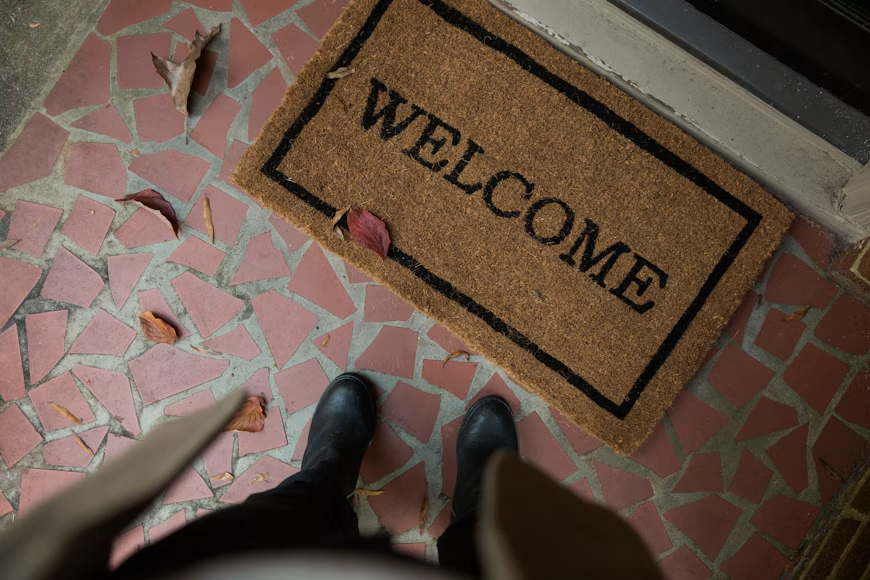
Just Know You’re Not Alone (Vayetzei 5787)

Just Know You’re Not Alone (Vayetzei 5787)

Like me, it’s possible you’re not a regular viewer of American Idol or the broader genre of mass media talent shows of the last couple decades. But if you’ve shopped in a supermarket or seen a television commercial, you’ve undoubtedly heard some of the products of these shows. Whether it’s Kelly Clarkson’s “A Moment Like This” playing over a grocery store PA or Grace VanderWaal’s “I Don’t Know My Name” soundtracked to a lifestyle ad, these songs have become a part of the collective background music of society.

Perhaps the biggest of these hits was Phillip Phillips’s “Home,” which became an instant classic as soon as it debuted live on the finale of American Idol in 2012. It went on to be the best-selling Idol ‘coronation’ song of all time, heavily featured in NBC’s 2012 Olympics coverage, movie trailers, insurance commercials, and pretty much every bar-, bat-, and b-mitzvah montage video of the last 14 years.


The key line of the song, repeated in both the initial verse and the chorus, is this:

Just know you’re not alone

‘Cause I’m gonna make this place your home

Home in this song is not any particular place. Rather it’s a place someone else makes for us (though that doesn’t preclude that we can make it for ourselves too). And the key element of home for Phillips is being aware that we’re not alone, that instead we are connected, supported, held, embraced, seen, heard, valued. “Don’t pay no mind to the demons, they fill you with fear,” he cautions. “The trouble, it might drag you down.” But “if you get lost you can always be found.” Just know you’re not alone—and then you can catch a glimmer that you’re not in danger, but in fact you are either at home or on your way back to it. “‘Cause I’m gonna make this place your home.”

“Home” is a travel song. “Hold on to me as we go,” it opens, “as we roll down this unfamiliar road.” Which connects it to the American folk tradition of travel songs like Woody Guthrie’s “This Land Is Your Land” or Paul Simon’s “America,” but also to the deeper sense of fluidity and motion that characterizes so much of contemporary life. Perhaps that’s why it struck such a deep nerve (and sold so many copies): In an era when our notion of home has been profoundly destabilized, Phillips sings of a sense of at-homeness we can tap into—even as our inner demons fill us with fear.

While I might suggest that most if not every Torah portion invites a reflection on home, Parashat Vayetzei might offer the clearest. Jacob is the first young adult we witness doing the key developmental task of young adulthood: leaving his childhood home to make a home of his own. Fittingly, the word bayit, house or home, occurs four times in Gen. 28:10-22: three times in reference to the “Home of God,” and once when Jacob imagines returning safely to beit avi, “my father’s house”—a signifier that he remains rooted and connected to his origins even as he sets out on a journey of discovery and becoming.

Yet this first section of the Torah portion invites us into deeper layers of reflection on the experience of home, particularly in the ambiguity of a word repeated six times in this same section: makom, place. The midrash understands the place where Jacob comes to rest as the Temple Mount, the site of the future Beit Hamikdash. Yet it is also a place in which Jacob himself seems to come to ground, to find his own place, to feel at least a bit at home on this long journey through the night.

To borrow from Phillip Phillips, we might ask, what does it take to make a place into a home—a home for us and a home for the Divine?

“He encountered (vayifga) the place…” (Gen. 28:11) Rashi comments: “Our Rabbis explained this as an expression of prayer, as in ‘and do not entreat (tifga) Me’ (Jeremiah 7:16), and from this we learn that he instituted the evening prayer. But Scripture altered its wording and did not write ‘and he prayed’ in order to teach you that the earth contracted for him.” That is, the Divine uprooted Mount Moriah from its place and brought it to Jacob.

The Sefat Emet asks a question on Rashi: How is contraction of the earth related to the institution of the evening prayer? He answers: “According to a person’s will, they can awaken the holiness of the Blessed Name in every single place. This is what Rashi means: Because our ancestor Jacob possessed a powerful will to come to Mount Moriah, even though he was very far away, Mount Moriah leapt to him.”

He continues: “This is the meaning of the evening prayer: In a time of darkness, there is no natural place for light to be revealed. Rather, only through an extraordinary will is illumination awakened in a manner beyond the natural order—for everything depends upon human will. And this is the meaning of: ‘to teach you that the earth contracted for him.’ This is to teach us that there is no place where one cannot experience inner illumination through honest effort.”

Is this feeling at home? In some senses, yes. If at-homeness is a condition of feeling connected to our roots, and if those roots are most deeply felt in the experience of inner illumination with its light and warmth, then we don’t need to be in the physical place we associate with home in order to feel deeply at home. We can experience a sense of at-homeness in our lives, in the universe, wherever we are. That, in so many words, is what the Sefat Emet teaches is the essential experience of genuine prayer.

On the other hand, it’s after Jacob has this experience that he makes a vow to God that includes a divine promise to bring him back to his father’s house. Likewise, the Midrashic tradition makes much of Jacob’s leaving the land of Israel and associates the return to beit avi, Isaac’s house, with a return to the homeland. This suggests that home and at-homeness might be two different things. Perhaps we don’t have to let go of a physical notion of home—a place of safety, familiarity, rootedness—in order to recognize that we can also experience being-at-home even when we’re on the road.

“God was in this place, v’anochi lo yadati, and I didn’t know,” Jacob famously says. Thus perhaps the point is to know, to be aware that connection is always possible, that the light is there inside. Just know you’re not alone and you can make this place your home.

For Reflection & Conversation

Have you ever had an experience of feeling alone or disconnected on a journey and then experiencing a sense of welcome or at-homeness? What about you enabled that experience to occur? What, if anything, did others do to help make it happen?
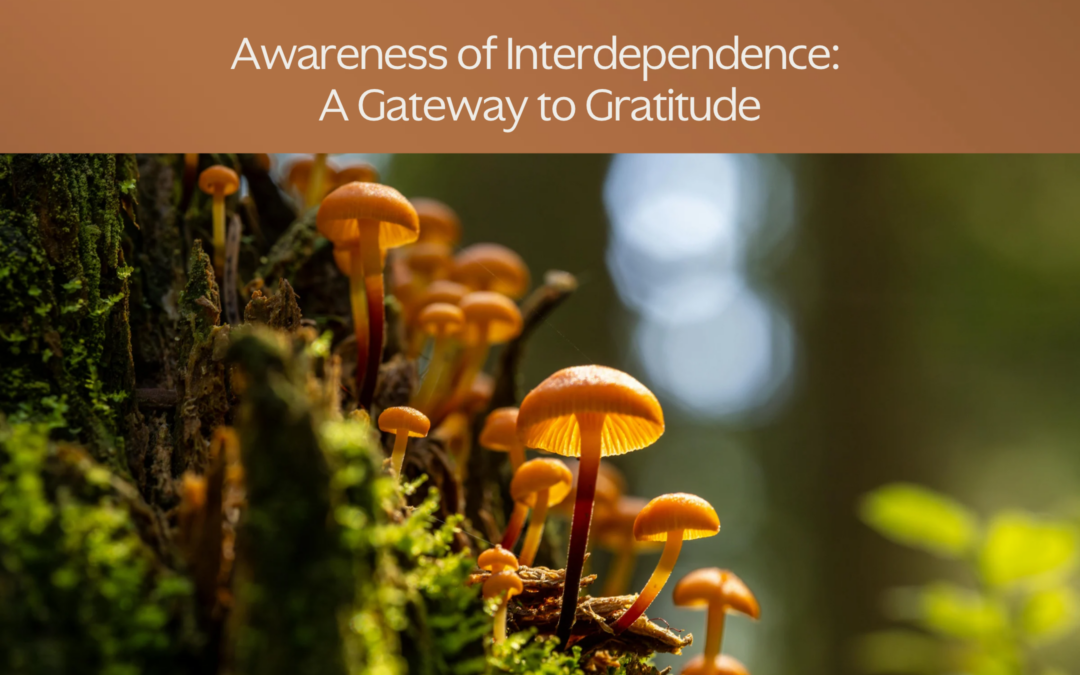
Awareness of Interdependence: a Gateway to Gratitude by Rabbi Sam Feinsmith

Awareness of Interdependence: a Gateway to Gratitude by Rabbi Sam Feinsmith

I find it instructive that the Hebrew word for gratitude, hodayah (הֺודָיָה), shares the same three-letter stem as the word for admission or acknowledgment, hoda’ah (הֺודָאָה): Yud-Dalet-Heh (י-ד-ה). In the Jewish liturgical writings, the term hoda’ah often denotes admission of our dependence on divine grace.

Concrete illustrations of this claim can be found in the Modeh Ani prayer for morning waking and the Modim prayer, the penultimate blessing of the Amidah (Silent Prayer):

Modeh Ani
מוֹדֶה אֲנִי לְפָנֶיךָ מֶלֶךְ חַי וְקַיָּם שֶׁהֶחֱזַרְתָּ בִּי נִשְׁמָתִי בְּחֶמְלָה, רַבָּה אֱמוּנָתֶךָ.

I admit (modeh) in Your presence, living and eternal Majesty, that You have returned my soul (read: consciousness) to me with compassion, abundant is Your trustworthiness.

Modim
… נוֹדֶה לְּךָ וּנְסַפֵּר תְּהִלָּתֶךָ עַל־חַיֵּינוּ הַמְּסוּרִים בְּיָדֶךָ וְעַל נִשְׁמוֹתֵינוּ הַפְּקוּדוֹת לָךְ וְעַל נִסֶּיךָ שֶׁבְּכָל יוֹם עִמָּנוּ וְעַל נִפְלְאוֹתֶיךָ וְטוֹבוֹתֶיךָ שֶׁבְּכָל עֵת עֶרֶב וַבֹקֶר וְצָהֳרָיִם הַטּוֹב כִּי לֹא כָלוּ רַחֲמֶיךָ וְהַמְרַחֵם כִּי לֹא תַמּוּ חֲסָדֶיךָ מֵעוֹלָם קִוִּינוּ לָךְ.

We acknowledge (modim) You and recount Your praise—for our lives, which are entrusted into Your hand, for our souls, which are deposited with You, for Your miracles that are with us every single day, and for Your wonders and goodness at every moment—evening, morning, and afternoon; You are the Good, for Your compassion never ceases, and You are the Compassionate, for Your kindness is neverending, and from of old, we have placed our hope in You.

In this light, perhaps we can understand hoda’ah (admission) as a set of mindful instructions for cultivating gratitude, hodayah. By recognizing and acknowledging our dependence on forces much larger than ourselves, we may be able to release the ego’s posture of self-sufficiency more readily and experience a spontaneous awakening to gratitude.

Why must we affirm our interdependence daily as a spiritual practice? Because it is all too easy to take the wondrous forces that sustain our lives for granted. Without intentional practice, our awareness of these underlying conditions fades into the background of daily life. Consider this teaching from the Hasidic teacher Rabbi Yaakov Aryeh of Radzymin (1792-1874, Poland; translation by my teacher and friend Rabbi Jonathan Slater):
מִדְרָשׁ: “‘אֶל מִי תְדַמְיוּנִי וְאֶשְׁוֶה’ (שְׁמוֹת רַבָּה מח:ב)—בָּשָׂר וָדָם, אִם מַהֲלֵךְ בָּאֲפֵלָה וְיָבֹא אָדָם וְיַדְלִיק לוֹ נֵר, צָרִיךְ לְהַחֲזִיק לוֹ טוֹבָה. כָּל שֶׁכֵּן שֶׁצָּרִיךְ לְהַחֲזִיק טוֹבָה לַהַשֵּׁם יִתְבָּרַךְ, שֶׁמַּעֲלֶה בַּבֹּקֶר אוֹר הַשֶּׁמֶשׁ…”
וְזֶהוּ “וְאֶל מִי תְדַמְיוּנִי וְאֶשְׁוֶה”, כִּי צָרִיךְ אָדָם לִהְיוֹת לוֹ הַכְנָעָה מַחֲמַת זֶה, וְלַעֲשׂוֹת תְּשׁוּבָה מַחֲמַת שֶׁבְּכָל יוֹם וָיוֹם קָם בַּבֹּקֶר וְהַשֶּׁמֶשׁ זוֹרֵחַ, וְאֵינוֹ נוֹפֵל בְּדַעְתּוֹ כְּלָל לִרְאוֹת: מִי הֵכִין לוֹ שֶׁמֶשׁ לִיזְרֹחַ שֶׁיְּהֵא אוֹר לוֹ? שֶׁזֶּהוּ מִן הַשֵּׁם יִתְבָּרַךְ, וּלְשַׁבֵּחַ אוֹתוֹ בְּעַד זֶה.
וְכָךְ יַחְשֹׁב: “אִם אָדָם עוֹשֶׂה לוֹ טוֹבָה לְהַדְלִיק לוֹ נֵר בָּאֲפֵלָה, כַּמָּה אֲנִי מַחֲזִיק לוֹ טוֹבָה—כָּל שֶׁכֵּן שֶׁצָּרִיךְ לְשַׁבֵּחַ לַבּוֹרֵא בְּעַד זֶה?”
וְצָרִיךְ לַעֲשׂוֹת תְּשׁוּבָה בְּעַד כָּל יוֹם וָיוֹם שֶׁלֹּא הָיָה מְשַׁבֵּחַ לַבּוֹרֵא בְּעַד הַאָרַת הַשֶּׁמֶשׁ…, וְיַחְשֹׁב כַּמָּה יָמִים עָבְרוּ וְלֹא הֶחֱזִיק טוֹבָה לַהַשֵּׁם יִתְבָּרַךְ. וְכֵן בְּעַד כָּל הַטּוֹבוֹת צָרִיךְ לְהַחֲזִיק טוֹבָה לַהַשֵּׁם יִתְבָּרַךְ.

Consider the midrash (Ex. Rabbah 48:2): “To whom, then, can you liken Me, to whom can I be compared?” (Isa. 40:25). If we are walking in darkness and another comes along and lights a lamp for us, should we not be beholden to thank them? Is it not more the case that we are beholden to thank God who raises the light of the sun each morning?

So must we be humbled by this teaching and do teshuvah, for each and every day the sun shines and it never occurs to us to think “Who prepared this sun to shine so that I will have light in my life?” We ignore that it is God who provides it and that we should praise God for it.

We should think: if another person did me a favor and lit a light for me in the darkness, how much would I be grateful to them – and so how much more should I praise the Creator for this?

And so we should do teshuvah for each and every day that we did not praise the Creator for the light of the sun… and similarly, we should think how many days have passed with each of their blessings, yet we have not thanked God for each and every one of them.

This text invites a kind of mindfulness in which we build our capacity to notice, acknowledge, and appreciate whatever sustains us in this moment. The sun rising to warm the earth. The steady rhythm of this breath and the next. The vast network of human labor and ecology—from living soil and rain to the hands that plant, harvest, and transport whatever nourishment we receive. The shelter, warmth, or care that may hold us. The moments of connection with others, near or far. And so much more.

When we return to prayers like Modeh Ani or Modim with this sensibility, they cease to be routine recitations. Instead they can become precise instructions for presence—daily invitations to bow before the miraculous causes and conditions carrying our lives. By training our hearts and minds to notice the continuous grace surrounding us, our daily acknowledgment becomes a lived, embodied expression of gratitude.

Thanksgiving may afford us a day to pause and acknowledge our good fortune. The Jewish spiritual practice of cultivating hoda’ah invites us to consider how we might weave that admission into the fabric of our daily lives, year in and year out, so we might live with deepened gratitude and appreciation.

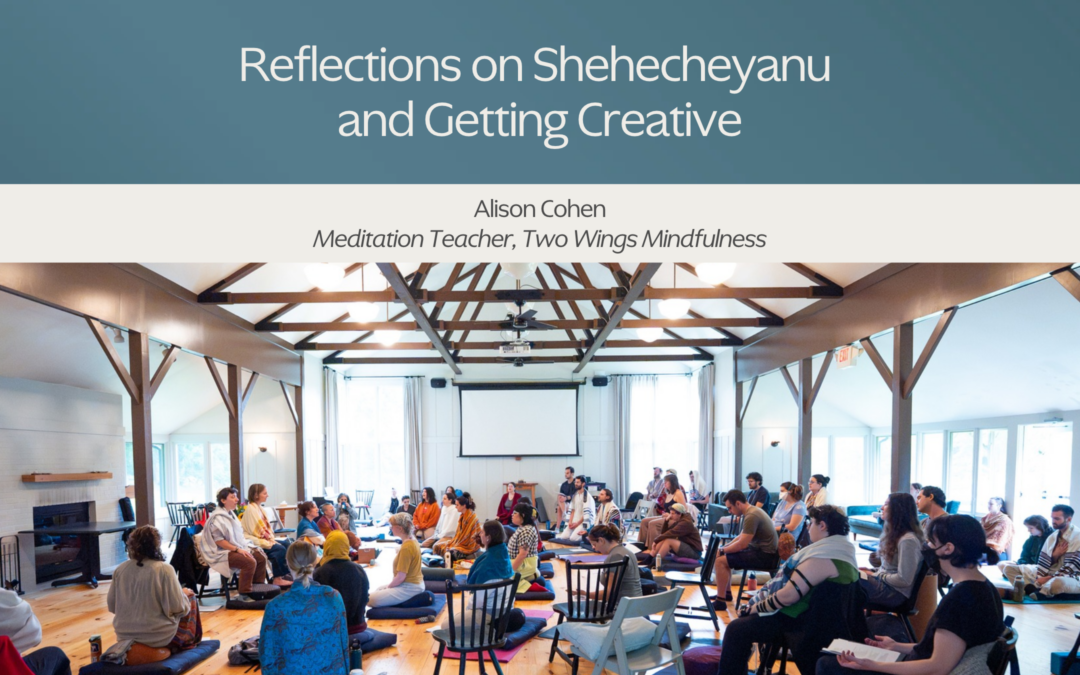
Reflections on Shehecheyanu and Getting Creative by Alison Cohen

Reflections on Shehecheyanu and Getting Creative by Alison Cohen

A few years ago, I purchased a piece of art because it resonated with my soul. That print hangs in my living room now, and it features the Shehecheyanu blessing, the sacred sentence that encourages us to bring awareness to firsts, to sanctify special moments in our lives through acknowledgment, humility, and joy. Since this is my first time contributing to the IJS newsletter, it feels especially sweet to chant the Shecheyanu right now:

Baruch atah, Adonai Eloheinu, Melech haolam, shehecheyanu, v’kiy’manu, v’higiyanu laz’man hazeh. Blessed are You, the Ineffable One, who has kept us alive, sustained us, and brought us to this moment.

Last month, members of IJS’s Young Adult Mindfulness Community, Shevet, came together for an online daylong retreat. It was such a blessing to teach it – that’s an understatement – and as we meditated together, sang together, and compassionately listened to each other’s reflections, most if not all of us realized that this was the first Jewish mindfulness retreat that we were experiencing in this new year of 5787. So we recited Shehecheyanu as a community in our sacred Zoom meditation hall. It was such a gift to accompany each other throughout the day, buoying one another’s hearts, and then there was this additional tender layer of savoring the experience through this ancient act of verbal gratitude.

Another fan of the Shehecheyanu was the remarkable Ilana Schatz, zichrona livracha, may her memory be for a blessing, the founding director of Fair Trade Judaica. In a beautiful Ritualwell piece entitled “Bittersweet Shehekheyanu: A Revised Blessing for Gratitude and Loss,” which Ilana wrote after receiving a devastating diagnosis, she explains that she didn’t want to stop saying the Shehecheyanu because it was so close to her heart as a way of expressing gratitude. But she associated the Shehecheyanu with moments of celebration, and in light of her new circumstances, she no longer felt called to say the closing phrase, “v’higiyanu lazman hazeh,” meaning “and brought us to this moment.” So she created a list of alternate, bittersweet, honest options for the ending of the blessing – here they are:

Who has eased our way – v’hinikhanu

Who has provided support – u’t’mikhanu
Who reminds us that we’re not alone – v’holekh imanu
Who dwells with us – v’shokhen imanu ba’zman ha-zeh

Who has not abandoned us
Who has comforted us – v’nikhamanu

I’m so grateful to Ilana for sharing about her process, because it’s a gentle reminder that Jewish wisdom and how we apply it to the nooks and crannies of our complex human lives – this is an ever-evolving project, a project that invites us, encourages us, maybe even demands of us, to get creative.

May each of us find ways to express gratitude that feel aligned with the truths of our lives, whatever those flavors may be.

An Amidah for Trans Day of Remembrance by Jes Golden

An Amidah for Trans Day of Remembrance by Jes Golden

On this Trans Day of Remembrance, Elohai, 

we bless You, Source of Life, 

G-d of Abraham, Isaac, Jacob, 

Sarah, Rebecca, Rachel, and Leah,

and of our ancestors and transcestors, 

known and unknown. 


You create all beings with wisdom and compassion, 

remembering the lovingkindness of every generation, 

each containing their own multitudes.


Source of Life, we honor the truth of impermanence: 

dew and rain, 

freedom and constriction, 

sickness and health, 

life and death. 


We behold these cycles with awe and grief. 


Nature’s cycles cannot explain the violence that cuts lives short, 

the sinat chinam, baseless hatred, 

that leads us to 

cover mirrors in mourning. 


May all who grieve, 

all who live without safety and freedom to be themselves, 

find healing, freedom, and ease. 


Let our hearts be touched 

by the light of Divinity we find 

reflected, expressed, and refracted 

in trans beauty. 


Elohim, grant us wisdom to see how binaries shape our world—

and how we can play with and transform categories, 

living closer to our truest selves and affirming our kin. 

Blessed are You, Source of Life, 

who gives us the capacity to question and to know. 


Return us to the Oneness that holds 

the many faces of the Divine. 

May we find wholeness within ourselves, 

among us, and in You. 


Forgive us for every moment we looked away from trans suffering,

for our complicity in violence. 

Help us turn toward one another,

repairing the world to one where trans life flourishes. 


Sh’ma koleinu—hear our voices.

We are so tired. 


Have compassion on us; 

receive our prayers for a great turning. 

Hear us not only in remembrance, 

but in hope of a day of trans embrace, love, and rejoicing.1 


On this day, this Trans Day of Remembrance, 

we remember our trans siblings whose lives were stolen. 


Remember us on this day: 

Your trans and gender-expansive children. 

Remember us for blessing, for long life, for health, for ease. 

Remember us for the courage to keep going. 

Remember our accomplices for strength:

to honor our dead

and defend our living.


With Your promise of compassion, Source of Life, 

show us the path 

to liberating our hearts and minds from transphobia and hatred.


We give thanks to You

for our lives,

for wonders:

queer joy on dance floors, 

in the streets, 

in one another’s loving embrace,

late in the night, at dawnbreak and noon. 

For all of these, we thank You.


May the One who makes peace

in the heavens, 

around Shabbat tables, 

in meditation halls— 

and bimheirah ve’yameinu, speedily and in our days, 

peace in the hearts and lives of trans folks— 

make peace in the world.


1 Liz Furman, “Trans Day Of”

Digging the Wells Within (Toldot 5787)

Digging the Wells Within (Toldot 5787)

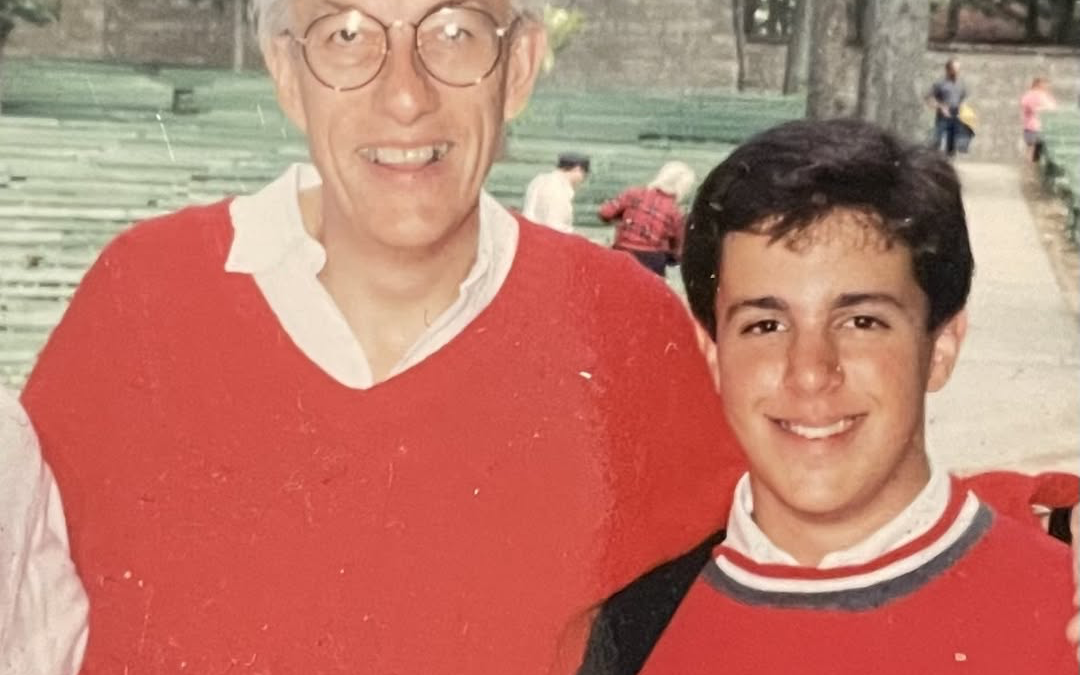
I first met Larry Livingston in July of 1991. I was fifteen and was, for the second year in a row, spending part of my summer playing the euphonium (a half-size tuba with the same register as a trombone) during music camp in Interlochen, just south of Traverse City, Michigan. Larry, whose regular job was teaching conducting and serving as dean of the music school at the University of Southern California, spent part of his summers conducting band and orchestra at the camp.

Then as now, it was immediately apparent that Larry was a gifted teacher. Child of two educators that I was, I knew one when I saw one. Larry was the real deal. This was two years after Robin Williams’s performance as the inspiring English instructor in “Dead Poets Society,” which had led plenty of teachers to be not a little resentful, because it set what seemed like an impossibly high bar. But for me, and for many others, Larry was that kind of teacher, the kind that made you, the text (music), and the classroom (rehearsal hall) shimmer with electricity.

I had dreamed of conducting an orchestra since I was three years old. Another amazing teacher, Dan Long, gave me my first baton when I was around that age. Ever since, I would stand in front of the stereo and play-conduct: Tchaikovsky, Beethoven, Brahms, whatever was on.

Larry saw the aspiring conductor in me, but he also saw much more. I remember sitting on a bench in front of the Interlochen Bowl the summer after my junior year—which, you may remember, is often the most challenging year of high school. I had done pretty well in all my classes except math, which had punched a hole in my confidence, and wasn’t entirely sure about my prospects. I had leadership roles in many activities and there were many possible doors to step through. Maybe I should go to music school? Maybe study something else? “A person like you,” Larry said, “should go to Harvard, Yale, or Princeton.” (In 1994, before the application volume increased a gazillion-fold, you could say something like that. I doubt I would get into any of those schools today.) To be seen and believed in that way quite literally changed my life.

Larry continued to be a mentor throughout college and early adulthood, and we have remained in touch over the years. But he lives in Los Angeles and I live in Chicago, and we both have busy lives. So it had been about a decade since our last in-person visit when, this week, we met while I was on a fundraising trip to LA. (Well into his 80s, Larry is still teaching and conducting. He came to dinner at 6 from a full day working with students from 10 am.) We caught up on each other’s families and our mutual friends, we talked about music and work, we reflected on our shared history, we counted our blessings. He told me about a current student of his who he hopes I might speak with and mentor in my own way. And here, 35 years after our first encounter, we both marveled at the journey our relationship has traveled. As Rabbi Yehoshua ben Perachya says in Pirkei Avot: “Make for yourself a teacher and acquire for yourself a friend.” Indeed.

Of the many curiosities of the life of Isaac, perhaps none is more puzzling than the fact that he re-digs the wells that his father Abraham had dug (Genesis 26:18). What is this story here to teach us?

Rabbi Shmuel Bornsztain (1856–1926), the second Sochatchover Rebbe and author of the Shem Mishmuel, cites his father, who cites the medieval scholar Rabbi Bachya ibn Pikuda’s Chovot Halevavot, who commented on a verse in Proverbs (20:5): “Counsel in the human heart is like deep water, but a person of understanding will draw it out.” The Shem Mishmuel continues: “The deep waters already exist in reality; they are merely covered and hidden in the belly of the earth. A person of understanding is one who removes the covering over them and draws them out. So too, the counsel in the human being already exists in reality, within a person’s mind and heart; one needs only to remove the physical materiality that covers and conceals it. This is the meaning of digging the wells.”

The Sochatchover tradition here echoes Plato’s understanding of education as “turning the soul,” uncovering that which already lies within. Or perhaps of Michaelangelo’s “Prisoners,” which, on a visit to Florence, one can see emerging gradually from the stone which seems to already bear the statue within. In one sense, it would appear to be an immaterial question. After all, why does it matter? The end product is the same.

Yet my own decades-long relationship with a teacher-mentor (in Talmudic parlance, a rav-chaver, a teacher/master-friend) helps me sense the significance here. As a young person, Larry saw my potential and helped me perceive it for myself. The idea that the deep waters already exist within and our task is to uncover them casts the work of life as not about acquisition—of knowledge, skills, people, or things—but rather revelation. It helps me imagine our lives as rooted and growing, a vocation of casting our tendrils deep into the earth to find and drink from the living waters—and of helping each other to cultivate and tend our gardens and orchards.

For Reflection & Conversation

Is there someone who has helped you realize some deep truths about your own life, who has helped you find your path? What in them helped them to do that? What in you helped you to accept their wisdom?


An Open-Armed Embrace (Chayei Sarah 5787)

An Open-Armed Embrace (Chayei Sarah 5787)

You may know the old Chinese story about the farmer and his son. A farmer experiences a series of alternately tragic and wonderful events: a runaway horse, a sudden windfall of wild horses, his son’s broken leg, his son exempted from the army draft because of said broken leg. In each instance, the farmer’s neighbors rush to declare the outcome a catastrophe or a blessing. But in each case the sagacious farmer replies, “We’ll see.” Don’t rush to judgment. Or, in the wise words of my friend Raffi Stein-Klotz, “You always never know.”

I will confess to feeling that way this week after the midterm election in the United States.

Despite predictions of a fascist takeover of the voting infrastructure, it seems that American voters were able to deliver an overwhelming message of disapproval. Both the New York Times and the Wall Street Journal ran headlines Wednesday morning that included the words, “Sharp Rebuke to Trump.” Given the incompetence and cruelty the Administration has demonstrated in too many of its actions, to say nothing of the shameless self-dealing and corruption of the President and those around him, I’m buoyed by the prospect that some of the suffering they’ve caused will be alleviated and some officials may begin to be held to account.

And yet. Maybe it’s my age, or maybe it’s having internalized that Chinese story a little too much, but I also find myself not thrilling to this moment but approaching it cautiously. I hear myself saying, “We’ll see.” Primarily that’s because of the discomfort I feel around the centrality of Israel and Jewish life in this election. I felt unease hearing Steve Kornacki talk on national television about Jewish voters in Michigan’s Oakland County, and what effect they might have on the senate election there. I felt similar unease when post-election analysis talked about the centrality of the Iran War (read: prompted by Netanyahu = Israel = Jews) to voter disaffection. And I felt it, too, when the President announced an early end to military aid to Israel—not because of the ultimate decision itself, but because this, of all things was what Trump chose to highlight on Election Day.

All of which is to say, we’ll see. While I’m happy with many elements of this election outcome, I’m also wary, particularly when it comes to what the coming months and years will mean for Jewish life, Jewish politics, and Jewish safety—i.e., my/our sense of at-homeness.

I’m not a political analyst and this isn’t a politics newsletter, so that’s really as much as I want to say about the election. But I am a rabbi and teacher of Jewish spiritual practices grounded mindfulness, and I’ve been writing the spiritual questions of feeling at-home in recent months. So I want to explore that a little more—and I’ll leave it to you to decide how it can inform your/our politics, i.e. our collective effort to be at home together.

Iris Marion Young was a feminist political theorist at the University of Chicago who died, too early, two decades ago. In the 1990s she wrote an important essay about home in which she took on some important feminist critiques of the concept of home. Most notably, perhaps, was the fact that a lot of writing and theorizing about home and the longing for it was not only written by men but also overlooked much of the labor of women who were charged with keeping house and home for men to come home to. In Young’s telling, that led some feminist writers to question and even reject the idea of home altogether.

Young offered a reappraisal which I find helpful. “The home is an extension of and mirror for the living body in its everyday activity,” she writes. One of the key things about home is that it’s often made up of objects that have meaning to us: pictures of loved ones, family heirlooms, or even just a pair of pajamas on the floor—but they are my pajamas. When it comes to house and home, Young observes, “our very identity is at stake.”

But here Young takes a surprisingly spiritual turn: “Personal identity in this sense is not at all fixed, but always in process. We are not the same from one moment to the next, one day to the next, one year to the next, because we dwell in the flux of interaction and history. We are not the same from one day to the next because our selves are constituted by differing relations with others.” To me, this sounds like an ad for mindfulness practice, an exhortation to cultivate our awareness of what’s going on internally and externally from moment to moment.

This leads Young, finally, to offer a way to reclaim the idea of home for those who might have found it overly fixed and static: “Home as the materialization of identity does not fix identity, but anchors it in physical being that makes a continuity between past and present. Without such anchoring of ourselves in things, we are, literally, lost.” In this understanding, home is not some unchanging thing, but an anchor—in much the same way one might relate to the breath in meditation practice. A refuge, a safe place, but also floating and able to move with us.

Ger v’toshav anochi imachem, “I am a stranger and a resident among you” Abraham tells the Hittites. “I am a stranger from another land,” Rashi interprets, “but I have settled down as a resident among you.” Jacob ben Wolf Kranz, The Maggid of Dubow (1741-1804) observes, “The tzaddik is like a ger, a stranger in this world; the essence and ultimate fulfillment of their lives is in the world to come.” He contrasts this with the perhaps more common worldview that one is a toshav, a resident: “It does not occur to them that the time will come when they must separate themselves from life upon the earth.”

In both the Maggid and Iris Young, I think we can sense an idea of home as something that involves holding on but not gripping tightly, an open-armed embrace. To be at-home is, yes, to be able to hold those things and relationships and other elements of our lives that give us a sense of our who we are. And, in the same breath, to be at-home is to hold those things lightly, to let them go even as we hold them, to recognize that nothing is fixed—no political party (or notion of a “political home”), no landscape, no relationship, no sense of ourselves. We and the world are constantly in motion. To be at home within it, to be at peace within and without, is to practice resting in that motion again and again, from moment to moment.


Art credit: Perkins Harnly; ‘Bedroom, 1940’
Mindful Torah Wisdom: Chayyei-Sarah with Rabbi Sam Feinsmith

Mindful Torah Wisdom: Chayyei-Sarah with Rabbi Sam Feinsmith

Chayyei-Sarah: Unifying Heaven and Earth¹

According to the Hasidic masters, it’s to become an embodied bridge between Heaven and Earth.
We find a blueprint for this in Avodat Yisrael, an 18th-century Hasidic commentary on Parashat Chayyei-Sarah:

R. Yisrael Hopstein², Sefer Avodat Yisrael, Chayyei-Sarah, s.v. V’haMelekh David zaken ba bayamim


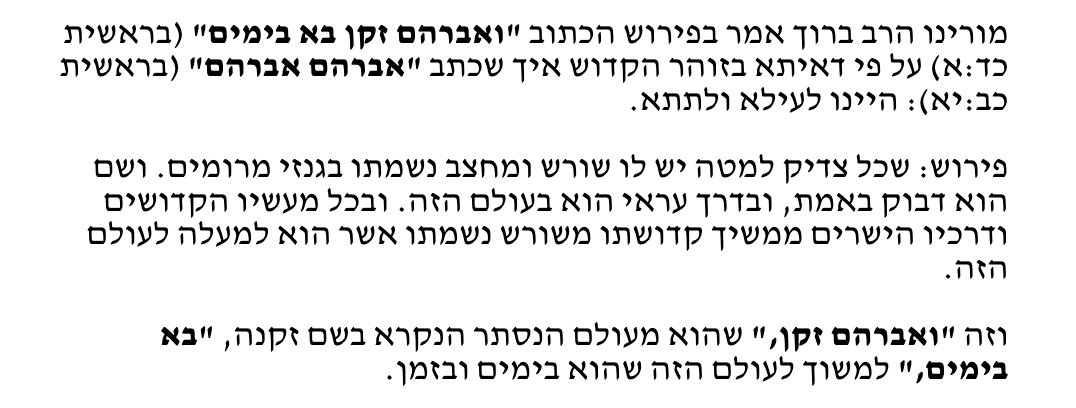
Our teacher Reb Barukh³ explained the verse “Abraham was now old (zaken), advanced in years (ba bayamim)” (Gen. 24:1) in accordance

with the… Zohar’s teaching regarding the verse “Abraham, Abraham” (Gen. 22:11): [one Abraham] above and [one Abraham] below.⁴ᐟ⁵

[Reb Barukh explained]: For every tzaddik (i.e., a person grounded in higher consciousness) below (i.e., on this material plane) has a root and a quarrying-place for their soul within the hidden treasuries on High. In truth, this is the inner place they cleave to, while abiding in this temporal world only as a passing visitor. Through their holy deeds and virtuous ways, they draw holiness from the root of their soul, which transcends this temporal world.

This then is the intent of “Abraham was now old (zaken),” for he was really from the concealed world, which is called ‘ancient (zikna).’ “Advanced in years (ba bayamim),” suggesting that he drew this timeless essence into this temporal world, which is delimited by days and time.

Why does the Torah repeat Abraham’s name? Reb Barukh teaches that we inhabit two identities: a temporal one and a spiritual one.

Our temporal identity is bound to time and change—our body, feelings, personality, beliefs, roles, and ego. It allows us to function and act in this world with a sense of agency and efficacy.

Our spiritual identity transcends time and space. It is our primordial essence, eternally bound to its Divine root and untouched by worldly shifts and sorrows. This is the source of our deepest wisdom and spiritual awareness—the root of true “eldering” (ziknah).

When we ground ourselves in this higher awareness, we realize our true identity is the soul, and we move through the temporal world without being enslaved by ego, attachment to outcomes, or personal honor.

Yet the ultimate goal isn’t to remain cloistered away in high spiritual states. It is “ba bayamim”—to draw that timeless essence down into our daily, time-bound existence.

How do we do this? Not by fleeing ordinary life, but by infusing it with presence. Every time we take a mindful breath, listen deeply to another person, bring loving awareness to a simple daily task, or bear witness to our busy minds, we perform “ba bayamim.” We inhabit time from a grounding in timeless presence—becoming the bridge where Heaven meets earth, right here and right now.

¹ This piece was composed in dialogue with an AI assistant. The ideas are all original. In a couple of small instances, some of the language for articulating them was developed by AI and then edited by Sam Feinsmith. 

² Rabbi Yisrael Hopstein (1737–1814), known as the Kozhnitzer Maggid and by the title of his classic work, the Avodat Yisrael, was one of the primary founders of Hasidism in Poland alongside the Seer of Lublin. A master Kabbalist and renowned advocate for the Jewish people, his commentary blends deep mystical insight with a profound emphasis on fervent prayer and finding divine light within every soul.

³ Referring to Reb Barukh of Medzhybizh (1753-1811, Ukraine), grandson of the Ba’al Shem Tov. Reb Barukh established a courtly estate in his grandfather’s hometown and claimed thousands of followers at the time of his death.

⁴ Based on Zohar Noach 58a, which reads as follows (translation adapted from sefaria.org): 

“Why ‘Noah, Noah’ (Gen. 6:9), written twice? [Because] each and every righteous person in the world has two spirits, one in this world and the other in the heavenly realm. And so we find that the Holy and Blessed One named all the righteous twice: ‘Moses, Moses’ (Ex. 3:4), ‘Jacob, Jacob’ (Gen. 46:2), ‘Abraham, Abraham’ (Gen. 22:11), ‘Samuel, Samuel’ (I Sam. 3:10).” 

It’s noteworthy that in response to being called by God twice by name, with the exception of Noah, all of these figures respond Hineni (“I am present”).  

⁵ Though our teacher uses hierarchical language of “above” and “below”, the Zohar itself speaks of a soul that operates in the temporal plane and another soul that abides in the World to Come.  

Vayera 5787

Vayera 5787

There’s a wonderful story about the great Hasidic master, Rabbi Levi Yitzchak of Berditchev. One day, he arrived in Lviv and approached the home of a wealthy, distinguished resident.


“Might I find a place in your home to spend the night?” he asked, without revealing his identity.

“I have no room for wayfarers. Go to an inn,” the wealthy man replied.

“A small corner in one of your rooms will be enough; I won’t trouble you with anything else,” said the rabbi.

“I have no room. And if you can’t afford an inn, go to the schoolteacher on the next street; he is accustomed to hosting guests,” said the wealthy man.

Rabbi Levi Yitzchak went to the schoolteacher, who received him warmly and cordially. Later, as he walked in the street, a passerby recognized him. Word spread immediately that the Rebbe of Berditchev had arrived in town. Before long, a crowd surged to the schoolteacher’s house to greet the rebbe. Among them was that same wealthy and distinguished man.

When he stood before Rabbi Levi Yitzchak, he said: “I beg forgiveness and pardon from our master and teacher, and my earnest request before him is that he honor my home with his visit. All the great individuals who came to our city have stayed at my home!”

Rabbi Levi Yitzchak said to him, “Abraham our ancestor was famous for the virtue of hospitality. When the angels came to him, the Torah recounts: ‘And he took butter and milk and the calf which he had prepared, and set it before them’ (Genesis 18:8). But what is special about this? After all, Lot did the exact same thing: ‘And they came into his house; and he made them a feast, and baked unleavened bread, and they ate’ (19:3). Yet we do not find Lot praised for his hospitality. Rather, by Lot it says: ‘And two angels came to Sodom’ (19:1). Lot recognized them as angels and invited them in. But by Abraham it says: ‘And he looked, and behold, three people stood over him’ (18:2). Abraham saw simple people, dust-covered wayfarers, weary and thirsty, and he pleaded with them to allow him to host them.

“You do not host guests,” Reb Levi Yitzchak admonished the wealthy man, “you host angels and the famous. The schoolteacher hosts human beings.”

Mic drop.

And yet: I don’t know about you, but if I’m honest with myself, much as I might like it to be otherwise, I’m closer to the wealthy man in the story than to Reb Levi Yitzchak. Why is that?

Because genuine hospitality—not just hosting friends or those one is familiar and comfortable with, but “dust-covered wayfarers, weary and thirsty”—is an extraordinarily vulnerable act. To let a complete stranger into one’s home is a gesture of enormous faith, as great as any of the other tests of faith that Abraham and Sarah encountered. And, if I’m being totally honest, that’s a test I’m still a long way from passing.

The twentieth century Algerian-French Jewish philosopher Jacques Derrida explores this theme in a reflection on hospitality. Derrida, who was stripped of French citizenship as a child by the Vichy regime, distinguishes between “the foreigner,” who is categorizable in language and law (e.g. “the famous rabbi visiting our town”), and the absolute other, someone who has no name, no legal status, no rights. “Absolute hospitality,” Derrida writes, “requires that I open up my home and that I give not only to the foreigner (provided with a family name, with the social status of being a foreigner, etc.), but to the absolute, unknown, anonymous other, and that I give place to them, that I let them come, that I let them arrive, and take place in the place I offer them, without asking of them either reciprocity (entering into a pact) or even their names.” (25)

In other words, it’s one thing to host a guest I know, or even a guest I don’t know personally but who I can position in my heart and mind. That kind of hosting might be an imposition—it costs me food, laundering the linens, toilet paper, etc.—but it probably doesn’t feel much like that. I get the enjoyment of my guest’s company, and I might experience a nice feeling of self-satisfaction for having done something good and hospitable, or even honor. “I hosted our community’s distinguished guest when they were in from out of town,” I might tell myself, “so I’m a good person—and my friends know it.”

Elsewhere in his reflection, Derrida points to an etymological chain linking the words host, guest, and hospitality. From more ancient Indo-European roots, we eventually receive the Latin hospes, meaning both host and guest who are bound through the law of hospitality—which, Derrida shows, has a lot to do with property and control of the home. For our purposes, I would call this Lot’s hospitality: law-abiding but/and status-oriented, grounded in knowledge of the placeable and familiar.

Derrida, in a philosophical register, and Reb Levi Yitzchak, in a more Hasidic one, invite us into deeper introspection. Hospitality towards those who are known to me is, fundamentally, safe. I’m not risking much, if anything, in the act. I’m still at home, still in my comfort zone, still in my locus of control, still the master of my house. In such situations, I’m behaving more like Lot than like Abraham—not bad, but not, perhaps, as far as I could go.

“There are four types of human being,” teaches the Mishnah: “One who says, ‘What is mine is mine, and what is yours is yours’—this is an average person. And there are those who say, this describes the people of Sodom.” The Mishnah contrasts this with the deeper expression of hospitality of Abraham and Sarah: “One who says, ‘What is mine is yours, and what is yours is yours’—this is a Hasid,” one who embodies hesed: profoundly open, without boundaries, vulnerably venturing beyond the safety of the known into an encounter with the unknown.

I’ll reserve commenting on this as social policy for another day. More immediately, though, I hope we can hear in these teachings a call to spiritual practice. So much of our practice has to do with the known and the unknown, how we navigate the familiar and the unfamiliar, each of which can generate a range of responses within us. The unknown can prompt fear and wariness. The familiar can engender comfort to the point of boredom or rote routine. Most of our lives are likely lived somewhere in between. And so we might consider our practice as a regular engagement with the question, What kind of home am I living in right now? What kind of hospitality am I—are we—living? And how might I/we reach deeper into the well so that we might open a little further, in the spirit of our ancestors?

For Reflection & Conversation

What is the most generous form of hospitality you can remember experiencing, as a host or a guest? What makes it stand out to you? What, if any, lessons might you draw from that experience for your ongoing inner spiritual work?

 
Lekh-Lekha 5787

Lekh-Lekha 5787

This past summer I found myself in a writing partner relationship with Rabbi Zvika Krieger who, among other things, is in our Marbeh Fellowship for Senior Jewish Mindfulness Teachers at IJS. Zvika is working on a book and sent me chapters to read and comment on (it’s about God and it’s fantastic), and he made me commit to sending him 5,000 words of the book I’m trying to write about at-homeness.

There’s nothing like a deadline to focus one’s attention. So a few days before I was due to send Zvika my material, I sat down on a Sunday morning and started writing. Five hours later, I was still in the same chair in my kitchen and had cranked out a solid effort. I felt fantastic.

I know this isn’t true for everyone, but for me writing is frequently entering a flow state. Words pour out. My attention is totally focused on the page/screen in front of me. And at the end of it, there’s this thing that emerged through me into the world. (That’s the fun part. Editing sucks.)

I don’t honestly know if that process is ‘home’ for me. I suppose it resembles the feeling other people have of being in a workshop or an art studio, or the way many musicians will describe playing their instrument. I’m much less aware of my surroundings, much more centered in my focus. There is no real sense of here and there, there’s just the writing.

I’m not quite sure that’s home. It’s not about comfort or safety, and it’s not really a moment when I want to invite guests in. If anything, it’s a very intimate moment on the way to sharing something with the world—which feels more like being at home to me. (I’m realizing as I write these words in that same kitchen chair early in the morning that I’d actually be kind of upset if someone walked in on me right now. Which means I’m not in a particularly hospitable mood. Which probably means I’m more a writer in his writing space than someone at home welcoming guests.)

In all this reflecting on at-homeness, one thing I keep coming back to is that I think the Jewish tradition has something quite unique to contribute to the conversation. Where Thich Nhat-Hanh taught that the whole world and everything in it is our home (a teaching I love and appreciate), I keep finding myself reflecting that that’s perhaps half of a Jewish take on the question, the downward-pointing triangle in the Star of David: Home is here, in this world, this moment.

But for so much of Jewish life, thought, and practice, home is also there, somewhere else: the land of Israel, Jerusalem, the Holy of Holies, shamayim (heaven), a place or a country we came from or are on our long way back to, even Torah itself. It’s the upward-facing triangle that points toward transcendence.

And, of course, the star itself is both of these triangles braided together: here and there, immanent and transcendent, then and now, all at once.

That paradoxical relationship with at-homeness seems baked into our story from the very beginning: Lekh-lekha, “Go forth from your homeland, from your birthplace, from your ancestral home to the land that I will show you” (Genesis 12:1). Our people and our Torah springs from a moment of estrangement, leaving one home and journeying toward another. It could well be that everything else is commentary.

In her recent book Unbelonging: A Life in Search of Home, linguist Catherine Jagoe quotes the writer Pico Iyer: “It’s only by stopping movement that you can see where to go; it’s only by stepping out of your life that you can see what you most deeply care about and find a home.” That leads Jagoe, who lived in many homes growing up and whose career as a Spanish-English translator has led to a rather unstable notion of home, to a reflection on what home might mean, at least for some, in the post-modern world: “The word identity comes from the Latin root idem (sameness). But we are not always the same; each of us is a constantly evolving kaleidoscope of selves over our lives and in different places and contexts. Just like postmodern identity itself, home is no longer fixed but, increasingly, seen as fluid. There is no one answer to the question ‘Where are you from?’ and perhaps I don’t have to pick; all of them are true.”

That’s a rich reflection. Child of Abraham and Sarah that I am, I resonate with it quite a bit. Yet simultaneously, as a descendant of those home-leaving/home-seeking/home-making ancestors, I think there’s more to say. There is a deep at-homeness I can and do sense that isn’t about multiplicity or all of that complexity, but is grounded in simplicity and familiarity: of language and texts and stories, of songs and rituals, of foods and humor, of places and landscapes, of a tradition that I know I belong to. I find so much, perhaps even the essence, of my own Jewish spiritual practice is about holding both of those triangles together at the same time.

“And look from the place where you are there,” says the Holy One to Abram (Genesis 13:14). The Ba’al Shem Tov, in one of the foundational teachings of Hasidism, comments: “A person is bound after their thoughts; in the place where a person’s thoughts are, that is where they are. A person can physically stand in the synagogue and pray, but their thoughts sail to the ends of the earth and are drawn after business affairs; then it is as if they are where their business is, and not in the synagogue.”

Guilty as charged.

He continues: “This is what is written: ‘And look’ — that you should perceive with a spiritual, psychological vision; ‘from the place where you are there’ — that you should not let your thoughts sail off to other places, diverting your mind and scattering your thoughts.”

When I tell people that Judaism properly understood is a mindfulness practice, this is one of the teachings I have in mind.

Yet I think we can also understand the Besh”t to be teaching us something deep about at-homeness here. Even, or perhaps precisely, amidst all the movement of life—between here and there, between past and future, between being and becoming—we are most fundamentally at home when we are present with our experience, when we are here now. That homecoming is always available to us, ready to welcome us at every moment.

For Reflection & Conversation

Consider Catherine Jagoe’s observation that, “Just like postmodern identity itself, home is no longer fixed but, increasingly, seen as fluid.” Now consider the Ba’al Shem Tov’s teaching that, “In the place where a person’s thoughts are, that is where they are.” What might they say to each other if they were talking together? What parts of either teaching resonate most or least with you? Why?