First Cohort of 28 Spiritual Directors Graduate from Kol Dodi

First Cohort of 28 Spiritual Directors Graduate from Kol Dodi

In a famous Hasidic saying, the Kotzker Rebbe was once asked: “Where does God dwell?” to which he replied, “Wherever you let God in.” Spiritual direction is the practice of letting God in, of noticing the sacred thread woven throughout everyday life.

Spiritual direction is a contemplative practice that invites one to grow in awareness of the sacred dimension present in every moment, no matter how mundane. In this practice, we assume that we all have a spiritual dimension and a need for meaning-making, whether or not we believe in God.

Spiritual directors act as companions on this journey, holding space for seekers to connect with their spiritual longing, discover and explore their inner wisdom, and strengthen their attunement to the sacred. Spiritual directors are not therapists, but trained guides who meet monthly with seekers to support their journey toward spiritual growth and wholeness.

In the fall of 2023, IJS launched Kol Dodi: Jewish Spiritual Director Training Program under the leadership of Rabbi Myriam Klotz. Kol Dodi is grounded in IJS’s contemplative and contemporary core spiritual practices for cultivating awareness of mind, body and heart, and for attuning to the Kol Dodi, which means “voice of the beloved.”

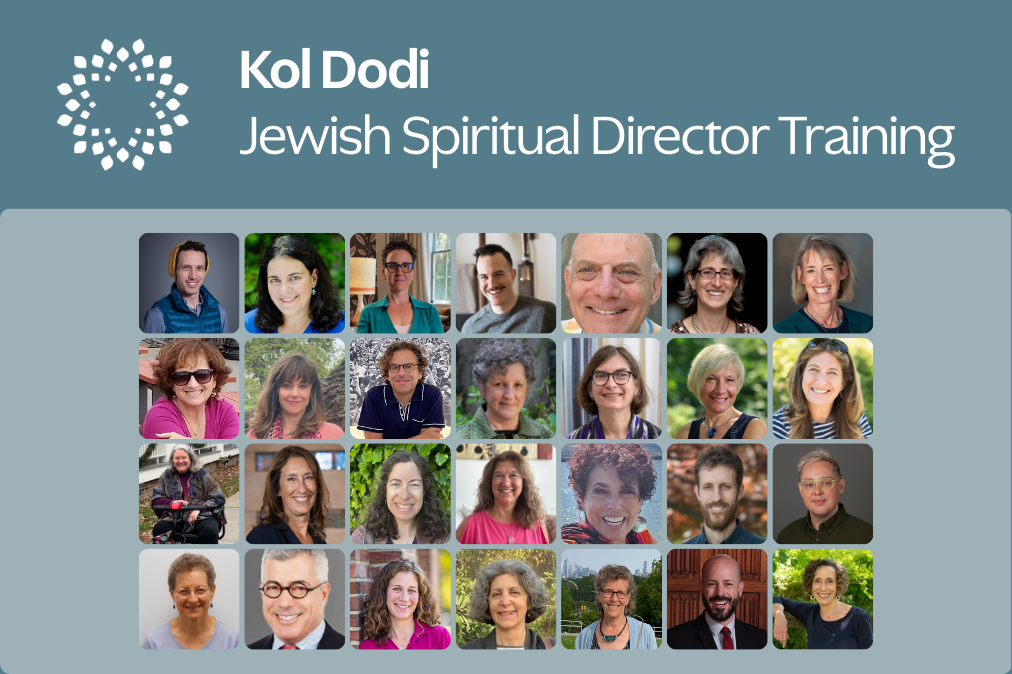
Recently, we celebrated 28 graduates of the 18 month spiritual direction training program. Current Program Director, Rabbi Elisa Goldberg notes that: “Many participants came to the program with significant professional accomplishments and commitment to their own personal practice. It was a blessing to work with individuals on such profound spiritual journeys and to know that they will be sharing their gifts with others.” Among the participants in the first cohort of Kol Dodi were rabbis, cantors, therapists, wellness practitioners, lawyers, doctors, chaplains, and Jewish communal professionals.

Spiritual directors offer seekers opportunities to pause in the midst of our busy lives to focus on the still small voice within. Meeting regularly with a spiritual director over time can help one to live a richer, more authentic life aligned with their deepest values, to cultivate compassion and resilience, and to develop spiritual tools to face life’s inevitable challenges. The practice of spiritual direction helps one to connect to life’s mystery, explore our deep interconnection with life’s mysteries, and deepen one’s unique experience of faith.

Kol Dodi provides opportunities to grow both personally and professionally. As one recent graduate of the program noted: “The Kol Dodi program has renewed my vocation as a spiritual caregiver and given me a greater appreciation of all that I have to offer… If only my work life had changed as a result of this program, dayenu. I’ve also been blessed to find great joy and purpose in offering spiritual direction to others. I’ve discovered what a life giving gift spiritual direction is, how simple the premise and yet so profound the results.”

Want to get involved? Looking to nourish your soul?
The individuals listed here have completed Kol Dodi: Jewish Spiritual Director Training Program and are available to provide direction to individuals. Please contact anyone on the list to schedule a free 30-minute introductory session to see if Spiritual Direction is for you.

The next cohort of IJS’s Kol Dodi: Spiritual Director Training Program will begin in fall of 2026. If you are interested in finding out more about the training program, please contact Rabbi Elisa Goldberg, Program Director at elisag@jewishspirituality.org

In the fall of 2025, we will be offering a Taste of Spiritual Direction and an opportunity to participate in time limited Spiritual Direction Groups. Sign up to be notified when registration opens.

Torah from the Well: Standing at Sinai Here and Now

Torah from the Well: Standing at Sinai Here and Now

Hi friends. I hope this message finds you well.

This month, we’re focusing on preparing spiritually for Shavuot—the festival that commemorates our collective receiving of the Torah at Sinai.

Many of us were taught to relate to that experience as a one-time event in the distant past. And while this historical moment continues to reverberate through Jewish life, Sinai can sometimes feel far away—almost like a relic.

But there’s another way to see it—one that views revelation not as something that ended, but as something still unfolding. This isn’t as radical as it might sound. After all, Jews who pray daily recite a blessing over Torah study, which reads:

Barukh atah Adonai, noten haTorah.
“Blessed are You, Timeless Presence, for giving us Torah.”

The Hebrew word noten, ‘giving,’ is in the present tense—suggesting that revelation is happening right now.

The Hasidic tradition takes this proposition seriously, teaching that we can receive chidushim—fresh Torah insights—from within, here and now. But this requires quieting the noise of the mind and listening deeply for the sacred wisdom bubbling up deep inside.

I call this paradigm ‘Torah from the well,’ because it doesn’t require us to climb to the mountaintop to experience revelation. Instead this paradigm invites us to dig down—to peel away layers of conditioning, fear, and confusion until we reach the clear, refreshing waters of our inner Torah.

What might we discover if we truly believed that new Torah is available to us here and now? How might we cultivate the habits of heart and mind that allow us to receive it? How could this inner Torah guide us toward greater wholeness, wisdom, and connection—and breathe new life into our relationship with our inherited tradition?

To explore these questions together, I invite you to join me for a 5-part meditation series that I offered through the IJS Daily Sit in May 2021: Standing (or Sitting) at Sinai, Here and Now. It’s available on demand, free of charge, on our YouTube channel. You can find the five sessions by clicking on the link in this blog post.

I hope this offering helps you tap into the Torah that’s already alive within you. I’m wishing you a meaningful journey toward Shavuot.

Take good care.

Josh in Conversation with Rabbi Shira Stutman

Josh in Conversation with Rabbi Shira Stutman

We are grateful to Rabbi Shira Stutman for sharing her insights with us. Please enjoy the conversation recording.

Rabbi Shira Stutman is a nationally known faith-based leader and change maker with more than twenty years of experience motivating and inspiring groups large and small. She is the senior rabbi of the Aspen Jewish Congregation and co-host of the top-ranked PRX podcast Chutzpod! in which she provides Jewish answers to life’s contemporary questions and helps listeners build lives of meaning. She also teaches Torah and speaks nationally on topics that include growing welcoming Jewish spiritual communities; building the connective tissues between different types of people; and the current American Jewish community zeitgeist.

As founder of Mixed Multitudes, a consultancy that exposes diverse groups of Jews and fellow travelers to the beauty and power of Jewish life, tradition, and conversation, she currently is working on a variety of projects: running programs that support Jews in having less reactive and more heart-centered conversations about Israel; teaching in progressive institutions about antisemitism; and serving as scholar-in-residence for projects that build the next generation of philanthropic leadership. She was the founding rabbi of Sixth & I Historic Synagogue in Washington, DC, in addition to a number of other start-up Jewish life initiatives.

Her new book, The Jewish Way to a Good Life, is now available for purchase: https://theexperimentpublishing.com/catalogs/winter-2025/the-jewish-way-to-a-good-life/

Mindfulness Practice of Radical Welcoming at the Seder

Mindfulness Practice of Radical Welcoming at the Seder

As we gather for the Seder, this meditation invites us to open our hearts—welcoming those present and absent, every part of ourselves, and the world’s joys and struggles. May we enter Pesach with deep presence, warmth, and gratitude, ready for renewal.

Mindfulness Practice of Radical Welcoming at the Seder

by Rabbi Miriam Margles

The Tikkun of Speech in Nissan

The Tikkun of Speech in Nissan

Each month offers an opportunity for a tikkun (“repair”), a rectification of some aspect of our being. The month of Nissan, this season of spring awakening and liberation, invites us into the tikkun of speech.

Pesach literally means “mouth speaks,” and it is known that how we utilize our voices, words, songs, and speech is key to our redemption from mitzrayim, from the narrow places of our lives.

I deeply appreciate a teaching from Reb Nachman via his disciple Reb Nosson that there are four levels of speech associated with the four cups of wine we drink at the Passover seder. Thus, the seder can be a journey through our rectification of these four levels, which both build upon each other and are interpenetrating.

The first level is adam b’tzalmo – a person and their self. This represents our self-talk. Are we speaking to ourselves with love and kindness? When we notice highly critical or self-shaming voices, can we pause and actually think or speak kinder words to ourselves?

The second level is adam v’chavero – a person and their friend. This is how we talk to one another. Are we doing so with love, honesty, clarity, and respect, seeing the other person as b’tzelem Elohim, created in the divine image? When someone says something upsetting, can we practice pausing to better support ourselves in responding wisely and thoughtfully rather than reacting?

The third level is tefillah – adam v’makom – this is how a person talks to the divine, what we call prayer. How might we rectify our prayer lives this season? Are we speaking to God as if our prayers matter, as if they are truly being received? Are we speaking from our hearts, from authenticity, or just engaging in liturgical recitation by rote? Are we praying at all?

The fourth level is nevuah – this is when the divine speaks through us, what our tradition calls prophecy. What does it mean, what does it take, what does it feel like to make oneself available as a tzinor, a channel for a greater loving intelligence to flow through us? How do we become an instrument of the divine? Perhaps when we attend to those first three levels of speech, we can be better prepared for the deeper listening that makes possible the channeling of truth in ways that others can fully receive.

Our tradition teaches that words create worlds. Bringing attention and renewed energy this month to our speech is a profoundly important spiritual practice if we are to co-create the more beautiful world for which our hearts yearn.

As we approach Pesach this year, may we remember to slow down enough to listen before we speak. May our words be fitting vessels for the truth of our hearts so that they may be received by those who need to hear them. And may we each know the delight of expressing our truth in authentic, beautiful, and healing ways.