
By Rabbi Joshua Levine Grater
My kids are getting older, and with their aging, they are starting to ask questions about time, length of life and death. They understand the concept of being born, as they have cousins who have been born recently, and they understand that life ends, both from their obsession with Harry Potter, which has main characters dying, and from the fact that their dad is often out at night at a shiva minyan. We have had some amazing discussions over this Pesach time, as they now like to sit and “talk like grown-ups,” as they put it—about time, life, memory, and understanding the differences between 100 years ago, like when their great-grandfather was born, 1000 years ago, and 3000 years ago, like when Moses lived. They are still only 9 years old, so of course I reassure them that they have a long and beautiful life ahead of them. And I try not to burden them with my own neuroses about time, my own struggles with understanding and living within the construct that yesterday will never happen again, that each day forward is a day closer to an end that is always fast approaching, but—please God—is hopefully far off in the future.
It is so wonderful to be a child, innocent and free of these mental burdens that can both invigorate and infuriate adults, as we all deal in our own ways with the concept of time and the counting of our days. I remember lying in bed, as my kids say they now do, wondering what it is like to die, how it will be that the world will go on and on, for billions of years, without me? This can either paralyze us into a life of fear, or it can inspire us to a life of meaning. Most of us live somewhere in between. As Dr. Sherwin Nuland writes so beautifully in his landmark book, How We Die, “Against the relentless forces and cycles of nature there can be no lasting victory.” But, with faith, hope, values and meaning, we can achieve a life that will live on beyond us.
We mark occasions of time, both celebratory and painful ones, which serve as guideposts in the sea of a lifetime. 128th birthday of Pasadena, 69th anniversary of the liberation of Auschwitz, bar/bat mitzvah, 13 year anniversary of 9/11 approaching, 66 years of the State of Israel—all important milestones in the life of individuals and nations. Yet, how many of us ever pay attention to the passing of each day, I mean really count and mark each day of our lives as important, meaningful, reason for celebration? As we are in the period known as sefirat ha’omer, the counting of the Omer, which counts the days from Pesach to Shavuot, I am thinking about counting our days, and focusing on the meaning of a day in our lives, which is the most concrete block of time that we all share in common.
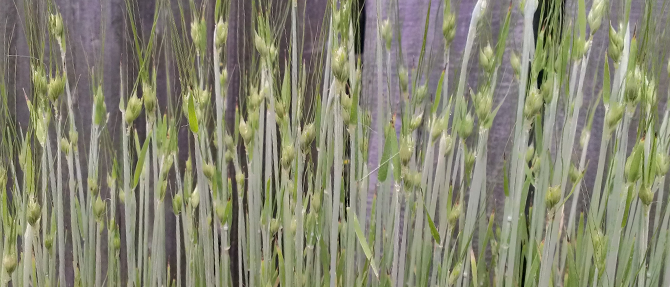
Biblically, the counting involved the time from the second day of Pesach until Shavuot, 49 days, culminating in the barley harvest and the offerings of the first grains at the Temple. Not being a farmer myself, I don’t know that much about barley, but I do know that it is a very sensitive grain, one that needs to be harvested at a precise moment; if that moment passes, the barley dies and the crop is lost. Hence, the counting of each day with great care and attention. Today, however, we are not harvesting any wheat or barley, and we don’t have the Temple, so why count? Where do we find meaning in this ritual? I want to suggest a few options.
Our lives are like the barley, sensitive and in need of great attention. Inside the tough, outer shell of the human body, our souls and spirits require love and devotion, a constant dedication of commitment to maintain a healthy life. We tend to focus on the body, exercising and eating right, getting enough sleep, taking vitamins and seeing the doctor. Yet, how many of us pay the same amount of attention, give the same amount of time and energy to our souls? Sefirat ha’omer offers us the chance to spend 49 days in direct contact with our souls on a daily basis, for each day that we count, we focus on a different aspect of our inner being.
Coming out of Mitzrayim (Egypt), we left the place of limitations and boundaries, a place that represents all forms of conformity and definition that restrain, inhibit or hamper our free movement and expression. Therefore, leaving Egypt is about embracing freedom from constraints. (Rabbi Simon Jacobson) The Omer invites us to count each day as a single unit of time, a unique period in our life that happens only once. What did today mean for you? Were you compassionate, disciplined, productive? Did you study, spend time doing something solely for yourself? Did you love someone today? Did you love yourself?
Each day has infinite value, infinite worth, infinite potential. We often overlook that idea in favor of greater periods of time: how was my week, my month, my year? Yet, hayom (today) is the most precious gift, for as the old adage goes, “today is a gift, which is why it’s called the present.” When we count each day, we don’t wait for greatness to come tomorrow or next week; when we count each day, we might find out how wonderful or painful, how rich or poor, how glorious or frustrating our lives truly are. If it is the positive, we can celebrate that. If it is the negative, we can recognize it and, hopefully, do something about it before it snowballs into something more major, more harmful.
This period of counting the Omer, these next several weeks, I invite you to tap into the power of life-affirmation through acknowledging time passing; mark the end of each day, before you go to sleep, by reviewing your day, seeing where you succeeded, achieved, produced, laughed, shared, gave, received. And, see where you could have done better, been nicer, kinder, who you may have hurt and who hurt you; ask for forgiveness and offer forgiveness. And then, with the spirit of our people, count the day.
As I have taught my kids, life is precious, each moment matters, the less we take for granted the better. As Shakespeare has Julius Caesar remind us, “Of all the wonders that I yet have heard, it seems most strange to me that men should fear; seeing that death, a necessary end, will come when it will come.” May we all live long, healthy and rich lives, and when that day arrives, when life in this world transitions to the next, may we have counted each of those days of life with as much fullness and fortitude as humanly possible.