Jan 17, 2025 | Blog, Rabbi Josh Feigelson, PhD, President & CEO, Institute for Jewish Spirituality
When I was a kid, in order to become an Eagle Scout you needed to earn 21 merit badges. Of those, some were required and some were elective. I remember my electives included things like ice skating and music (which were, conveniently, things I did anyway outside of Scouting). The required merit badges were things like First Aid (no surprise), Citizenship in the Community, Swimming and Lifesaving.
At Scout camp one summer, somewhere in the study for these last two, I vividly remember fulfilling a requirement that involved jumping into the water with my clothes on. The task was to remove a pair of blue jeans while in the water, tie the legs together, blow air inside, and then tie the waist and wear it around the neck — that is, to create a makeshift life vest. Real-life MacGyver stuff. Of all the activities associated with these merit badges, I found it to be the hardest — and the most memorable.
Looking back, one of the things I most appreciate about that episode was that, like many other activities in Scouting, the lesson was this: You already have what you need, at least a lot of the time. It’s right here, if you can muster the imagination to sense it. Don’t have exactly the piece of rope you need? Take two smaller pieces and put them together with a square knot (if they’re the same thickness) or a sheet bend (if they’re different thicknesses). Down a tentpole? You can make a lean-to. Don’t have bread for French toast? You can make scrambled eggs. And, in the case of swimming with my jeans on: Don’t have a life preserver? Make your pants into one.
This doesn’t work in every situation, of course. There are times when we simply don’t have the necessities, emergencies of the highest order. But what Scouting taught me through these lessons at a young age was an orientation toward resilience, ingenuity, improvisation, faith and trust — that we have more than we might think at first, that there are more possibilities here than meet the eye, that at times of crisis we can access the means of our salvation more readily than we might assume at first blush.
“These are the names of the children of Israel who came to Egypt with Jacob, each one coming with his household.” Commenting on this first verse of the Book of Exodus in his Degel Machane Ephraim, Rabbi Moshe Chaim Ephraim of Sudilkov (1748-1800) offers a powerful teaching about this kind of orientation, which he links to God’s promise to Jacob a few chapters earlier: “I will go down with you to Egypt and I Myself will bring you up” (Gen. 46:4). In both cases, the Degel says, the divine Presence (Shekhinah) is the very means of ascent. “It is like one who wants to go down into a deep pit but is worried what will happen when he wants to come back up. So he takes a ladder with him into the pit. The Shekhinah is the ladder.” Like the jeans life preserver, the means of our salvation — on a spiritual level, at least — are more accessible than we might realize. (Thanks to my colleague Rabbi Sam Feinsmith, who translated and wrote about this teaching in our IJS text study series several years ago.)
I hesitate to share this teaching in light of the devastation in Southern California this week. So many have lost so much, and, if offered without care, it could land in a way that sounds dismissive. So I want to be clear that my intention in offering this Torah is not at all to minimize the pain and suffering, or to simply preach self-reliance. That is not, I believe, what the Degel is saying, and it’s certainly not what I’m trying to say.
Rather, I think this Torah might serve as an invitation to those who are suffering, and to all of us who are witnesses and who carry the burdens that are uniquely ours during these dark winter months: to find some quiet amidst the chaos and, in that quiet, sense if we can perceive the presence of a ladder up. The ladder may not reach all the way out, we might perceive just a rung or two — in our own minds and hearts, in the care of friends and loved ones, in the support of caregivers and strangers. But we can give ourselves permission to try to sense the ladder, and in doing so can be agents of our own liberation.
As we say so often, this is why we practice: for moments when life is hardest, when the spiritual struggle is most challenging. As the Degel and the Torah itself remind us, our people drinks from deep, inexhaustible, wells of spiritual strength. Those wells can be available to us — even when we’re treading water with our jeans on. May they provide nourishment and comfort to all those who need them today.

Dec 27, 2024 | Blog, Rabbi Josh Feigelson, PhD, President & CEO, Institute for Jewish Spirituality
Dear friends,
I heard from many people this week about The New York Times columnist David Brooks’s essay, “The Shock of Faith.” I won’t speak for him (he does that for himself in 2,000 words). Nor do I really want to have a conversation about whether Brooks, who talks about his Jewish life, is really a Christian at this point (he deals with that a bit in the essay). Instead, I want to respond to Brooks with gratitude, compassion, and an invitation.
Gratitude: I generally think we need more thoughtful discussion of religion and spirituality in American public life, so I’m grateful when someone writes a piece like this that prompts reflection and conversation. I’m grateful that Brooks discusses and centers, among other things, virtues like interconnection, compassion, justice, healing, and spiritual intimacy. I appreciate that he’s trying to open up some space for college-educated people (those of us with an “overly intellectual nature” — read: many American Jews) to consider how religion and spirituality might function in their own life. And I’m glad that his piece might introduce more people to wonderful contemporary thinkers and writers like Christian Wiman and Avivah Zornberg. Joseph Soloveitchik appearing on the Times Op-Ed page–even in a piece he might find problematic–is a good thing.
Compassion: My overriding thought on reading Brooks’s piece was something along the lines of, “I wonder what would happen if he came on a retreat with IJS.” Because so much of what Brooks describes in his piece sounds, to me at any rate, familiar: Someone raised in a Jewish home and in institutional Jewish life who didn’t find what he was looking for on a spiritual level and, eventually, sought it in other traditions. That was one of the primary motivations for creating IJS a quarter-century ago, to help seekers like Brooks find what they’re looking for in our own tradition–because, of course, we have these riches too, but they have often been obscured (there’s that “overly intellectual nature” again).
Brooks describes a literal mountaintop experience in which he was overcome by a sense of the Divine presence. Reaching for a Puritan prayer book in his backpack, he finds verses that speak to him. These included, “Let me learn by paradox that the way down is the way up”–which, for me, evoked the Hasidic concept of yeridah l’tzorech aliyah, a spiritual descent for the sake of ascent. Or another verse: “The broken heart is the healed heart,” which brought to mind the classic teaching of the Kotzker Rebbe, “There is nothing so whole as a broken heart.”
In the last section of his piece, Brooks identifies three “interrelated movements” of what he has come to understand as “faith”: Sanctification (in Hebrew: kedusha); Healing the world (tikkun olam); and Intimacy with God (devekut). He doesn’t use the Hebrew terms–and I wondered whether that was because he knew them but didn’t find them appropriate for this column, or that he didn’t know them. Over and over as I read his column, I found myself wondering if Brooks was aware that these same rich concepts exist in thick, rich Jewish language–that he could find many of the jewels he sought right in his own backyard. ‘
An example, from a text I taught at my local synagogue earlier this week: In his Sefat Emet (Genesis, for Hannukah 14:9), Rabbi Yehudah Leib Alter of Ger offers a provocative take on the Hannukah story. The Talmud, of course, teaches that we celebrate Hannukah because of the miracle of the oil that lasted for eight days. Yet the Sefat Emet points out that this hardly seems like the basis for establishing a holiday: After all, the Jews of the time weren’t actually under an obligation to light the menorah, seeing as they were unable to do so due to circumstances beyond their control. So why create a holiday to commemorate a miracle which enabled the performance of a mitzvah that they didn’t have to do in the first place?
He answers his own question: “The Holy One made miracles in order to raise the spirits of the children of Israel. As a result, they reaccepted anew the yoke of divine sovereignty, to joyfully be servants of YHVH. Thus by means of these miracles, they re-dedicated their Divine service–and that’s why the holiday is called Hannukah (i.e., ‘dedication’).”
When I taught this text this week, I found myself posing the question, “Why are you lighting Hannukah candles this year?” Because I think the Sefat Emet is challenging us. If we are only lighting the candles because “that’s what Jews do,” or some vague sense of rote obligation or commemoration of a distant historical event, then we’re not really doing it right. Instead, I would suggest the Sefat Emet is asking, even demanding of us, to try to tap into something far richer, far deeper: the miraculous, the holy, the “numinous” as Brooks calls it, that pervades the world, if only we slow down enough to attune ourselves to it.
That is the aim of our practice of Judaism, our dedication to a life of Torah. It is precisely to longingly, lovingly pursue communion with the Divine Presence, to make ourselves vessels for the Shekhinah. It’s to live out the verse from Psalms (42:3) that Brooks quotes, “As the deer pants for the water brooks, so my soul pants for Thee, O God” (which, by the way, is one of the standard songs we traditionally sing on Shabbat). Brooks quotes Christian Wiman: “Religion is not made of these moments [of sporadic awareness of the Divine Presence]; religion is the. means of making these moments part of your life rather than merely radical intrusions so foreign and perhaps even fearsome that you can’t even acknowledge their existence afterward.” Amen–he nailed it.
Which leads me to my invitation, which is extended to David Brooks and to anyone with whom his column resonated: These things you’re seeking are things we’ve been developing and teaching at IJS for decades, so please–come join us! The binary that Brooks posits, between spirituality on the one hand and religion on the other, is one we at IJS understand and, I think, subvert or upend on a daily basis. It is possible to be both spiritual and religious, to live (using the binaries Brooks quotes from Rabbi David Wolpe) simultaneously in touch with both emotion and obligation, soothing and mobilization, self-satisfaction and dissatisfaction with the world. That’s precisely what we try to do at IJS day in and day out.
Hannukah, perhaps more simply than any of our other holidays (it involves nothing more than lighting a candle in the darkness), provides us with an opportunity to attune ourselves to the Divine Presence in our lives and in the world. May all who are hurting find healing, may all who are feeling alone find communion, and may all who are seeking find inspiration in the lights of Hannukah this year.
Dec 20, 2024 | Blog, Rabbi Josh Feigelson, PhD, President & CEO, Institute for Jewish Spirituality
On Tuesday morning this week, I stood amidst the ruined homes of young members of Kibbutz Kfar Aza, one of the kibbutzim overrun and decimated by Hamas terrorists on October 7, 2023. These small apartments had provided a way for the kibbutz to help young people get their start in adult life. Their location, closest to the western fence of the kibbutz, made them the first line of attack. Along with the murders, there was evidence of rape, and the brutality of the home violation — bullet holes in walls, ransacked belongings — is still visible in plain sight, as the kibbutz members have not yet returned to their homes and decided what to do with this area: create a memorial, rebuild, or something else.
From the same spot on that fence in Kfar Aza, I could see the northern Gaza neighborhoods of Jabalya, Beit Lahiya, and Beit Hanoun. If you enter these areas in Google Maps to try to calculate the distance between them and Kfar Aza (I just did), you’ll get an unusual response: “Can’t find a way there.” These neighborhoods have been emptied since the Israeli military response after October 7, thousands of homes damaged and destroyed. Standing there on Tuesday morning, I could hear the constant hum of aerial drones along with occasional explosions.
This was my first visit to Israel since October 7. The visit was organized by The iCenter and included over 70 Jewish educators from around the world. It was a short and intense trip: four days of meeting with Israelis, hearing their stories, listening. We talked with teachers at Sha’ar HaNegev regional high school about the challenges of supporting and educating children who have suffered incredible trauma — even as they, the educators, dealt with their own. In Sderot we listened to Youssef Alziadna, a Bedouin Arab Israeli who drives a minibus and heroically saved 30 lives of young people — many of whom he has known since they were young children — at the Nova Festival. We talked with educators and families from Kiryat Shmona, in the north of Israel, who have been living in hotels for the last 14 months, unsure when they can go home.
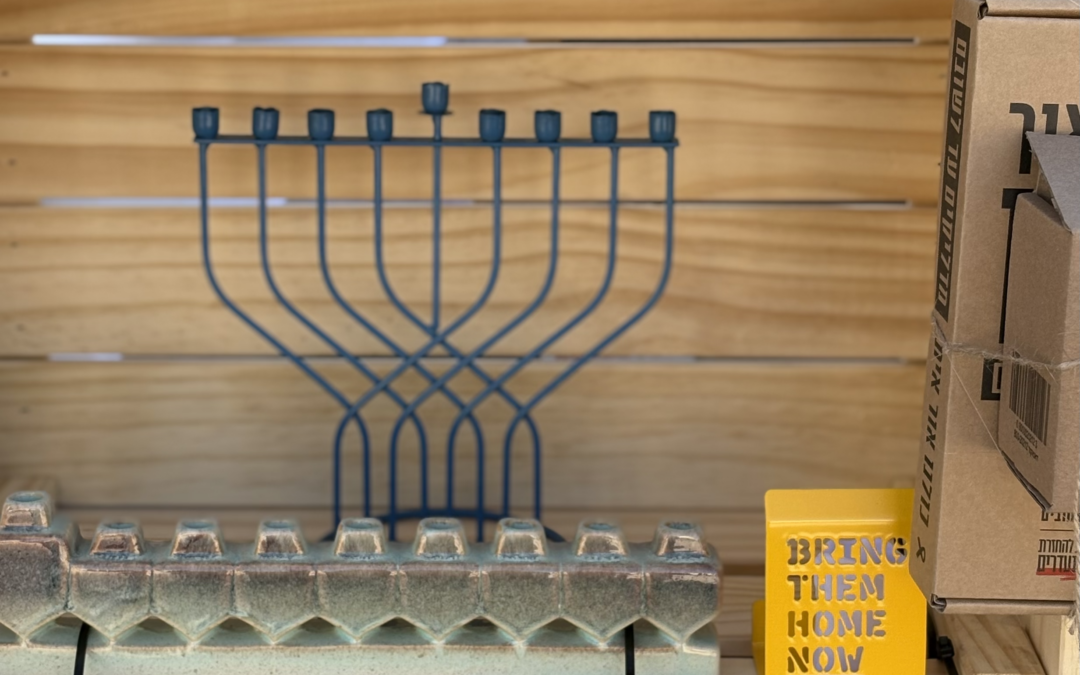
That theme, home, was what seemed to keep coming up for me again and again. Visiting Kikar Hahatufim (Hostages Square) Wednesday morning in Tel Aviv, I felt myself at the epicenter of a campaign that has touched virtually every public space in the country: machzirim otam habayta achshav, Bring Them Home Now. The hostages need to come home. The soldiers need to be able to come home. The people of Kfar Aza and Kiryat Shmona and all the other hundreds of thousands of displaced Israelis need to be safe to come home — just like the people of Beit Hanoun and Jabalya and Beit Lahiya and throughout Gaza. Everyone — every human being — needs to be safe, needs to be able to come home.
I have been to Israel many times, and I’ve lived in the country for two-plus years of my life. Visiting Israel always raises enormous questions about home for me — as I expect it does for many Jews (as it should, I believe). There is an at-homeness I experience in Israel that is just unimaginable for me in America, and at various points in my life I’ve thought about whether and how Israel could really be home for me. That internal conversation is always complicated and hard. But this trip it was even more so, because so many more people are experiencing their own displacement, their own not-at-homeness — even in, especially in, a place they think of as home. (This was only accentuated by the air raid sirens that greeted us 20 minutes after our arrival in Tel Aviv and woke us at 2:30 a.m. on Thursday night.)
The story of Joseph and his brothers is many things, but it is certainly a story about the complexities of family and home. It prompts us to ask questions like, Whom do we treat as family, and what does it mean to do so? How do we create and sustain a shared home together? And, perhaps most acutely in the story of Joseph himself, what spiritual capacities might we be capable of nurturing in those moments when we are far from home: alone in a pit without water, working as a servant in the home of a foreigner, forgotten in a prison in Egypt (or a tunnel in Gaza)?
While I have always admired people who do so, it has not been my practice to kiss the mezuzah when entering and leaving a place. But Tuesday morning in Kfar Aza, entering the shelled out childhood home of our tour guide Orit, I found my right hand instinctively rising up to the mezuzah on the way in and out. Without really even thinking about it, my body seemed to be practicing a kind of mindful awareness: You are in a home, a Jewish home, be mindful. There were family pictures, puzzles that over the years had been completed and glued together and hung on the wall, artifacts of a family’s life through decades of children and grandchildren.
Perhaps my hand was prompting my mind to pray: May Orit’s family, may all these families on all these borders, return home from their exile. May they, may we, experience healing. May they, may we, be safe. May they, may we, return home now.

Nov 21, 2024 | Blog, Rabbi Josh Feigelson, PhD, President & CEO, Institute for Jewish Spirituality
Many years ago, when my oldest son (now 21) was little, he asked for me to read him stories from a children’s bible on our shelf. It had belonged to my wife as a kid, and I was excited that Jonah wanted to hear these stories.
But of course it got complicated, because these stories are not, in fact, children’s stories for the most part. They talk about some pretty adult topics.
I particularly remember when we got to the Binding of Isaac. I was worried–talk about a story not made for children. How is he going to respond here? Do I need to do some on-the-fly editing? I read with some trepidation. And then I arrived at, “And Abraham took the knife and lifted up his hand,” and Jonah interrupted: “Whoa, whoa, whoa!”
“Here it is,” I thought. “I’m about to traumatize my child, and he’s picking up on it” (yes, I noted the irony). I stopped reading and turned to him.
“Yes?”
“Where did he get the knife?” (N.B. Evidently this wasn’t a straight translation, as the knife is mentioned in the Torah in verse 6.)
My mind had spun out a whole story about this interaction, a big set of assumptions. But it turned out that Jonah’s question wasn’t my question, and the problems he had weren’t my problems. Imagine that.
We find an incredible contrast like this in Parashat Chayei Sarah (Genesis 23:1-25:18). Abraham sends his servant to find a wife for Isaac–and we learn that the servant is a wordy fellow. A good deal of the Torah portion is taken up with recounting his private dialogue with God and then telling the story of his encounter with Rebecca–including all his concerns: How will I know she’s the one? What if she doesn’t want to come? What if I fail in this mission? Understandably, his mind seems rather unsettled right now.
And yet when the time comes and Rebecca’s family asks her, Do you want to completely change your life and go off to a foreign land and marry Isaac–who you’ve never even laid eyes on, she answers with a single word: Elekh, I’ll go (Gen. 24:58). Whatever her concerns may have been, the story conveys a sense that Rebecca’s mind, in contrast to Abraham’s servant, was calm. Her elekh is a kinetic translation of hineni–Here I am.
People often ask me, Do you think meditation is a countercultural thing in Jewish life? Honestly, yes. Why? Because we are such a wordy people. We love–and I mean love–language. We love studying through language, praying through language, playing with language. We even espouse the belief that the Creator brought the world into being through language: “And God said, ‘Let there be light.'” Jews are a people not only of the book, but of the word and the letter–of story, of law, of academic study and publication. Jews love words–and thank God for that!
Yet like so many things, this extraordinary feature of Jewish life can present a shadow side: we can become caught in our stories, trapped in our words, subsumed by our worries. We can develop an understanding that the primary or perhaps only way to respond to life is developing language around it–in our own heads, in conversation, in law or policy.
We know there are alternatives, though. There are other models of being in our minds–including the way of mindfulness meditation, an aim of which is to calm the discursive mind: that part of our mind that lives in language, that is always evaluating, judging, planning, worrying, spinning stories about the past or future. We seek to quiet it down, to practice hashkatah, quieting, as the Piacezner Rebbe put it. We try to cultivate another way of thinking, a different kind of thought–not spinning up or out, not constantly thinking new thoughts, but slower, calmer, more spacious. And that makes the kind of quiet and silence we practice in meditation still a rather counter cultural thing in Jewish life.
Yet the roots of this kind of approach to mind and language are deep in Jewish life. We can find them (irony, again) in our texts–“Better few words with intention than many without,” as the Shulchan Arukh says–and in our many practices and traditions that focus primarily not on words in the mind but actions of the body and feelings of the heart. And we can find them in our knowledge of people–friends, family, neighbors, ancestors–who embody and exemplify a life of quiet presence and spacious wisdom.
Rebecca, with her simple elekh, “I’ll go,” is one of those ancestors–as is Isaac, who goes out, simply it would seem, to pray in the field (Gen. 24:63). And in a time when we are surrounded with a surfeit of language inside our heads and out, we might tap into the strength of the spiritual inheritance of quiet they leave us.

Nov 14, 2024 | Blog, Rabbi Josh Feigelson, PhD, President & CEO, Institute for Jewish Spirituality
I was riding in a Lyft at 4:30 a.m. on Sunday morning, en route to LAX to make a flight home in time for my son’s 12th birthday party. My driver, a middle-aged African-American woman, asked me where I was headed. “Chicago.”
“Chicago?! Take me with you! That’s where I’m from.”
“Oh, where in Chicago did you grow up?”
She proceeded to name what felt like 25 different neighborhoods: First she lived in Evergreen Park, then in Bronzeville, then in Rogers Park, then PIlsen, then another, and another, and another. It felt a little like the passage in the Torah that describes the 42 different places the Israelites encamped. I got the sense that she had experienced a lot of insecurity in her life.
I told her I was glad to have traveled to Los Angeles right after the election. It was a welcome change of scenery after the tension and divisiveness of the campaign.
“You know, I really don’t pay attention to politics,” she said. “I don’t vote. And you know why? Because I have panic attacks. I have so much stress and anxiety, and I just need to try and stay calm and focused so I can pay my bills. It’s a real struggle for me to stay calm–and all that election stuff doesn’t help.”
The conversation has lingered with me all week as I’ve talked with many others about the outcome of the election and how we’re each responding. Most of the people I interact with at work and in life are college-educated American Jews, and most of them are high-information voters. Many folks volunteered on campaigns, many donated money, and virtually all voted and paid attention to the election cycle. This lovely person who was my driver in the wee hours of Sunday morning lives a very different life.
What I was most struck by was how she described struggling with anxiety and depression–because that’s something it seems we all share. So many people in my life suffer in a similar way. For so many people, across socio-economic strata, our minds, our hearts, and our bodies are overwhelmed by the weight of the world. Yet, for many of the people I know, that anxiety gets channelled into even more compulsive engagement in the news–which is, perhaps, a sign of their relative privilege of not worrying quite as much about paying their bills on a month-to-month basis. I imagine there are many other lessons and explanations.
One of the people who suffers the most in Parashat Vayera (Genesis 18:1-22:24) is Hagar, Sarah’s handmaiden who is the mother of Ishmael. While Sarah originally had encouraged Abraham to have a child with Hagar, her mood changed almost immediately–and in this week’s Torah portion, now with a child of her own, she demands that Abraham kick Hagar out of the house. Hagar and her son find themselves dying of thirst in the wilderness, and Hagar, understandably, can’t bear to watch her son suffer.
It’s at this moment that an angel calls out to Hagar and tells her that God has heard her son’s cry, ba’asher hu sham. It’s difficult to translate this phrase, but it suggests something like, “exactly where and how he is right now.” Rashi, following the Midrash, says it means that God hears and judges Ishamel exactly as he is in this moment–without consideration for what he may become in the future. And right now, he is a crying, suffering child.
Mindfulness practice teaches us to try to quiet the mind in order to be present with the truth we’re experiencing in this moment–not to become caught in the stories our minds can spin about what might be. That is, our practice encourages and guides us to listen to ourselves and others ba’asher hu sham–exactly as we are in this moment, not what we could be in the future. That’s not to say we shouldn’t be wise and discerning about what may come, or that we shouldn’t plan for the future. It’s rather to say that we should practice grounding ourselves in the truth of our experience right now, and from that grounded place try to make good judgments.
I think that’s an enormous struggle for many of us in the world we live in. For some of us, the constant overwhelm of media, the firehose of political news, the ongoing challenges in the Middle East–it can generate a state of anxiety about the world and what we take to be true. For others, like my Lyft driver, forces like economic precariousness and constant moving about might leave us without a sense of ground, an ability to feel really at home in our lives.
The invitation of our practice is to give ourselves the gift of acknowledging where we are, ba’asher hu sham–in this moment, in this time, in this place, in this body. When we do so, we have the opportunity to sense firmer ground beneath our feet, greater support amid the turbulent seas of life, water to drink amidst what can feel like a parched desert.