
Jul 5, 2012 | by Rabbi Lisa Goldstein, Former Executive Director, Institute for Jewish Spirituality

It was cool and drizzly when I left my apartment one morning last week, wearing my spring raincoat, but by mid-afternoon, it was sunny and warm. At the end of the day, I walked out of the office, leaving my coat on the rack outside my office door. I rode the crowded subway to my stop, dropped in at the grocery story to pick up a couple of things, and as I started to cross the street to my apartment, all of a sudden, I knew.

The keys to my apartment were not in my bag. They were in the pocket of my raincoat, hanging on the coat rack outside my office door.
I know that moment so well, that mental click from forgetting to remembering. It’s a cold, jarring sensation. It’s the jolt that accompanies waking up in meditation or suddenly knowing the right word for the crossword puzzle. In American Sign Language, it’s the popping up of the index finger in the sign for “understanding.” I think it must be related to the burst of the sephirah chochmah, the flash of creative insight that wasn’t there a moment ago.
The stories that accompany remembering can vary. It can be the exasperation and self-judgment that focuses on the forgetting. (“I am such an idiot! Now I have to get back on the subway, go all the way back to the office and then retrace my steps again!”) Or it can be marveling at the mind’s ability to wake up, even when it used to be asleep. (“How amazing that I remembered before I actually reached into my bag to find my keys!”) It can even be compassion. (“Our poor brains! Think of all the things that bombard us day in and day out! No wonder we forget so much. How else would we survive?”)
For me, the small, inconvenient act of forgetting and remembering spurred me to consider: what else have I forgotten? Have I remembered to be grateful for owning a key and a raincoat, for having the physical strength to get back on the subway, for having an office and a job, for walking through the early evening light in New York City with the thousands of other people, each with their own hopes and disappointments and stories?
So much of spiritual practice is about remembering to remember.
Jun 27, 2012 | by Rabbi Lisa Goldstein, Former Executive Director, Institute for Jewish Spirituality
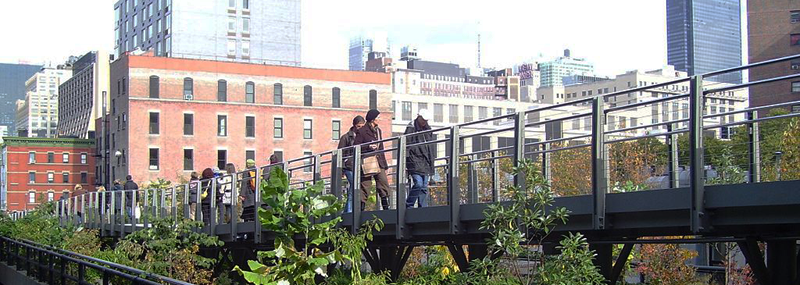
photo credit: Beyond My Ken
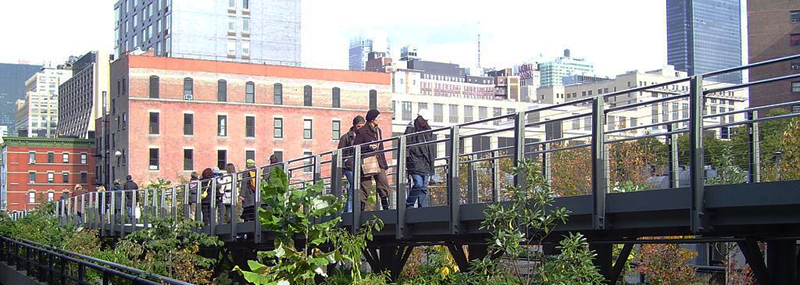
One of my favorite places to bring friends and family who come to visit me in New York is The High Line. The High Line is a former elevated railroad track that ran between the meat packing district and 34th Street. Thanks to the efforts of a handful of visionary citizens, the track is now an elevated park with beautiful gardens, intriguing art pieces, inviting gathering places and unusual third-floor views of the surrounding architecture.
I recently noticed a new art installation by the Israeli-born artist Uri Aran. It is easy to miss at first. But around 25th St, if you listen carefully, you can hear from among dense leaves a voice listing animals. Soon it is apparent that it is listing “good” animals, such as a cat or a platypus, and “bad” animals, such as a spider or shark. The voice is flat and has a slightly pompous tone.

At first, I was nonplused. What exactly makes a platypus a good animal? And why are spiders on the “bad” list? Didn’t Aran read
Charlotte’s Web?? Then I laughed: I was dividing the good and bad list into my own list of good and bad, and in a way that is every bit as arbitrary as the original list. And of course I do that all the time, about the strangers I see on the subway, the things I see in shop windows, the ideas that come into my head: Good. Bad. Good. Bad.
In fact, one of the things I most love about the High Line is that the people who created it were able to see the good in something that the city thought was bad. Here was a rusted, dilapidated eyesore, ready to be demolished. But a few neighbors had the imagination to consider what it could become – a place of wildflowers and gelato, a little urban beach and public art.
It’s a great reminder.

Jun 20, 2012 | by Rabbi Lisa Goldstein, Former Executive Director, Institute for Jewish Spirituality

I just returned from vacation, where I went hiking from village to village in the Atlas Mountains. The Atlas Mountains are very steep and rugged, but people have lived there for as long as anyone can remember. The villages cling to the sides of narrow valleys in neat, terraced rows of mud and stone houses, walnut and cherry orchards and small plots of barley and peas. The trails between the villages are narrow and rocky, created by goats and shepherds over centuries.
As we walked along these ageless paths, I found myself remembering a story I heard as a child, one of those stories that kept me awake wondering at night. There is a huge mountain a mile high. Once every hundred years, an eagle flies low over the mountain and brushes off one grain of sand from the top with the tip of its wing. Think of how long it would take to wear away the entire mountain! And yet, that is only the first second of infinity.
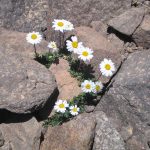
We often think of mountains as the symbol of solidness and durability. One of the teachings of mindfulness, however, is the experience of impermanence, as we observe how the breath moves in and out, how sensation changes, how thoughts arise and pass. And as we hiked, I was struck by how the mountains too are changing all the time due to the rivers washing down rocks and sand, the ice and snow carving the stone, the huge boulders that fall down to the valleys, the footsteps of hundreds of people and animals pressing down, even the alpine flowers that push up through the rocks. These mountains are in fact wearing slowly down. It is just a matter of time and scale.
Of course, if I stop to think about it, I know in my head that not even the mountains are exempt from the law of change. But to look up the valley and experience that fact took me aback for a moment. Then I thought of the blessing for seeing tall and lofty mountains: Blessed are You, God, who performs the work of creation. Who continues to perform, over long and short periods of time.
And I realized again: It is such a blessing to be small and ephemeral, to see the beauty of the world inside us and around us, to glimpse the preciousness of this life, its fragility and glory, and to share it with joy with those around us.
May 30, 2012 | by Rabbi Lisa Goldstein, Former Executive Director, Institute for Jewish Spirituality, Meditation
 I hate shopping. I get overwhelmed very easily by the competing demands of all the products, prices, and salespeople. When I can’t find what I’m looking for right away, I tend to get discouraged and walk away, often intending to make do without. So when I went to the neighborhood camera store to buy a replacement battery and they didn’t stock the kind I needed, I took a deep breath and girded my loins to plunge into what must be the world’s most bustling, enormous camera and video superstore.
It was an astonishing experience. I was directed to the second floor where I waited in a short line. The clerk typed my request into his computer and within seconds, a little bin shot up along a conveyor belt straight from the warehouse. The clerk put the battery in another bin and sent it along; I received a receipt, and went downstairs to pay. After paying, I was directed to a third station where my battery was already packaged into a little bag and was ready to be picked up and taken home. The whole thing took less than ten minutes and each person I interacted with was friendly and helpful.
This experience brought me a completely new sense of awareness and appreciation. In truth, every time I go to the grocery store or to the bookstore or to buy a new pair of hiking boots, there are steps of the process that are usually completely invisible to me. I pick the product off the shelf and take it to the cashier and carry it home. But someone keeps the books and pays the invoices for the merchandise. Someone put the product on the shelf. Someone ordered it. Someone transported it to the store. Someone packaged it. Someone made or took care of or grew it. There are entire systems at play that enable me to buy an object. And this is not even to mention the fact that some of these systems are fair and others cause untold suffering to those who are part of it and to the earth itself.
How would shopping be different if I stopped to remember the chain of people, places and events that enabled each thing I wanted to buy? Instead of being largely an experience of desire, ignorance, and gratification, could it be an experience of appreciation, awareness and responsibility? And how might that ripple out into the world?
May 23, 2012 | by Rabbi Lisa Goldstein, Former Executive Director, Institute for Jewish Spirituality
 Shavuot, the holiday that celebrates the gift of Torah, begins on Saturday night. The Torah itself describes this occasion as being accompanied by dramatic and terrifying noise and spectacle: thunder, long shofar blasts, earthquake, fire and smoke. As I type this, I am listening to the honks and sirens on Seventh Avenue far below, and I wonder: if Mt. Sinai were in New York City, would anyone notice if God started proclaiming?
Mt. Sinai, of course, is in the middle of the desert, a place of profound and almost absolute quiet. Some people say that the Hebrew word for desert, midbar, means “a place of speech.” That sounds completely counter-intuitive unless you consider that a desert is a place that is so quiet that we might finally hear the Speech that is actually there all the time. And in fact, there are midrashim, or rabbinic stories, that say that God is always speaking at Sinai, but that on the day Torah was given, the 6th of Sivan so long ago, the desert was completely silent so that we could really hear.
Contemplative Jews (including me) love those midrashim. To a contemplative person, silence is clearly the better context to hear the voice of truth. It is in the silence that the noise of life can settle down and reveal the hidden wisdom that grows underneath. So why does the Torah text itself insist that the Torah was given in the midst of so much clamor?
Perhaps it was the setting. Perhaps it was the extreme contrast between the quiet desert and the thunderous mountain that startled the Israelites into the possibility of hearing something new. In that case, in our noisy lives, the contrast of stillness may be exactly the thing that startles us into that same possibility.
My intention for this Shavuot is to engage in some great Torah learning, to spend time with dear friends and to eat some New York cheesecake. It is also to find a quiet corner, even in this frenetic city, to see if maybe I can hear something unexpected and true.
May 14, 2012 | by Rabbi Lisa Goldstein, Former Executive Director, Institute for Jewish Spirituality

Contrary to many assumptions, spiritual practice is not in fact easy. There are so many reasons – truly compelling reasons – to get up from the cushion, to close the prayerbook, to break the pose, to cancel the meeting with my hevruta (study partner). And yet, the really hard part of spiritual work begins when we transition from the centering stillness of our practice to the busy, confusing, distracting realities of everyday life. But of course, that is where spirituality especially counts: in how we treat both beloveds and strangers, in how we make the thousands of decisions, big and small, day to day. At its heart the practice of paying attention moment to moment is preparation for wise and compassionate action in the world.
This blog is intended to be reflections on trying to live a mindful life in the bustling, vital craziness of New York City. I will share my ideas, explorations and experiences in hopes that you will find them helpful in your own practice and your own life.
And I welcome your thoughts and experiences as well. Since I first had the privilege of joining the Institute for Jewish Spirituality world ten years ago as part of the second rabbinic cohort, one of the biggest surprises and greatest blessings was finding a whole community of fellow travelers. I expect to learn much from you as we all move through this miraculous complex gift of life.