Mindfulness as a Conflict Resolution Resource

Mindfulness as a Conflict Resolution Resource

Written by Rebecca Schisler in 2021, edited and adapted 10/2023

The Mishnah, the core text of the Talmud, relays a concept called “mahloket l’shem shamayim” – conflict ‘for the sake of heaven.’ The ancient rabbis valued an approach to engaging in difficult discourse which has the potential to preserve and even deepen or strengthen relationships, rather than harm them.

The critical role of mindfulness in “mahloket l’shem shamayim” became apparent for me the other night while I was on the phone with a loved one. We get along well, and he is someone whose ideological perspectives and outlooks are often similar to mine. But we found ourselves in a tense, blameful and defensive conversation with the heat rising.

In the middle of it all, I asked him if we could just take a ten-minute break. We hung up and I laid on my bed and breathed. My impulse was to come up with my next line of defense to make him feel remorse for saying something hurtful – but my experience with mindfulness practice supported me in remembering that the most skillful thing to do in a non-urgent moment of heat is to pause and allow my nervous system to regulate. I practiced mindful breathing for ten minutes. It worked. My emotions settled and my mind cleared a bit.

I called him back. Our conversation continued with more space and openness, and concluded with us joking, mutually apologizing, and appreciating what had happened.

We just needed that moment of space.

Much of what reduces harm in a moment of conflict, and potentially even makes it productive, has to do with our ability to self-regulate when we get triggered. It’s crucial that we learn how to do this – and unfortunately, it’s a skill that not all of us were taught. It’s also helpful to know the science: on a physiological level, when I am experiencing a strong emotional reaction, my access to my prefrontal cortex is compromised. This is the part of the brain that is able to empathize, reason, think critically, and self-reflect.

This means that it is unwise to attempt to have a productive conversation about difficult issues – particularly with a loved one, or someone who poses no threat and whose relationship I value – when either one of us is in a heightened state of significant emotional reactivity.

When the heat is rising, it’s time to pause, take a break, and breathe – not to plan the next line of attack or defense. In this pause, it’s best to literally just breathe. I set a timer if I need to, and focus on my breath – not my thoughts. Then, the nervous system begins to self-regulate. I am able to think more clearly. And I am less likely to say something harsh or hurtful that I’ll later regret, likely won’t help get my point across anyway, and may further the divide between us.

Global tensions are high right now. We are swirling in environments of reactivity, blame, violence, and trauma. All of this has an impact on our mental and emotional stability, and interpersonal conflict is more likely to erupt.

My friend and I agreed that a frontier in leadership must be cultivating skills for engaging in conversation with people who hold different opinions and values. There would be more solidarity, collaboration, and peace among us if we could learn to effectively process our emotions and express empathy with those with whom we disagree. This can be incredibly difficult, especially when conversations trigger our own traumas. It gets personal. But it’s possible, and always worthwhile.

As someone with loved ones across political and ideological divides, I’m not a stranger to triggering conversations. Though never easy, if engaged in a skillful and compassionate way, they are often where some of the most important change, epiphany, and healing in our lives and in our communities occurs. I’ve failed plenty of times, but I’ve learned a lot and have also succeeded in moving the needle towards greater understanding and mutuality.

If you’re struggling with how to have difficult conversations with loved ones during this time, or any time, you can utilize some principles of mindfulness practice in a basic three-part process:

      1. Become aware that you are in an emotionally reactive state. You may notice your heart beating quickly, that you are holding your breath, the heat is rising, you feel emotionally overwhelmed, you can’t find the right words, etc.
      2. Choose to pause. Gently remove yourself from the interaction if needed.
      3. Take some space to focus on your breath. 5-10 minutes of mindful breathing is ideal, but even 5 to 10 deep breaths can shift the nervous system enough to have a beneficial impact.

Learning foundations of mindfulness can support us in nurturing our capacity for wise response. IJS holds daily meditations online with guest experts in the field of Jewish mindfulness, and our Gift of Awareness course is a great starting point for beginning a practice.

During these turbulent times, may we support ourselves and one another in cultivating skills for compassionate and effective communication across divides, so that we can unify our hearts in pursuit of healing and peace, both in the world and in our own communities.

Bereshit 5784: Band of Brothers

Bereshit 5784: Band of Brothers

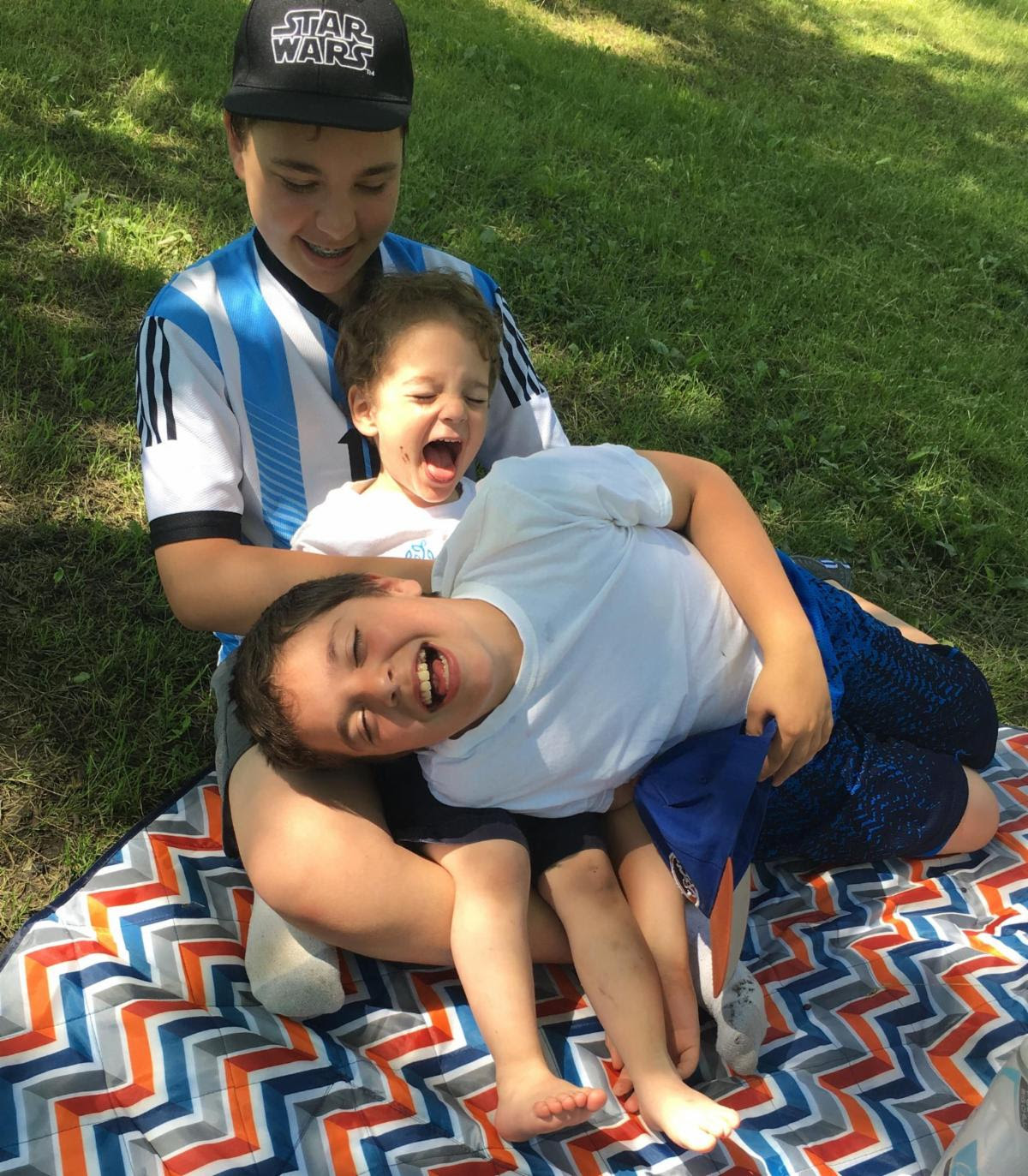
If there’s one constant to my life, it’s siblinghood. From the moment I was born, I have been the youngest of three brothers. Since my second child was born, I have been the father of siblings (pictured above on a family picnic when they were little). When my brothers and I got married, I learned what it meant to have sisters.

But my experience of siblinghood didn’t come about exclusively through biology or marriage or family life. In my rabbinic school class, we often addressed each other–half-jokingly, but also kind of seriously–as “Holy Brother!” (and often still do). In the Boy Scouts we referred to each other as brothers–the way fraternity or sorority members do, the way monks and nuns do, the way soldiers do.

And perhaps all of that has led to a lifelong preoccupation with this notion of siblinghood. What does it mean to be a brother or a sister or a sibling? Some of it has to do with sharing a language: the intimate language of family, the shared people and places and jokes. Some of it has to do with sharing experiences: shared purpose or effort or struggles. And some of it has to do with the sense of responsibility that’s present: My brothers and I know, without even asking, that we and our families can show up and stay at each other’s houses and take food from the fridge. We know, without even asking, that we can list each other as emergency contacts for our children.

The Book of Genesis is, as much as anything, an extended reflection on the meaning of siblinghood: The children of Noah, the children of Terach, Isaac and Ishmael, Rebecca and Laban, Jacob and Esau, Rachel and Leah, Joseph and Dinah and their brothers. Every Torah portion in Genesis is animated, often centrally, by questions about siblinghood–about what it means to be a brother or sister, what it means to share a common ancestor.

Of course, at root the Torah teaches us that we all–all human beings–ultimately share the same common ancestors, Adam and Eve, and beyond that, the same divine source. And thus the primordial story of siblings, that of Cain and Abel, serves as something of a touchstone for this whole exploration. This is the story that essentializes siblinghood into questions of violence and responsibility:

When they were in the field, Cain set upon his brother Abel and killed him.

God said to Cain, ‘Where is your brother Abel?’ And he said, ‘I do not know. Am I my brother’s keeper?’

‘What have you done? Hark, your brother’s blood cries out to Me from the ground!’

(Gen. 4:8-10)

While Cain’s rhetorical question, “Am I my brother’s keeper?” rings in our ears as a fundamental question about human life, the words that immediately precede them are equally important. Those words are: lo yadati, I do not know. Rashi, quoting Bereshit Rabbah, captures the importance of these two words: “He became a gonev da’at elyonah” — a deceiver of the Most High, or, perhaps more literally, he stole ultimate awareness. In his moment of rage, Cain was overcome; and in the moment following, when confronted with his action, he would not or could not allow his awareness to recognize it, so he lied to himself and to the source of genuine awareness. That led him to ask a question, “Am I my brother’s keeper?” which, it would seem, he meant rhetorically–“I bear no responsibility for him!” And we can understand why Cain spins this story in his mind, because when he is ultimately forced to confront the reality of his actions, he is overcome once again: “My sin is too great to bear” (4:13), he cries. In the immortal words of Jack Nicholson: He can’t handle the truth.

The question of siblinghood–who, if anyone, we call a brother or sister or sibling; who, if anyone, we label as a friend, a neutral, an enemy; who, if anyone, we call a tragic but necessary casualty; and what, on the basis of that labeling, our posture is towards them–this is one of the deepest, most difficult, and most important questions we confront. We are living through a time suffused with these questions right now. It’s why so many of us are shedding tears.

It should go without saying that the violence and brutality suffered by so many Israelis at the hands of Hamas last Shabbat were heinous desecrations of the image of God. Failing to acknowledge this is, itself, an act of “stealing ultimate awareness.” Likewise, failing to acknowledge that those who were murdered and kidnapped seem to have been targeted for no other reason than that they were Jews (or people who were with Jews at the time) is an act of seemingly unconscionable disbelief. We Jews, who have endured so much trauma through the centuries, are understandably activated by it.

And: The question of da’at, awareness, is ultimately the question that keeps coming back–day by day, hour by hour, moment by moment. Where are we directing our awareness? Toward whom? With what kind of quality or valence–curious, compassionate, angry, something else? What do we notice, and what do we–willingly or unwillingly, wisely or unwisely–overlook?

Just last week, our people read the Book of Kohelet (Ecclesiastes). My own wonderful rabbi, Ari Hart, like many others I expect, went to that book for guidance as the violence unfolded in shul in real time. Ari invoked Kohelet’s most famous passage: “A season is set for everything, a time for every experience under heaven.” Speaking for myself, the time isn’t right yet–I still feel too raw to create the necessary space to reflect dispassionately on where and how to train my awareness. Hostages are in harm’s way. My own loved ones are on the front lines. My practice helps, but there are still many many moments when tears cloud my vision and my thinking. And I’m not living under threat of rocket fire.

And, in the same breath, the gifts and demands of da’at, of awareness, this most basic element of our humanity and thus our status as images of the Creator–those gifts are ever-accessible, those demands are ever-present. And so I practice, and I invite you to practice, in the aspiration that, through all the fog and haze, in the midst of all the chaos and tumult in the world and in our mind-hearts, our da’at might be whole and our bodies, our spirits, and our worlds–and the bodies, spirits and worlds of our brothers and sisters and siblings, and of all beings–might be at peace.

Bereshit 5784: Band of Brothers

A Special Message from IJS

Dear friends,

Like so many others, I awoke this past Shabbat morning to the heart-rending news from Israel. And like so many others, as the hours and days have unfolded, I have struggled to contain all the emotions: fear, grief, anger, confusion, gratitude for those who are keeping others safe and bringing healing to those in need. As I danced with my community on Simchat Torah–somberly, with tears in my eyes–I felt a new appreciation for Rabbi Abraham Joshua Heschel’s famous words about praying with his feet.

Like so many others, I am praying for the well-being of my own family, friends, and loved ones, including nieces and nephews who have been called back to active duty, a brother and sister-in-law and many good friends who, like millions of others–Israelis and Palestinians–must now seek shelter from bombs and missiles. These prayers come alongside our collective prayers for the safe return of those taken captive, healing for the injured, safety for innocents, and a peaceful resolution to the war as soon as possible.

And, perhaps like you, I find that in these times, I lean on my spiritual practice as much as ever. I find comfort and insight arising from meditation. I find healing in prayer, chant, and song. I find wisdom and depth in the words of Torah.

But most important, I find that now is when community matters most to me. It is in that spirit that I write today to say: the IJS community is here for you. Now, as ever, we are here for you with all of our resources: Our daily Jewish meditation sit at 12:30 pm ET or on demand; our weekly Jewish yoga studio at 11:00 am ET on Mondays; our podcasts and courses; our teachings and our teachers. We are here for you, we are here for one another, day in and day out.

These are hard days, and hard days are why we practice–together. As the Jewish people and the world make our way through this profoundly difficult time, I invite you both to lean on this community and to join in so that others may lean on you.

With blessings for well-being and prayers for peace,

Rabbi Josh Feigelson, PhD
President & CEO

Bereshit 5784: Band of Brothers

Shemini Atzeret 5784: Being There

Like many people, I grew up with a beautiful Yom Kippur break-fast. Immediately after the end of services, my family would drive over to our family friends, the Rubinfelds. Rivka, the matriarch, always had out a delicious spread of bagels and lox and whitefish and rugelach. I remember the acidic sting of orange juice in my parched mouth, and the sensation of it landing at the bottom of my empty stomach. (I also remember that the radio was always on during the day at the Rubinfeld house, ever since 1973. Rivka is Israeli.)

My own children haven’t grown up with this ritual, which I regret. A big reason why is that in the early years of our family life, I was a rabbi with institutional responsibilities. I oversaw three simultaneous services on campus at Northwestern University. And, being a younger man than I am now, not only did I give sermons at all of them and co-lead the Reform service, I also timed things such that I could lead Musaf and Ne’ilah myself at the Orthodox service, my home base. By the end of it all, I was so exhausted that I could barely move. The kids were little, and it became easiest for them to just go home and for me to make my way there eventually. Break-fast became a bowl of cereal.

But like most things, there was a silver lining. After everyone had hurried out to go to their break-fasts, I remember lingering in the room that served as our little shul. It was just me and the room. I still had on my kittel, the white robe I had worn for most of the last 25 hours. And in that empty room, I could still sense the energy and life force we had generated and shared, the songs we had sung, the heartfelt prayers we had offered. The room was empty, and yet it was full—not in a nostalgic way, but in some way that was both present and absent at the same time. 

My podcast this week, devoted to the holiday of Shemini Atzeret that we observe this Shabbat, is about lingering. The Talmud imagines the Holy One saying to the people of Israel something to the effect of, “We’ve had such a wonderful time together these last weeks. Stay one more day.” Hence Shemini Atzeret has no particular mitzvot: no sukkah or lulav, no matzah, no shofar. Just being. Or, perhaps, lingering—just as I was somehow moved to do at the end of Yom Kippur years ago.

The way the calendar works out this year, Shemini Atzeret is the day on which we read the book of Kohelet (Ecclesiastes, also sometimes spelled Qohelet). One of the reasons we read this book at this time of year, I believe, is that it reflects this mood—a combination of spiritual groundedness, wistfulness at the passage of time, the sensibility of taking it all in after “the long season of tending and growth” in the words of Marge Piercy, aware that it will fade and pass and arise again. In this, Kohelet’s mood is not unlike a kind of posture we cultivate in mindfulness meditation as we bring awareness to the life-giving sensation of breath entering our nostrils and lungs, and then fading as we breathe back out into the world.

Breath, one way to translate the word hevel in Hebrew, is a—perhaps the—central metaphor in Qohelet. As Rabbi Audbrey Glazer writes in the introduction to the stunning new translation and commentary of Qohelet he developed with Rabbi Martin Cohen, “Hevel… manifests a ‘qualified optimism’ such that awareness of the evanescent feeling of life as vapor enables a deeper cultivation of joy! ‘Enjoy life, for not only injustice, but everything, is contingent.’ By enjoying the passing pleasures from moment to moment, we can deepen our appreciation of the nature of being amidst its evanescence. Such awareness then further reveals its own glimmers of deeper light that wash over the present.”

We have traveled a long journey these last months—in fact, this entire last year: A journey through Torah (we start all over this week!), through the holiday cycle, through the seasons, through natural rhythms of birth, growth, and life, dying, death, and decay. Shemini Atzeret, this final moment on the journey, invites us to breathe, to delight in our awareness, and to start the cycle anew with, hopefully, a deeper sense of loving interconnection (hesed), a greater capacity for compassion (rachamim), a refined attunement to true joy (simcha), and an expanded quality of wholeness and peace (shalom) within, between, and all around us. May it be so.

Sukkot 5784: The Embrace of the Sukkah

Sukkot 5784: The Embrace of the Sukkah

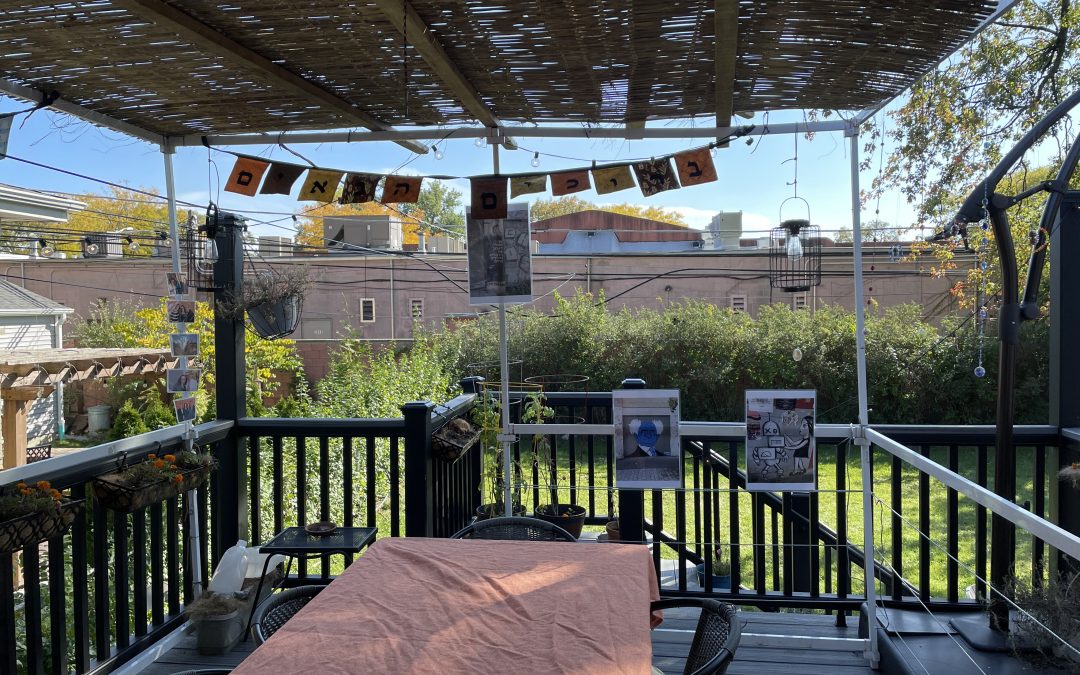
One of the many emotional moments of my year of mourning for my father came when I was building our sukkah. Sukkah-building is often a family affair, because it’s so hard to do alone and it’s something kids generally love to do. That was true for me growing up, and it has been true with my own children. While so many other Jewish rituals involve putting away and cleaning up, sukkah-building is creating something where nothing existed before. Unlike cooking, a sukkah doesn’t get consumed but lasts. It lives in space. And you can decorate it. What’s not to love?

But what also usually happens in our family is that the kids get tired after the initial phase. So after my children had helped put together the poles and put up the canvas tarp (the skhach—a bamboo mat in our case—would go on top much closer to the holiday), I was left alone to do some of the last touches. That year, I decided to secure the sukkah to a railing so that it wouldn’t blow around too much, as it had the year before. I took out some rope and began tying knots and hitches I had learned in the Boy Scouts.

And that’s when I thought of my Dad, who had been our Scoutmaster growing up and who taught me not only how to do the actions I was performing with my hands, but the context in which I was doing them. As I wrote in a letter to him that I posted on Facebook, “I would have loved to call you to tell you about it, because I know you would have schepped a lot of nachas. I’m sure you’re enjoying a wonderful sukkah up there. We have a picture of you in ours, and we miss you.” (Picture of our family sukkah is above.)

There’s something in this story that gets at the heart of what Sukkot can be: a time of visceral, embodied, felt openness and flow—between the natural world and the world of civilization we construct that, in our minds at least, separates us from it; between people past and future who are with us here in the present, guiding our hands and visiting us as ushpizin; between our own hearts, minds, and bodies, which, in this uniquely physical, spatial ritual, flow through one another.

Yet for all that, the act of sukkah-building and sukkah-dwelling depends on letting go (something I explored last week). The sukkah is meant to be a temporary dwelling, and this particularly comes through in the requirements for the roof. As the Mishnah teaches, the skhach or roof of the sukkah must be made of formerly living material. If one had a grape vine and wove it on top of the sukkah in order to serve as skhach, the sukkah would not be a sukkah until the vine was cut. As long as it’s still attached to the earth, still holding on and still able to grow later, it can’t serve as skhach. The message would seem to be: We can’t hold on. We have to let go.

In that letting go, of course, we find possibilities for different forms of embrace—with neighbors, loved ones, ourselves, the world, the Holy One. By opening the walls and doors of our homes, by venturing outside, we bring down the baffles of our regular homes and can enter the embrace of a less secure yet more expansive sense of home.

Haazinu 5784: Let It Go

Haazinu 5784: Let It Go

Earlier this year, my youngest son, Toby, and I watched The Lord of the Rings trilogy together. He is a fantasy genre lover, and, true to form, fell in love with the story of Frodo Baggins’s long journey to Mount Doom, his struggle to carry the Ring of Power along the way, and his mission to throw the ring into the lava inside the mountain and destroy the ring once and for all.

Of course, Frodo doesn’t do this alone. He has the help and support of a whole fellowship (the titular “Fellowship of the Ring” of the first of the three books/films). And in particular, he has the help of his closest friend, Sam, who is always looking out for him. In the climactic scene of the film, Frodo stands inside the volcano, holding the ring out over the lava. All he has to do is drop it. But the Ring of Power, as it has done throughout his journey, beckons him with a seductive call, and he can’t manage to do this one simple final act—the act that will stop a war and save the world. Sam calls out, “Just let it go!” But Frodo can’t.

In case you haven’t seen it, I won’t spoil what happens next. Suffice it to say the ring does ultimately wind up in the lava—but Frodo is left hanging from a rock above the molten lava, clinging on for dear life. He has no strength left. His mission is accomplished. He contemplates letting his life end. But Sam reaches out to him and, in the first words spoken since his last exhortation, he now says, “Don’t you let go!”

I had never noticed this parallelism before, the “Just let it go” and “Don’t you let go” of Sam in this scene. But it struck a deep chord in me on this viewing and I’ve been coming back to it frequently in the months since. Because it encapsulates so simply one of the fundamental discernments we constantly have to make: When do we hold on? And when do we let go?

On deep level, human development can be summarized as living these two questions: From the holding on/clinging that characterizes the relationship between a parent and an infant, to the letting go that happens at the moment of death, grief, and mourning. Like a heartbeat, the stages in between are full of grasping and relaxing, closing and opening our grip, in real and metaphorical ways: in relation to people, things, places, ideas, identities. What do we hold on to? What do we let go? The question pulsates, returning again and again.

One of my favorite prayers in the Yom Kippur liturgy comes in the evening service: Ki Hinei kaChomer, “Like Simple Clay.” The poem, from 12th century France, compares the Jews gathered to pray to raw material in the hands of various tradespeople: clay in the hands of the potter, uncut stone in the hands of the mason, silver in the hands of the smith, etc. The craftsperson chooses what to do: to shape gently, to stretch and mold, to smash, to melt, to crush. “So too are we in Your hand,” the poem says of the Holy One, with a plea to “look to Your Covenant,” remember our relationship, and not give in to baser inclinations.

Many folks, including, most likely, the author of the poem, understand the theology here as something roughly like, “We deserve to be destroyed, but please forgive us and let us live.” If that works for you, abi gezunt as we might say in Yiddish—great! I’ll confess that it doesn’t work so well for me and, if you’re reading this, I expect it might not work so well for you either. So let me offer another way to read it, influenced by the example of Sam and Frodo.

It is not only the Holy One who is the potter holding clay or the ship captain steering the rudder. We are also those people. In every moment, we hold in our hands the raw material of life: our breath, our awareness, our presence. When we “look to the Covenant” and remember the virtues of lovingkindness and compassion—the essence of the 13 Attributes of Mercy which form the core of Yom Kippur—we have the opportunity to adjust our grip: To loosen it where we are holding too tightly, to strengthen it where it has become slack. That invitation/demand is available in every moment, with every breath. It is even more available on Shabbat. And it is especially available on Yom Kippur, Shabbat Shabbaton—an ultimate Shabbat in which we set aside the cares of the world for a day and so that we may abide in our individual and collective presence, and the Divine Presence.

My blessing and prayer for you and all of us, then, is that Yom Kippur be a moment–or, really, a long series of moments–of letting go of what needs to be let go, and holding on to what needs holding. May we emerge from this day rebalanced and renewed in our embrace of life, the world, one another, and the Divine Presence.