It’s Darkest Before the Dawn: Vayishlach 5784

It’s Darkest Before the Dawn: Vayishlach 5784

Like so many others, I’ve been struggling for words since October 7. “Ein milim,” “There are no words,” is the phrase many Israelis have used to greet one another. For me, it feels like this time has tested the limits of my ability to formulate words, that language is insufficient to reflect and express all the thoughts and emotions I’ve been having.

Regular readers will have noticed that I’ve been preoccupied with questions of speech and silence in the last eight weeks, for this very reason. Judaism is, if nothing else, a tribute to the magnificent possibilities of language. It’s probably why silence feels so immediately countercultural to so many Jews–even though Judaism has a rich tradition of teachings and practices of silence, many of which we teach here at IJS.

But we’re living in a moment when, especially thanks to social media, we may judge ourselves–and we are certainly judged by others–about both our speech and our silence, the words we say or write and the ones we don’t. In the last two months, I have received my share of critical feedback for personal or organizational statements that, in the eyes of the reader, failed to say what needed to be said–on behalf of Jewish Israelis, Arab Israelis, Palestinian Arabs, Jews confronting antisemitism, Muslims confronting Islamophobia, the kidnapped, the soldiers, the innocent civilians. Feedback has come from everyone from strangers to former students to close relatives. As a result, I have felt acutely aware of and careful with the words I’ve said and written—and with those I’ve left unexpressed. I have felt a kind of sensitivity, an intense critical gaze, peering over me and judging me both for the letters on the page and the spaces in between them.

To be sure, I’ve gotten much more positive feedback than negative. And I appreciate every piece of feedback, whether affirming or critical, as it’s a gift that enables me to learn and grow. But if, as the great leadership theorist Ron Heifetz teaches, leadership is the art of letting people down at a rate they can absorb, then–and I’ll say this on behalf of my fellow Jewish communal leaders–our speech acts today feel like an acute lesson in its limits. Language doesn’t seem capable of communicating all that we want and need to express. It often feels like I’m groping around in the dark, looking for words and expressions I can’t quite find, waiting for the sun to shine and illuminate them for me.

Parashat Vayishlach brings us to the climax of the story of Jacob, so much of which takes place at night. As Avivah Zornberg has noted, Jacob is a creature of the dark, the night: He steals Esau’s blessing from his blind father, Isaac, who lives in a kind of perpetual nighttime; his dream of the ladder connecting heaven and earth takes place at night; his own deception at the hands of Laban, resulting in his marriage to not only Rachel but her sister Leah too, happens at night; it’s at night that he paints Laban’s flocks, and it’s in the darkness that he flees Laban with his family. Now, as he prepares to encounter Esau, he is again awake in the middle of the night, making preparations.

It is notable, therefore, that Jacob’s famous wrestling match with the mysterious man/angel takes place as the sun is about to rise: “And he wrestled with him until the break of dawn” (Gen. 32:25), and “He said, ‘Let me go, for dawn is breaking,’” (v. 27). After the angel leaves, the Torah notes that “the sun rose upon him” (v. 32). Rashi picks up on a perhaps unusual detail in the Hebrew in this last verse: viyzrach lo hashemesh, literally “the sun shone for him.” Rashi seems puzzled about the word lo, for him. His first interpretation is that this is idiomatic, the way we might say that “the sun was shining on me” to mean that something good happened for us: “When we reached such-and-such a place, the sun shone on us.” In this case, it comes to say, perhaps, that the sun shone upon him and he was healed of the injury he sustained in his fight. Or, Rashi offers, that just as the sun had set when Jacob left home (Gen. 18:11), it now rose to greet him as he returned.

But perhaps the Torah is gesturing at the idea that, after a lifetime of living in the murkiness of the night, Jacob finally experienced the light that comes “seeing the Divine face to face” (v. 31), of arriving at not only a physical but a spiritual home. Perhaps Jacob is finally at home with himself—and thus prepared to encounter his twin brother not from a place of fear or lack, but from a grounded sense of abundance: “To see your face is like seeing the face of God,” he tells Esau. “I have everything” (33:10-11)—I am content, I am not afraid, I can embrace you wholeheartedly.

Despite the Rabbis’ midrashic and Talmudic interpretations, I think the plain meaning of the story is that Jacob and Esau both mature into a posture of generosity. They are willing to give one another the benefit of the doubt, to be charitable in both their speaking and their listening. We don’t know what might have led Esau to that, but we can see that, for Jacob, it comes about after the profound inner work that allows the shadows of the night to emerge into the warmth and clarity of sunshine. That’s something I’m working on for myself as a I read and listen to the words of others, and I hope it’s something you’re working on, too. As we make our way through our own long nights, we need all the help we can get. May we support one another on the journey toward the dawn.


Wordly Wise: Toldot 5784

Wordly Wise: Toldot 5784

I recently heard a podcast interview with Benjamin Wittes, the editor of a blog called Lawfare that I read every now and then. Wittes was talking about the role of context in determining the meaning of speech acts according to the law. He cited the following example: If an insurance salesman says to me, “You have a beautiful house, it would be a shame if something happened to it,” we can understand that as a perfectly normal thing to say. But if a mob boss says the same thing to me, we would understand that as a threat. That is to say, words often don’t have absolute meaning. Rather, we have to understand the context in which they are uttered in order to discern the meaning they convey.

I’ve been thinking about this issue of words and context a lot lately, in the midst of the Israel-Hamas war. There has been, of course, a great deal of public discussion of the meaning and context of the words, “From the river to the sea.” Likewise, we encounter questions about the context in which references to Amalek are invoked, or  the meaning of words like “humanitarian pause” or “ceasefire.” At the rally on the National Mall that I attended on Tuesday, I found myself thinking about how messages that are directed internally to the Jewish community are understood by people in other communities—or how words directed internally within other communities are heard and experienced by our own, given our particular stories and experience. Words like “Never Again” can evoke different emotional responses depending on our own history, who is saying them, where and when.

There is perhaps nothing Jewish tradition does better than consider the possible meanings of words. Torah, in its broadest meaning, is understood not only as the Five Books of Moses, but the thousands of years of interpretation of those books—and of the further interpretation and discussion of those interpretations. For Jews, the work of making and interpreting and understanding language is the holiest thing there is. It is what we mean—or, perhaps more accurately, one of the things I think we mean—when we say, as the Mishnah does, “The study of Torah is equivalent to all the other mitzvot put together.”

Parashat Toldot contains one of the murkiest, most mysterious passages in the Torah: Jacob’s deception of his elderly, blind father, Isaac, in order to steal his brother Esau’s blessing. One of the ways we can understand this story is as a reflection on the complexities of language and interpretation. We can read the story as the struggle of Isaac to understand clearly what is happening—and of Jacob to discern how to behave. As readers, we sense Isaac’s profound challenge: He seems to know something is off in this situation, as reflected in his repeated attempts to verify the identity of Jacob (who he thinks, and wants to believe, is Esau). We can sense Jacob’s struggle to carry out the task. And we can even sense the struggle we, as readers and interpreters, have in discerning the meaning of the story—this last perhaps most clearly when Isaac asks, “Who are you, my son,” and Jacob replies, “I am Esau, your firstborn.” Rashi, unable to live with the idea that Jacob lied so directly, strains credulity by parsing the verse, “I am, [and] Esau is your firstborn.” In the context of the story, such an interpretation is incredible. In the context of Rashi’s larger project, and his theological and ideological commitments, it’s understandable. Context is key.

One of the values I find in mindfulness practice is that it invites, even demands of me to pause and consider the context of words—both words I speak or write and words I hear or read. As I shared recently, I’ve been referring a lot lately to the Buddha’s five principles of right speech (and right listening): Are these words true? Are they timely? Are they gentle? Are they beneficial? Are they spoken with goodwill? Wartime is, almost by definition, one in which our capacity to create space between stimulus and response is reduced. Our world of social media, which is designed to feed and feed on our reactive impulses, intensifies that reality even more.

All of which suggests to me that we need to double down on our practice, to insist on more space and time in evaluating the words we see and hear, and the contexts in which we see and hear them, and crafting the words we put out into the world and the contexts in which we do so (and, it should go without saying, to reduce our time on social media).

So much depends on our words. A few words uttered by Jacob in this week’s Torah portion have an enormous effect on his own life and that of his descendants—right down to today. May our practice help us communicate wisely and listen with clarity and resilience.

The Reach of Our Light

The Reach of Our Light

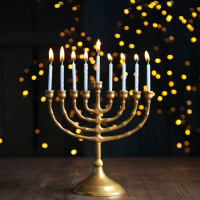
I was a teenager the first time I was in Jerusalem for Hannukah. Coming from Christmas-centric life in Toronto where every grocery, pharmacy, and book store was splashed in tinsel and endlessly rang out Christmas muzak, I remember how surprising, how moving it was to be in Jerusalem and feel the presence of Hannukah everywhere. Sitting in an Italian restaurant, the whole dining room was brought to a hush as the owner lit the candles of the hannukiah and everyone in the restaurant sang together. Entire main streets of store windows had electric hannukiah bulbs shining into the night. But I found the most striking sight walking in older neighborhoods where the four-story apartment buildings with little courtyards in front of them had low stone walls abutting the sidewalk – and there, sitting on the stone walls, at the edge of each building’s property, were glass aquariums with lit hannukiyot inside them. Along the length of these quiet streets, the sidewalks were flanked with these glowing, flickering outdoor flames.

The Sages of the Talmud teach – it is a mitzvah to place the hannukiah at the entrance of your home, on the outside.  And if you live upstairs, they alternatively assert, place the hannukiah in the window, facing the public domain. Igniting the flame (hadlakah) is only half of the practice at the heart of lighting the Chanukah candles. The lighting is partnered with the act of placing the candles (hanacha) so that they are visible to the outside world. This can be within the warmth and enclosure of your home, shining outward, but if possible, we are called upon to bring this light to the outer edges of our property, to the farthest boundary that our personal domain can reach, touching the public sphere.

What a beautiful image for practice. Chanukah candles serve such a different purpose than Shabbat candles. Shabbat candles are meant to give light to our individual homes, to bring pleasure as well as utilitarian light to the intimacy of our meal and to the company of those gathered around our Shabbat tables. Even the circling gesture of waving our hands three times around the Shabbat candles gathers their light inward. The placement of Chanukah candles, on the other hand, is guiding our intention and attention outward. It is striking that the light of the Chanukah candles should not be functional. It is not intended to light up our homes and we are prohibited from making any mundane use of it. We are instructed simply, subtly, just to look at the light of the candles, and to make it accessible, available for others to be able to look at it too. It becomes our conscious intention for the light that we ignite to touch all those whose lives brush past our own. The boundary between inside and outside dissolves along with the boundary between insider and outsider. And it’s the light that connects us to one another.   

So let’s ask the question that carries the literal flame of the candles into the illumination of our souls – in this dissolving of boundaries, how do we strengthen and direct our inner light so that it extends to the outer limits of our reach, enabling many, many others to be lit up by it? 

R. Levi Yitzchak of Berditchev (18th century Hasidic master) teaches that hanacha, placement, comes from the same root as menucha, rest. He states, “And menucha – rest is called the container in which you put love.” The practice of lighting and placing the Hannukah candles is teaching us to locate a quality of restfulness within. There, we create a container within us for love to be nurtured and amplified so that it can be felt by others, so that it becomes visible to others in the softness and warmth of our gaze, our presence. As the hours of sunlight grow brief and night stretches long, as the air gets colder and the impulse to hibernate and withdraw might feel strong, we are invited to instead extend warmth and light through our whole beings to everyone we encounter.  We’re invited to be creative about the ways we reach beyond our usual circles, to extend loving. We’re invited to be daring in thinking of the directions we extend ourselves – to reach toward painful places, to meet people in the rifts of conflict, in the dissonance of difference, to find delightful strangers and mirror to them their beauty and goodness and to receive others mirroring your own beauty and goodness back to you.

We have the opportunity to help each other in this. Know that we are in a collective project, generating collective energy in reaching light outward with compassion and kindness. Know that you can bring relief. Know that you can bring love into much needed places. The more we practice, the more radiant the inner container becomes, and the further and clearer its light can extend.

Loving and Pursuing Peace

Loving and Pursuing Peace

Pursuing peace in our incredibly polarized and conflicted world can be a tall order. But our mishnah has some guidance for us in this endeavor. It is written there that we must be like Aaron, the high priest, both rodef shalom—pursuers of peace—as well as ohev shalom—lovers of peace. Pursuing peace has to do with our action in the world – we have to go for it, to work for it and make it happen! And ohev shalom, which the rabbis teach actually proceeds rodef shalom—has to do with loving peace.

Chayei Sarah: Into the Multiverse

Chayei Sarah: Into the Multiverse

My oldest son, Jonah, was the first to introduce me to the contemporary idea of the “multiverse.” While the concept, and even the term, have been around for centuries (Wikipedia tells me William James used it in 1895), the notion has gained particular traction in today’s media. The TV show “Rick and Morty,” which Jonah loves, is built on the idea of “infinite timelines, infinite possibilities” in infinite universes that the scientist Rick has figured out how to travel between. There are the recent Spiderman movies, which feature a multiverse containing infinite varieties of Spider-people (and even a SpiderPig). Even if you’re not familiar with these more recent vintages, much science fiction writing about time machines is built on the notion of multiple possible timelines/storylines and the ability to alter history (see Star Trek, for example).

I speculate that one reason the concept seems so prevalent today has to do with the internet, which has opened up so many possible storylines. Jonah is 20 years old, meaning he has never really known a world without Google or YouTube or even social media. Don’t like the story? Then just create a new one and post it. A second reason might also be the calamitous storylines we seem to be on–climate change in particular–and the implicit promise that either we might somehow change them through accessing the multiverse or that, even if our world is headed in the wrong direction, there are other versions of us out there who are ok.

This last observation points up a kind of fulcrum on which the multiverse hinges: It can offer us an optimistic vision (“We can change the story!”) or a rather nihilistic coping mechanism (“We’re done for, but it’s okay because humanity in a parallel universe is living harmoniously on solar energy and fusion and eating plant-based food.”). Sitting on that see-saw can be exhausting, as one moves from optimism one moment to pessimism the next. Perhaps that’s where mindfulness practice comes in: to allow us to sit calmly at the fulcrum, neither dreaming about a hopeful future nor dreading a hopeless one, but just being present in the present with what’s here and real right now in our experience.

One of the striking things about Parashat Chayei Sarah is that a large chunk of it is devoted to telling and then retelling the same story, that of Abraham’s servant to find a wife for Isaac. (I wrote about this in my essay on Chayei Sarah in Eternal Questions.) The differences in the accounts of the omniscient narrator and the servant himself are not major; they don’t take place, as it were, on separate timelines. The differences are so imperceptible that the medieval commentators don’t make much of the story, even though it takes up a good deal of real estate in the Torah portion. But I think one of the lessons the Torah is teaching in repeating the story is that we, ourselves, are capable of telling different versions of the same story. We are capable of imagination. While, yes, we aim to see clearly the truth of what is happening, we simultaneously acknowledge that the truth can be experienced and told in multiple ways. Perhaps, that is to say, we already live in the multiverse.

For me, as for many, this Shabbat is going to begin and end an hour earlier than it did last week because we turned back the clocks. I have always found the effect of this clock change on my Shabbat experience to be striking. Through an act of collective consciousness, we have agreed that the sun now sets at 4:35 this week instead of 5:43 last week where I live in Skokie, and that changes the storyline of my day and even my week. Though the sun still rises and sets in more or less the same parts of the sky as it did a week ago, my relationship with the colors and rhythms of the natural world, not to mention with work and family schedules, is changed considerably. It’s jarring and a bit mysterious, a little thrilling and a little scary (and a little crazy-making: I’ve been waking up before 5 am all week).

Shabbat itself is, of course, an act of imagination: While the Rabbis maintain that Shabbat exists every seven days whether we observe it or not, our experience is that we have to collectively choose to make it for ourselves–or, perhaps, we have to allow ourselves to be chosen by Shabbat. (Yes, this calls to mind Ahad Ha-Am’s famous line: “More than the Jewish people has kept Shabbat, Shabbat has kept the Jewish people.”) We might think of Shabbat as a gift from the multiverse (which might itself be another name for the Infinite), telling us that there is a different way to live, a different way to be, than the way we experience the world the other six days of the week–and it doesn’t involve escaping to somewhere else or hoping for a superhero to save us, but is, instead, available to us right here, right now. With all the suffering we and so many others are enduring today, that is a gift I want to give myself, you, and everyone.

Mindfulness: The Foundation for Peacemaking (Vayera 5784)

Mindfulness: The Foundation for Peacemaking (Vayera 5784)

Twenty-five years ago, right out of college, I lived in Jerusalem for a year. While I grew up with a very strong Jewish identity, I didn’t receive the kind of Jewish education that would allow me to study Talmud in the original Hebrew/Aramaic or to walk into a beit midrash and know what all the books on the shelf were, much less how to open them up and study from them. In college I met people who did have that kind of education, so I decided to spend my first year after graduation acquiring it. That took me to Jerusalem.

My mom had a friend from Ann Arbor whose son was my age–he went to the high school across town, so we didn’t know each other–and who was also spending the year in Jerusalem. His name was Chris, and his family was of Palestinian Arab ancestry. Chris had studied to be a journalist and had an internship that year at the Jerusalem Times, an English-language Arab newspaper. Our mothers suggested we meet. We did, and we became friends.

Chris spent a couple afternoons a week tutoring students at Bethlehem University in English. He invited me to join him and I was excited to go. These were the heady days between the Oslo Accords and the second intifada, the days of od yavo shalom aleinu. Transportation wasn’t difficult, though it did require bringing my passport along for a ride on a bus line serving the Arab community that left from just outside Damascus Gate. An Israeli soldier boarded the bus to check everyone’s papers on the return trip. I made the journey several times.

These were still the nascent days of email and well before social media, so I confess that I’ve fallen out of touch with the people I met then, including Chris. But a few memories stand out a quarter-century later, memories I find stirring in me these days.

The first is that, while I felt safe enough to go, I did not feel safe enough to identify as a Jew. The rest of the time I lived in Jerusalem I walked around wearing a kippah and flowing tzitzit. But as I approached Damascus gate, I took off the kippah and tucked the tzitzit into my pants. As soon as I got off the bus on Derekh Hevron, on the edge of the Jewish neighborhoods of south Jerusalem, the kippah went back on and the tzitzit came back out.

Related to this, I remember an encounter with a young woman at the university. At one point she asked me, “Are you Arab?” I told her I wasn’t, but I didn’t tell her I was Jewish, either. “Amazing. You look like an Arab.”

I remember disembarking from the bus and walking down the hill toward my apartment, the sun beginning to set over Jerusalem. And I remember feeling, even in those more hopeful days, this indescribably melancholy feeling: My bus ride had been less than ten miles; genetically, it seemed, I could pass for an Arab (and of course she could pass for a Jew); and yet these two societies felt worlds apart.

The story of Abraham prompts me to reflect on some elements of my own story here: the passing (in the form of Abraham trying to pass off Sarah as his sister); the so-close-yet-so-far nature of the relationship between Ishmael and Isaac and their descendants; questions of speech and silence, of honesty and something less than it; questions of fear and courage.

While Parashat Vayera contains the Greatest Hits of the story of Abraham–welcoming the angels, standing up for the people of Sodom, the Akedah–there’s a little story nestled within it that often gets overlooked. It comes just after Hagar and Ishmael are rescued in the wilderness and before the Binding of Isaac. It’s the story of Avimelech and Abraham resolving a land dispute. Set against the backdrop of their previous history, which involved deception and the threat of sexual violence, it’s all the more remarkable: Abraham and Avimelech are able establish a kind of working trust of each other. “The two of them made a covenant,” the Torah says (Gen. 21:27) and “Abraham resided in the land of the Philistines for many days” (v. 34).

Our work at IJS is not that of policy, so it seems far out of my lane to comment on military or political strategy. And in the fog of war and the age of quick takes and misinformation, I find myself doubling down on the importance of listening, discernment, and what I’ve come to call the silence of presence. Yet one clear thing I’ve found arising for me over the last few weeks is an increasingly urgent reminder of the foundational nature of mindfulness practice for peacemaking–both within ourselves and between each other.

Peace is made possible by, among other things, our capacity to be aware of, honest about, and yet not necessarily governed by our emotions. This is the bedrock of resilient listening. When we can practice mindful awareness grounded in compassion; when we can practice setting wise boundaries while grounding ourselves in love and interconnection; when we can practice tikkun hanefesh, repair of our own hearts and spirits, then and only then can we possibly begin to create the conditions for honesty, coexistence, and peace–the conditions for genuine tikkun haolam.