
IJS Winter Course Lineup
Registration is now open for our winter courses! Use Code WINTER20 for $20 off Registration
Check out our full winter course lineup!

Registration is now open for our winter courses! Use Code WINTER20 for $20 off Registration
Check out our full winter course lineup!
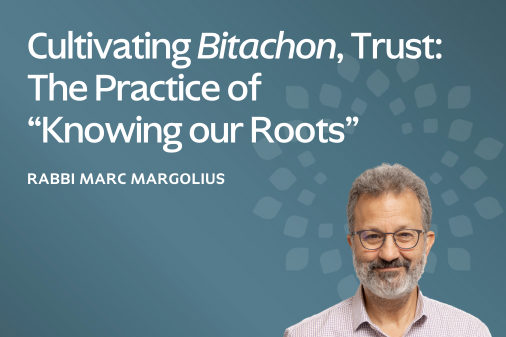
“Knowing our roots” means cultivating conscious contact with a deeper source of nurture and support. This core Jewish spiritual practice is embodied by Joseph, the protagonist in the Torah reading cycle which coincides with and follows Hanukkah, and which concludes the Book of Genesis.
Throughout the story of Joseph and his brothers, he manifests the middah (spiritual/ethical quality) of bitachon, awareness of being implanted in and connected to a source in which he trusts. When Joseph interprets the dreams of the butler and baker in prison and, when he is freed, the dreams of Pharaoh, he insists that God, not he, is the source of their interpretations. According to Rashi, Joseph in effect tells Pharaoh that “the wisdom is not mine, but God will answer and put an answer into my mouth that will bring peace to Pharaoh.” Through his quality of bitachon or trust, Joseph understands himself simply as a conduit, a vessel through which the Divine source will flow.
Despite the manifold challenges and injustices Joseph experiences throughout the narrative (being sold into slavery, imprisoned unjustly, and forgotten by those on whom he depended) he maintains this awareness of a greater or deeper power operating within him. His consciousness of and trust in this process does not waver, even when its energy leads him into extreme challenges and painful experiences.
Strikingly, throughout the Joseph narrative in Genesis this deeper, greater power is never described as operating overtly. God functions down below the surface, in the roots, never “speaking” explicitly to Joseph or anyone else. The hidden reality of the Divine is clearly present but, as depicted in this the narrative, human beings must acknowledge and draw it out. The character of Joseph illuminates and symbolizes this process of drawing up sacred energy through the roots.
Joseph is associated in Jewish mystical tradition with Tzadik, one who does that which is right, acting in alignment with the deeper flow of the Divine. The Friday evening liturgy of Kabbalat Shabbat features Psalm 92 (click here for a healing chant by MIRAJ, a trio consisting of Rabbi Geela Rayzel Raphael, Juliet Spitzer, and Rabbi Margot Stein), which concludes:
tzadik katamar yifrach,
the righteous bloom like a date palm, thrive like a cedar in Lebanon,
sh’tulim b’veit Adonai, b’chatzrot eloheinu yafrichu,
planted in the house of the Holy One, they flourish in the courts of our God.
Od y’nuvun b’seivah d’sheinim v’ra’ananim yehiyu
In old age they still produce fruit; they are full of sap and freshness,
Lehagid ki yashar Adonai, tzuri v’lo avlata bo
attesting that the Holy One is upright, my rock, in whom there is no flaw.
Our roots, planted in the Divine, represent the nexus between ourselves and the deeper Source from which we emerge and which is constantly causing us to flourish. When we grow in awareness of this constant process—when we “know our roots”—then we, like Joseph, can experience a sense of bitachon, trusting in that flow and our ability to draw it up through ourselves into the world. Through this practice, moment by moment each of us has the potential to act as a tzadik, one who does what is right, manifesting the Divine flow, healing and repairing ourselves and our world.
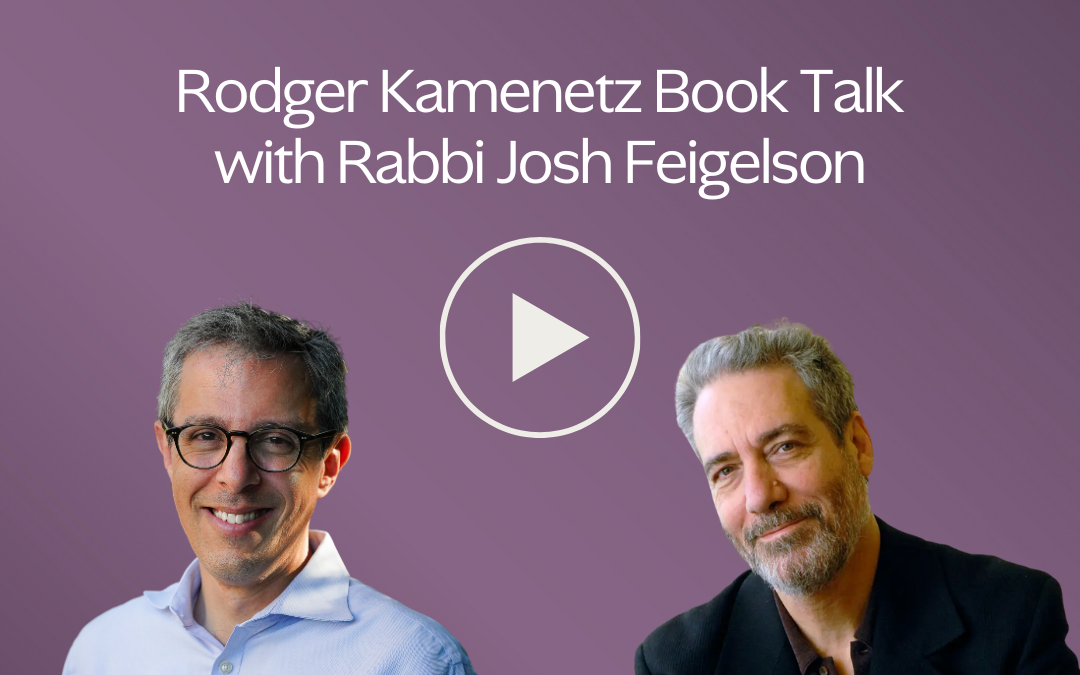
We are grateful to Rodger Kamenetz for sharing his insights with us. Please enjoy the conversation recording.
Rodger Kamenetz is an award-winning poet, author, and teacher. Of his 13 books, his best known is The Jew in the Lotus, the story of rabbis making a holy pilgrimage through India to meet with the Dalai Lama. His account of their historic dialogue became an international bestseller, prompting a reevaluation of Judaism in the light of Buddhist thought. Now in its 37th printing overall, The Jew in the Lotus is a staple of college religion courses. The New York Times called it a “revered text.” A PBS documentary followed, and a sequel, Stalking Elijah, was awarded the National Jewish Book Award for Jewish Thought.
If you would like a copy of Rodger’s book, you can purchase it here.
If you would like to continue studying with Rodger, learn more and register for his upcoming course, Seeing into the Life of Things

Note: The Jewish spiritual tradition uses the term ‘ayin tovah (lit. “a good or favorable eye”) to describe a specific way of focusing our attention on the good. This language may feel inaccessible to readers who are blind or visually impaired. If you are such an individual, we invite you to adapt this teaching to your own experience in a manner that feels more accessible.
It’s easy these days to focus and even fixate on things that seem to be going wrong: rising antisemitism, uncertainty about the future of the ceasefire between Israel and Hamas, widespread political corruption and corporate greed, threats to democracy and civil rights, and rampant gun violence—to name a few of the big ones. The more we tap into our newsfeeds, the more anxious, powerless, embittered, and hopeless we may feel, as our negativity bias is confirmed repeatedly.
Craig and Devon Hase, contemporary meditation teachers, define it as follows:
“[It’s] the simple but powerful idea that we, as humans, are more likely to [focus on] what’s bad than what’s good. Why? Most likely it’s evolution. Evolution doesn’t care whether you’re happy. Evolution just cares whether you pass genes along. And so, if you’re living in a jungle with a bunch of attack cats and poisonous snakes, better to be on high alert all the time, and a little stressed out, than relaxed and happy and dead at sixteen.
Maybe all that made sense ten thousand years ago. But these days, with the advent of the information age, our negativity bias is continually enforced…which means your negativity bias is being confirmed and confirmed and confirmed, until all you see when you look out at the world is people doing bad stuff and the planet going up in flames.”
—Craig and Devon Hase, How Not to Be a Hot Mess: A Survival Guide for Modern Life, pp. 58–60
The issue is not that many problems aren’t real or don’t deserve our attention and concern. It’s that there are also many wonderful things happening in our lives and world that we tend not to notice when caught in negativity bias.
Perhaps this is why Rabbi Meir, one of the greatest sages from the time of the Mishnah, stated:
“We are obligated to recite one hundred blessings each day” (B. Talmud Menachot 43b).
He recognized that we need to proactively commit to focusing on the good—to cultivate the middah (soul-trait) known as ‘ayin tovah (lit. “a good or favorable eye”).
“Yes,” you might say, “but how?”
Craig and Devon Hase offer some concrete guidance:
“[Focus on] the good. How many of us train our [inner] eye to [focus on] the good?…And how often, in our daily rush of bad news, bad politics, and bad hair days, does the mind incline itself toward what’s already good?
[H]ere’s the thing…most people, most of the time, actually treat each other pretty okay. And though we are in the midst of an ecological crisis that needs to be addressed yesterday…, we can still train the mind to [focus], right now, in this present moment, on everything that is going right. Not because we are trying to fool ourselves, but because we have already been fooled, and we need to reset the focus and [attend] with [a] fresh [perspective] to what is already true so that we can build the resilience we’ll need to address all the things that have to get done today, tomorrow, and for all the days after that” (ibid.).
The invitation is not to ignore problematic things by retreating from the world or burying our heads in the sand. Rather, it’s to focus on the manifold blessings in our lives so that we can cultivate enough gratitude, appreciation, and resilience to turn toward difficulty with a buoyant, open heart—without becoming flooded or overwhelmed.
To support you in this work, I invite you to keep a gratitude journal each day, working your way up to listing one hundred blessings per day by the time our next newsletter goes out in December.
Begin small—for a few days, list five things for which you’re grateful. Then move up to ten, adding five new things when you’re ready, and so on. Don’t worry if you never make it to one hundred. The point is to intentionally direct your attention toward the good, to notice what doing so feels like in body, heart, and mind, and to offer spontaneous words of blessing.
If you find it hard to begin, here’s a list of one hundred things for which you might cultivate gratitude, composed by my teacher, friend, and colleague at IJS, Kohenet Keshira haLev Fife and IJS Kivvun Cohort 6.
And guess what? If you pray from the siddur three times daily and recite the traditional blessings over food, going to the bathroom, and ritual activities, you’re already reciting one hundred blessings a day. Over this next month, you might try to recite more of them with kavvanah (intention, feeling, mindfulness), really pausing to notice the blessings they’re pointing to.
For example, when you praise God for “clothing the naked” (malbish ‘arumim) during the morning blessings, pay close attention to the sensations of your clothing on your skin and notice if gratitude might arise spontaneously as you do.
Especially when taking in the news, make a practice of pausing for a few moments to remind yourself of some of the blessings you’ve recorded in your gratitude journal. Notice how doing so impacts your negativity bias and your capacity to lean into difficulty without becoming flooded.
Perhaps in this way you might begin to develop a new habit of moving about the world with an ‘ayin tovah, focusing on the good as a gateway to gratitude and resilience.

We are grateful to Jane Eisner for sharing her insights with us. Please enjoy the conversation recording.
Jane Eisner has spent her career breaking barriers in journalism. The first woman to edit Wesleyan University’s student paper, she went on to hold senior roles at the Philadelphia Inquirer for 25 years before becoming the first female editor-in-chief of the Forward, where she expanded readership and earned multiple awards. Eisner has also reported for leading outlets, including The New York Times and The Washington Post, taught at Penn and Columbia, and written Taking Back the Vote: Getting American Youth Involved in Our Democracy (2004). She recently completed an interpretive biography of Carole King for Yale’s Jewish Lives series, where she explores the legendary musician’s extraordinary career, personal struggles, and cultural impact. Today, she serves as writer-at-large for the Forward and consults for the independent news site Shtetl.
If you would like a copy of Jane’s book, you can purchase it here.

The Hebrew month of Cheshvan brings a welcome relief from the spiritual highs of Tishrei— we get to take a break from large communal gatherings and integrate all that transpired for us during the high holidays. With more space for solitude and intimate time at home, we have a chance to bring renewed energy to the inner work of spiritual practice and prayer. In ancient Israel, Cheshvan is when people began to pray for rain.
From a spiritual perspective, rain represents all that we need for life to bloom forth and flourish; it symbolizes the possibility of sustenance, and the union of heaven and earth. Our tradition teaches that unlike dew, the proper rainfall in its season is dependent upon our prayers and deeds. Following the description of six days of creation, Torah says that vegetation had not yet sprouted upon the earth because it had not yet rained, as there was no human to work the land. Rashi, citing the midrash, comments that the rain had not yet fallen upon the earth because there was no human to pray for it. Indeed, the midrash seems to suggest that the human being was essentially created to pray for rain. Our mystical tradition teaches that we as humans are the intermediaries between heaven and earth, and the channel that makes that connection possible is prayer.
This month, we might focus on revitalizing our prayer practices. We can bring mindfulness here by unifying our body, heart and mind within the action of prayer itself. The Baal Shem Tov shares some beautiful instructions on this via his homiletic reading of God’s command to Noah: “Make a shining stone for the ark.” The Baal Shem Tov points out that the word “ark” in Hebrew— teivah— can also be translated as “word.” The verse continues, “Come, you and your entire household, into the teivah.” A person must go deeply inside of the words of prayer, bringing their heart, attention, and all of their being— their full household— to the words, until they begin to sparkle like a glass window through which the divine can radiate.
This approach to prayer invites a slowing down. You might choose just one verse from the prayer book to focus on, bringing all of your attention to each word until you can sense its meaning in your heart and even in your body, and then proceed to the next. As an example, you can nurture this practice with a simple morning prayer—
“Modeh ani l’fanecha, ruach chai v’kayam” — Grateful am I before you, living and eternal spirit” — or “Elohai neshama shenatata bi tehorah hi” — “My God, the soul that you have given me is pure.”
Slow down enough to feel the essence of every single word. Notice the impact it has on your mind, and on your heart.
May our practice and our prayers in this watery month of Cheshvan allow all that transpired in the high holidays to soak deeply into our beings, so that we can embody and nourish the seeds of our intentions for the year ahead.
I’m imagining us in Noah’s ark.
As the Hebrew month of Cheshvan begins and a new cycle of Torah reading is initiated, we read Parshat Noah. We encounter an ark; Noah, his family and a few of every living species; and a flood of utter destruction that wipes out all life on earth.
For the past two years, I have been holding the narrative of Noah’s ark close to me as a source of spiritual inquiry and practice, engaging with questions like – What qualities did Noah cultivate that preserved him in a violent generation? What is the spiritual practice of taking refuge in the midst of the flood of corruption and chaos? How did sanctuary in the ark school Noah’s heart and mind during the three hundred and seventy-eight days he lived in it?
These are worthy questions but in the fragile newness and uncertainty of the Israel-Hamas ceasefire, I am holding a different question. I am folding into this other question all the feelings of witnessing the return home, finally, of twenty living hostages with weeping, relief and something adjacent to joy but too cracked and broken to wholly call it joy, and with heartbreak for the families who are still waiting to receive the bodies of their killed loved ones, and with unresolved questions about sufficient aid entering Gaza, and witnessing Palestinian families returning to the rubble that was their homes, and holding my breath (and still breathing) as the unclear, unstable future of these two nations slowly takes shape amid layers of profound grief, pain, possibilities and an unclear road ahead. The flood is not over but, perhaps, the worst of the destruction has ended. I’m imagining us in Noah’s ark, coming to rest, finally, on the peaks of the mountains of Ararat as the floodgates of heaven and the deep are stopped up and the waters begin to recede. I’m asking – What spiritual guidance can we draw from Parshat Noah about the beginning of transition out of destruction and survival, and into the next stage of reclaiming life?
After a hundred and fifty days tossed on unstable water, the ark comes to stillness on a mountaintop. Tenuous as it is, there is enough solid ground for the ark to rest – va’tanach ha’teyvah. The ark rests. Noah rests. And he opens a window to the wide sky, an opening to the air, to light and to the devastation outside. Then, in order to track the slow progress of the receding waters which takes another two hundred and twenty-eight days, Noah first sends out a raven. Later, in multiple attempts, he sends a dove.
What is the dove/yonah? The dove is a small, slender bird. Be’er Mayim Chaim notes that in the Song of Songs, the dove is referenced as yonati, tamati – my dove, my love. It is the tender, cherished beloved. It becomes the symbol of peace. But so soon after horror, loss, anger and fear, this tenderness cannot be released first. It will not have anywhere to land.
So before sending out the dove, Noah sends out the raven/orev, a large, rough squawking bird that “went back and forth.” Hasidic commentators understand this movement as a reference to the changing dynamic of spiritual expansion and contraction – ratzo va’shov. Spiritual growth in general is not a linear progression. All the more so in extreme circumstances – we are constricted, we fall open, we expand and we shrink. Be’er Mayim Chaim adds that orev also means “a mixture.” The raven embodies a complicated mixture of opposites, “of bad within the good and good within the bad.” What a mixed, fraught moment this is, in which the heart floods open, washed with relief, able to finally take deeper breaths, and the heart grips with pained constriction, back and forth.
At the Jerusalem rally on October 11th, after the ceasefire was declared and the return of the remaining hostages was imminent, Rachel Goldberg Polin expressed this potently. Speaking about the book of Kohelet/Ecclesiastes, which we just read on Sukkot, she said that Kohelet teaches, “there is a season and a time for everything. But now, today, we are being asked to digest all of those seasons, all of those times, at the exact same second – winter, spring, summer, fall – experience all four right now. It says there is a time to be born and a time to die and we have to do both right now. It says there is a time to weep and a time to laugh and we have to do both right now…It says there is a time to tear and a time to heal and we have to do both right now…and it says there is a time to sob and there is a time to dance and we have to do both right now.”
This is not only descriptive of what so many of us feel. It is prescriptive of the soul-work that is ours to do. This is a time to consciously feel and know the intense mixture of expansive joy and the contraction of pain, of release and anger, grief and celebration, all at once. It is exhausting, messy and intense. It is also alive, agile and true. To attend to each one means not letting opposing truths or feelings cancel each other out. As we turn to face all the realities that are present and all that have been present over these two years, the wild mix of emotions deserves space, patience and mindful attention so they can move through us and so that we can keep our hearts as agile and our thinking as clear as possible.
So often, only after the worst is over, only when it is safe enough to let go of the ways we have been pushing or gripping in the face of looming danger and teetering vulnerability, can we begin to attend to the extent of the wreckage, and also begin to heal, build and hope. Our hearts are raw and tender from these past two years. The flood is not over but this time of receding waters asks us to learn from Noah’s waiting, meeting each stage of transition with presence and patience and discerning what is needed. This period asks us to exercise our hearts and awareness with a different kind of diligence, a different kind of attention to the many oppositional dimensions that exist together at once – to meet them, feel them, know them and release them into flight. Only then can we access the tenderness underneath. Only then can the dove, the tender wings of loving and new life, leave the protective shelter of the ark and find a genuine place to begin to build its nest.
I want to leave you with an excerpt from Leonard Cohen’s poem, Prayer for Messiah, giving these images moving expression.
O send out the raven ahead of the dove
O sing from your chains where you’re chained in a cave
your eyes through my eyes shine brighter than love
your blood in my ballad collapses the grave
¹ Hasidic commentator, Rabbi Chaim Tyrer of Czernowitz (1760–1816).
² The mother of Hersh Goldberg Polin who was murdered in Hamas captivity.
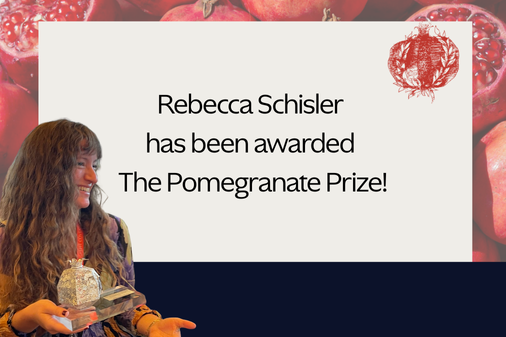

[New York, NY, September 17, 2025] – Rebecca Schisler, a core faculty member at the Institute for Jewish Spirituality (IJS), received the prestigious Pomegranate Prize given by the Covenant Foundation. She is one of just 10 Jewish educators in the U.S. to receive the 2025 honor and the second IJS faculty member to have earned the coveted designation. The organization presented the annual awards at a reception held on Tuesday, September 16th, at the Museum of Jewish Heritage in New York, NY.
At IJS, Rebecca leads the development of innovative programming for younger adults, most notably creating the organization’s Shevet Jewish Mindfulness Community, a program for those in their 20s and 30s that includes a 30-minute weekly online practice, an annual retreat, and in-person programming in the Bay Area, Brooklyn, and Cambridge. According to IJS President & CEO Josh Feigelson, Rebecca is transforming how younger adults engage with IJS and with their own practice.
“Rebecca is at the forefront of a movement to engage young Jews in a Judaism that speaks to them,” he wrote in a recommendation letter to The Covenant Foundation. “It is a Judaism that combines mindful living, meditation, chant, dance, somatic practice, ecological awareness, and earth-based practices—with the depth and richness of our people’s texts, traditions, and the rhythms of Jewish life.”
According to the Covenant Foundation, The Pomegranate Prize “is designed to recognize emerging leaders in the field of Jewish education by encouraging them in their pursuits and offering the resources and connections necessary to accelerate their development, deepen their self-awareness, and amplify their impact on the field.”
“When Rebecca began teaching at IJS three years ago, we had virtually no offerings specifically for young adults,” said Fiegelson. “Since that time, Rebecca has led the creation of weekly online and in-person offerings for people in their 20s and 30s, resulting in more than 5,000 new Instagram followers and dozens of meaningful new programs that have helped thousands of young adults struggling to find their place in American Jewish life today.”
In addition to her leadership role at IJS, Rebecca also teaches mindfulness for Or HaLev and Stanford University’s School of Medicine. Previously, she served as an educator for Wilderness Torah, The Awakened Heart Project, EdenVillage Camp, Urban Adamah, and HaMakom. Rebecca also co-authored the Mahloket Matters curriculum while serving as a senior social/emotional learning consultant at the Pardes Center for Jewish Educators.
A rabbinical student at ALEPH, Rebecca is passionate about integrating ancestral wisdom traditions with innovative approaches to personal and collective healing and liberation. She teaches Jewish spirituality as an embodied, transformational, and accessible path, with relevant and timely wisdom for all.
“I’m so grateful for the opportunity to do such meaningful work and for all the ways I’ve been able to grow here at IJS over the past three years,” Rebecca shared with IJS staff immediately following the event. “More than anything, I’m grateful to get to collaborate with such incredible souls.”
About the Institute for Jewish Spirituality
The Institute for Jewish Spirituality (IJS) is a sacred haven for nurturing the mind, body, soul, and spirit. Since 1999, we have helped countless people navigate our turbulent world by learning to slow down, reconnect with themselves, and find a greater sense of purpose — all grounded in mindfulness and the deep wisdom of Jewish tradition. From guided meditation and contemplative text study to leadership training and retreats, IJS creates opportunities to become more mindful, compassionate, and resilient—and build a more just and peaceful world together.
###
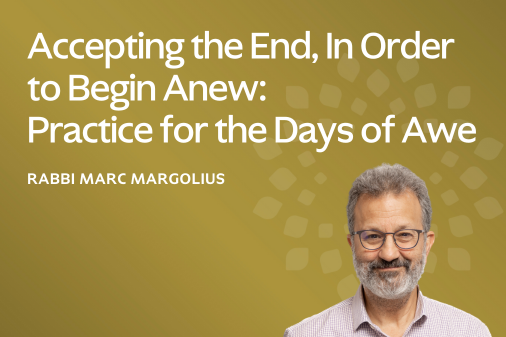
One of the central (and paradoxical) themes of the Yamim Nora’im, the Days of Awe, is that accepting our mortality opens the gate to personal transformation. The extent to which we make peace with the end of our lives helps us begin to live more fully today.
Moses models this kind of radical acceptance as we move towards the end of the annual Torah reading cycle. The Sages imagined Moses vigorously resisting God’s decree that he should die before reaching the Promised Land, moving progressively through the five stages described by Dr. Elisabeth Kubler-Ross in her classic work, On Death and Dying¹: denial, anger, bargaining, depression, and finally, acceptance.
His ultimate acceptance of his demise enables Moses to request and extend forgiveness to the people he has led through the wilderness – and to praise God, with whom he has been negotiating furiously:
They [the heavenly court] came and said to Moses: ‘The hour has arrived for you to depart from the world.’ He said to them: ‘Wait until I bless Israel, for they have not found contentment from me all my days, because of the rebukes and warnings with which I rebuked them’ … [Moses] said to Israel: ‘I have caused you a lot of grief over the Torah and over the commandments, but now forgive me.’ They said to him: ‘Our Master, you are forgiven.’ Israel also arose and said: ‘Moses our Master, we have angered you a lot and increased the burden upon you. Forgive us.’ He said to them: ‘You are forgiven.’ They came and said to him: ‘The moment has arrived for you to depart from the world.’ [Moses] said: ‘Blessed be the name of the one who lives and abides forever.’²
In accepting mortality, Moses finds a gateway to forgiveness, transformation, and gratitude, rather than being stuck in blaming and bitterness.
Throughout the Days of Awe, we are like Moses, face to face with our finitude. Yom Kippur is a voluntary near-death experience. We rehearse our own deaths and imagine our own eulogies. We wear white or dress in a kittel representing our own burial shrouds. We recite the Vidui, the confession we are to profess before we die, say Yizkor prayers for those we have loved and lost, remember our martyrs, and end the day as we are meant to end our lives, by chanting the Shema. We abstain from food, drink and sex, freeing ourselves from our customary focus on our bodily wants and needs. These practices enable us, like Moses, to attend to deeper, more enduring truths than our own, inevitably bounded physical survival.
A Hasidic teaching observes that Moses’s awareness that he would die before reaching the Land prompted him to see beyond himself and pray on behalf of the Israelites. Earlier in Deuteronomy (3:23), Moses tells the Israelites, “Vaetchanan el Adonai baeit hahi leimor, I pleaded with YHVH at that time, saying….” (Deut. 3:23). Rabbi Mordecai Yosef Lainer of Izbica (1801-1854) interprets this verse as indicating a shift in Moses’s awareness stemming from the finality of his death:
Why did Moses see fit to tell Israel about this prayer? It might appear as if his prayer accomplished nothing! Nevertheless, through this Moses made it known to the people that his prayer became a protection for them: “Even in your undertakings in the Land of Israel I will be your Rabbi, and so throughout the generations.” He demonstrated to them that he accomplished something through his prayer.
We learn this from the word “I pleaded with (va-etchanan)” – which is in the reflexive form. This means that Moses was filled with supplications, and his prayer flowed in his mouth. This signifies that God aroused him to pray, and so surely this prayer will not return unfulfilled. That is signified in the phrase “at that time (ba-eit hahi)”: Moses said, “Even after the Holy Blessed One had sworn not to bring me into Israel, God nevertheless did not prevent me from praying.”³
In this interpretation, the acceptance of death opens Moses’s awareness even more to the needs of others, allowing prayer to rise organically from concern for them rather than from self-service.
Our mindfulness practice is rooted in hitlamdut, curious, non-judgmental attention to the truth of our experience—in this case, our habitual inclinations about our mortality. Some of us lack the luxury of denial and are forced by illness and/or age to confront death. Some of us struggle with depression and suicidal tendencies, and must practice keeping thoughts of mortality in their proper, healthy place. For those of us who devote much psychic energy to avoiding our mortality, the example of Moses teaches us to turn towards that which we would rather avoid.
Psychologist Marsha Linehan describes this capacity for radical acceptance as “the ability to perceive one’s environment without putting demands on it to be different; to experience one’s current emotional state without attempting to change it; and to observe one’s own thoughts and action patterns without attempting to stop or control them.”⁴ Practicing acceptance is an opportunity to turn towards even that which we most wish to deny. We notice the power of our resistance, and apply compassion rather than judgment; we console ourselves by infusing grief with love.
As we move into this season of death and rebirth, may we receive the deep lessons of accepting (without embracing) our inevitable death. May it help us turn with greater urgency towards life, with more clarity, wisdom, and compassion for ourselves and others. May we envision previously unnoticed transformational possibilities and be freed from that which keeps us bound to old, familiar patterns. May our capacity to accept endings engender myriad beginnings within us and our world.
Taking the teaching into practice:
Taking the teaching into prayer practice: Unetaneh Tokef, a prayer featured in the High Holiday liturgy, includes the deeply challenging reference to “who will live and who will die” in the year ahead. It also includes a passage which goes to the heart of accepting our temporality: adam yesodo mei-afar, our origin is dust. Experiment with this part of the prayer, using this lovely melody (watch and listen here to a melody sung by Cantor Steve Zeidenberg and choir at Congregation Beit Simchat Torah in NYC; for the audio, click here for the same melody sung by Cantor Ayelet Porzecanski; for classical hazzanut, try Cantor Leibele Waldman’s recorded version.
¹Elisabeth Kubler-Ross, On Death and Dying (New York: Macmillan, 1970).
²Midrash Tanchuma, Vaetchanan 6:2.
³Rabbi Mordecai Yosef Lainer of Izbica, Mei HaShiloach on Vaetchanan (trans. Rabbi Jonathan Slater).
⁴Marsha Linehan, Ph.D., Cognitive-Behavioral Treatment of Borderline Personality Disorder, (Guilford: 2018), p. 147.

Below is an excerpt from Rabbi Jordan Bendat-Appell’s teaching for the first week of Elul, as part of The Shofar Project 5785. Our guide this year is Rabbi Alan Lew’s now-classic book, This is Real, and You are Completely Unprepared.
Our Elul practice doesn’t begin with a focus on our behaviors as one might suspect. Rather, it begins by shining a light on our perception. Rabbi Lew introduces Elul with the Torah portion of Re’eh, which he translates as “Look!” He writes (p.65):
Pay attention to your life. Every moment in it is profoundly mixed. Every moment contains a blessing and a curse. Everything depends on our seeing¹ our lives with clear eyes, seeing the potential blessing in each moment as well as the potential curse, choosing the former, forswearing the latter.
Our capacity to choose wisely depends on our capacity to perceive clearly. This isn’t a seeing that depends on vision, but one that comes from attentiveness of heart and mind. Elul begins our practice with this commitment to seeing ourselves as clearly as we can and to engage in cheshbon-ha-nefesh, a soul accounting.
In addition to prayer, meditation, and mindful focus, you may want to try one more practice for cultivating clearer perception: look up. Put differently, we can shift our attention from the details and minutiae of our lives to instead take in a broader landscape or perspective. Many of us spend many hours every day with our bodies hunched over devices, attending to the endless details of our daily lives or scrolling through our feeds and messages. This curved-in posture mimics that of a person who is sad and despondent. This physical posture can induce us to feel low and constricted in spirit. Conversely, looking up, both literally and figuratively, improves our posture and may also lift the spirits and broaden our lived sense of our moment. As R. Jonathan Sacks writes:
This is one of the enduring themes of Tanach: the importance of looking up. “Lift up your eyes on high, and see who has created these things,” says Isaiah (Is. 40:26). “I lift up my eyes to the hills. From there will my help come” said King David in Psalm 121.
When we shift our attention so as to take in a larger perspective, we open to the world around us, bringing in a quality of spaciousness into our awareness. This spaciousness exists whether or not we pay attention to it. When we do pay attention to it, and then reflect on our lives within the context of that spaciousness, our view of ourselves changes as it integrates this broader view. To perceive ourselves and the world around us more clearly, we must also look beyond our narrow concerns. Take time to actively shift your attention, to roll back your shoulders, lift your chain heavenward, and breathe deeply.
¹ It is important to note that “seeing”, as used here, is metaphorical and does not rely on the literal ability to see.
A FREE four-week online program for the Hebrew month of Elul.

A FREE four-week study and practice group for young adults.
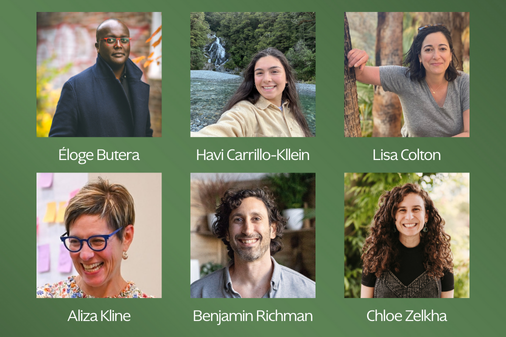
We are thrilled to welcome six extraordinary leaders to the Institute for Jewish Spirituality’s Board of Directors. Each brings a deep commitment to Jewish spiritual practice, a wealth of professional expertise, and a passion for shaping a vibrant and inclusive Jewish future.
Our newest board members reflect the communities we seek to serve—diverse in background, geography, and life experience, and united in their dedication to the mission and vision of IJS. They are creators, changemakers, and bridge-builders, with talents ranging from entrepreneurship to spiritual leadership, from human rights advocacy to community organizing.
Meet our new board members:
This new class of board members includes younger Jews, individuals from varied geographic backgrounds, as well as Jews of Color and Mizrahi Jews—reflecting IJS’s vision for an inclusive board that represents more of our participants and the greater Jewish community.
We are entering an exciting period of growth and innovation at IJS, and we know these new voices will help guide us with wisdom, creativity, and heart. Please join us in welcoming Éloge, Havi, Lisa, Aliza, Benjamin, and Chloe to the IJS Board!
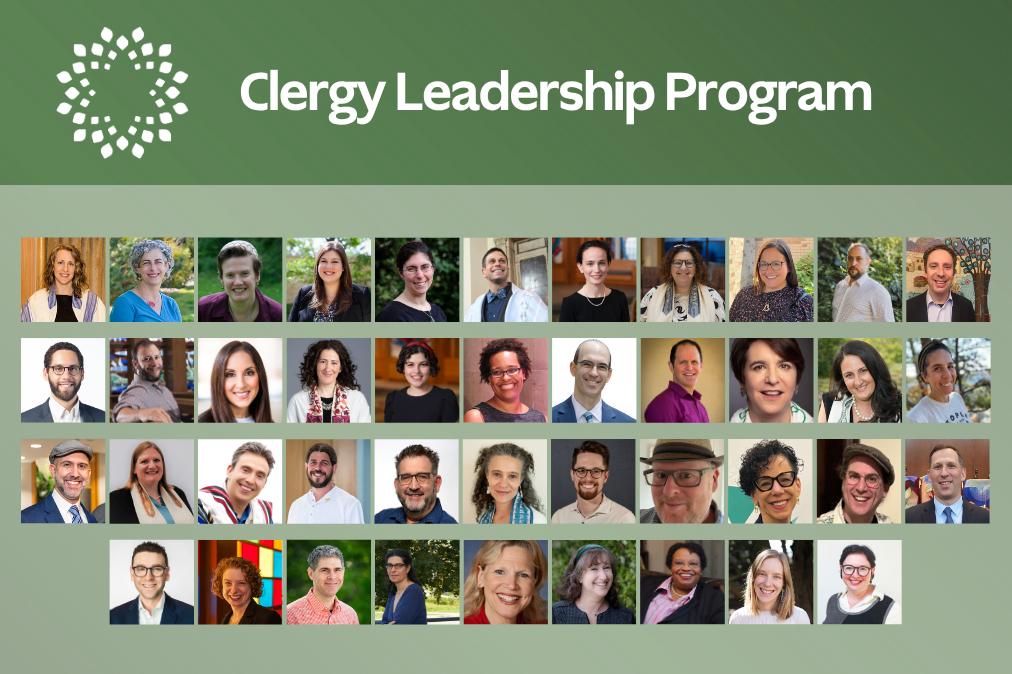
On July 20, 42 Jewish spiritual leaders from around the world will gather at the Pearlstone Retreat Center to meditate, pray, sing, study, and practice mindful movement, kicking off the Institute for Jewish Spirituality (IJS) 2025-2026 Clergy Leadership Program (CLP).
With nearly 600 alumni now bringing mindfulness practices to synagogues, campuses, schools, organizations, and communities throughout the country, IJS’s flagship course has been reshaping the landscape of American Judaism—one “mindful moment” at a time.
The clergy of the CLP will spend the next 18 months together, in person and on Zoom, learning and practicing a variety of Jewish spiritual practices grounded in mindfulness in a supportive community of practice. The goal is to nurture their spiritual lives, foster greater calm and resilience, and expand their skills in cultivating consciousness and character in their leadership. They’ll also learn to embody mindful Jewish spiritual practice in their communities, fostering greater spirituality and wellbeing for everyone.
One of the cohort members, a freelance rabbi and community builder, looks forward to “being able to have a stronger mindfulness practice—to ground me, to allow me to embrace the magic, to help others to do the same.” This program, she says, would provide connection, structure, and a vessel for growth for me as I create the next season of my rabbinic work and life.”
The 2025 cohort includes an array of ordained rabbis, cantors, and kohanot (Hebrew priestesses) in positions of spiritual leadership—as synagogue clergy, educators, Hillel professionals, activists, ritualists, executives, and entrepreneurs. They span the denominational spectrum and serve communities across the U.S., Israel, and Europe.
The Institute for Jewish Spirituality celebrates the diversity of this group, which includes Jews of Color, Mizrachi and Sephardic Jews, LGBTQ+ folks, people with disabilities, and individuals with a range of political perspectives.
The program will include affinity groups led by faculty who hold each identity, and will feature an updated curriculum incorporating more teachings from people with historically marginalized identities alongside traditional Jewish text. IJS is working to further refine a pedagogy of inclusion that enables each participant to feel that they are being held and cared for in the fullness of their humanity, that their spiritual needs are being met, and that their unique living Torah can inspire and elevate us all.
The core practices of the program—prayer, song, chant, meditation, embodied practice, tikkun middot (character refinement) practices, and Torah study—are informed by various strands within the Jewish mystical tradition and serve to deepen participants’ spiritual awareness, authenticity, equanimity, self-compassion, and resilience.
When clergy learn to practice mindful leadership, enriched by Jewish wisdom, they can more skillfully engage their inner lives as a powerful force for personal and collective transformation. By leading from a place of inner wholeness, clarity, balance, and love, they can more readily give of themselves and guide the spiritual evolution of others.
CLP alumna Cantor Kerith Spencer-Shapiro, said of her experience:
“The CLP… cohort changed my clergy life, reinvigorating and lifting up my personal prayer practice and allowing me ‘permission’ to bring together all of the spiritual elements of my whole person. I am ever grateful to IJS for continuing to be a foundational part of who I have grown into as a clergy member and meditation teacher.”
The program faculty includes Rabbi Sam Feinsmith, Kohenet Keshira haLev Fife, Rabbi Miriam Margles, Rabbi Dorothy Richman, and Cantor Lizzie Shammash—each of whom is a seasoned teacher of Jewish spiritual practices grounded in mindfulness.
Beyond catalyzing Jewish spiritual renewal, the program is designed to meet a pressing need: Many clergy describe feeling depleted and overwhelmed after leading through years of turmoil from COVID, political strife, the ongoing war between Israel and Hamas, and rising antisemitism worldwide.
Kohenet Amanda Nube, a Jewish educator at Chochmat HaLev, a Jewish Renewal congregation in Berkeley, California, wrote: “I think being in a cohort of mindful Jewish clergy at this moment, in this year and coming years, is what we ALL NEED. Cultivating mindfulness of our strengths, our weaknesses, and our leadership could not be more critical for me personally at this very moment in time and history.”
IJS will tailor the 2025-2026 curriculum to hold participants amidst their pain and overwhelm, and help them refill their inner reservoirs, restore their balance, deepen their resilience, and lead with greater clarity, responsiveness, and courage.
For many, this is a sanctuary of self-care after years of caring for others, and an opportunity to revitalize their service with enriched resilience and a sense of sacred purpose.
At a recent convening of CLP alumni, Rabbi Naamah Kelman, herself an alumna of the program and former Dean of Hebrew Union College/Jewish Institute of Religion in Jerusalem, urged clergy to nurture themselves before serving others: “In these moments of darkness and despair,” she said, “I think we need to—as clergy, as caretakers, as leaders of our community—find that place of light within ourselves.”
The members of CLP 2025-2026 are ready to do just that:
Cantor Tracy Fishbein, Cantor at The Temple, Congregation Ohabai Shalom, in Nashville, Tennessee, wrote: “Like many in 2024, I find myself often overwhelmed and exhausted by the constant giving of myself to those in both my personal and professional lives. I am hopeful that this program can give me some tools to cope with the overwhelm and reconnect with my own holy spark that is sometimes lost in the work that I do. I am hopeful that this program will allow me to grow my patience for my children, colleagues, and congregants.”
IJS is also preparing clergy to inspire the next generation of young people to connect to Jewish life in new and sacred ways. At a time when many Jewish communities are shrinking, IJS is growing—and that’s because there’s more interest in the healing power of Jewish mindfulness than ever before, especially among youth.
Jes Heppler, one of the young IJS leaders, said: “IJS is meeting a spiritual hunger that many young people have today—the desire to figure out what Judaism should look like in our lives.”
By helping clergy tap into this yearning and nurture it across the U.S. and abroad, IJS is building on this valuable momentum and sparking a resurgence of contemporary Jewish spiritual life.
IJS is particularly grateful to the Righteous Persons Foundation and the E. Rhodes and Leona B. Carpenter Family Foundation for their support of the Clergy Leadership Program.
Lisa Arbisser – SAJ: Judaism That Stands For All (New York, NY)
Caryn Aviv – Judaism Your Way (Denver, CO)
Rachel Barenblat – Congregation Beth Israel of the Berkshires (Williamstown, MA)
Deana Berezin – Temple Israel (Omaha, NE)
Vera Broekhuysen – Congregation Beth El of the Sudbury River Valley (North Andover, MA)
Daniel Burg – Beth Am Synagogue (Baltimore, MD)
Cornelia Dalton – Westchester Jewish Center (Westchester, NY)
Devorah Felder-Levy – Congregation Shir Hadash (Los Gatos, CA)
Tracy Fishbein – The Temple, Congregation Ohabai Sholom (Nashville, TN)
Andy Gordon – Bolton Street Synagogue (Baltimore, MD)
Yosef Goldman – Freelance Spiritual Artist (Brooklyn, NY)
Ari Hart – Skokie Valley Agudath Jacob (Skokie, IL)
Jordan Hersh – Beth Sholom Congregation (Frederick, MD)
Jennifer Kaluzny – Temple Israel (West Bloomfield, MI)
Lindsay Kanter – Temple Emanuel (Kensington, MD)
Talia Kaplan – Congregation Beth Shalom (Overland Park, KS)
Georgette Kennebrae – Freelance Rabbi and Community Builder (Porto Santo, Portugal)
Todd Kipnis – Temple Shaaray Tefila (New York, NY)
Chaim Koritzinsky – Congregation Etz Chayim (Palo Alto, CA)
Judy Kummer – Freelance Lifecycle Officiant, Spiritual Care Counselor, Eldercare Programming (Boston, MA)
Sari Laufer – Stephen Wise Temple (Los Angeles, CA)
Arielle Lekach-Rosenberg – Shir Tikva (Minneapolis, MN)
Andrew Mandel – Central Synagogue (New York, NY)
Rachel Marks – Temple Beth Israel (Skokie, IL)
David Markus – Congregation Shir Ami (Greenwich, CT)
Oded Mazor – Kehilat Kol HaNeshama (Jerusalem, Israel)
Steven Nathan – Lehigh University Office of Jewish Student Life (Bethlehem, PA)
Amanda Nube – Chochmat HaLev (Berkeley, CA)
Sam Rosen – Congregation Beit Simchat Torah (New York, NY)
Benjamin Ross – Temple Shaaray Tefila (White Plains, NY)
Rachel Sabath Beit-Halachmi – Har Sinai-Oheb Shalom Congregation (Baltimore, MD)
Josh Schreiber – Congregation Agudath Achim (Taunton, MA)
Michael Schwab – North Suburban Synagogue Beth El (Highland Park, IL)
Philip Sherman – BJBE (Deerfield, IL)
Ariana Silverman – Isaac Agree Downtown Synagogue (Detroit, MI)
Bradley Solmsen – Park Avenue Synagogue (New York, NY)
Danielle Stillman – Middlebury College (Middlebury, VT)
Marcia Tilchin – Jewish Collaborative of Orange County (Orange County, CA)
Naomi Weiss – Congregation Kol Shofar (Sausalito, CA)
Harriette Wimms – The JOC Mishpacha Project (Baltimore, MD)
Ariel Wolpe – Ma’alot (Atlanta, GA)
Lana Zilberman-Soloway – Congregation Or Ami (Westlake Village, CA)
We are grateful to Yiscah Smith for sharing her insights with us. Please enjoy the conversation recording.
Renowned spiritual teacher and author Yiscah Smith has spent a lifetime guiding seekers toward deeper authenticity, inner peace, and connection with the Divine. In her newest work, Planting Seeds of the Divine, she offers a rich and soulful roadmap for cultivating God-consciousness from within, drawing on centuries of Jewish wisdom and her own lived experience. If you would like a copy of Yiscah’s book, you can purchase it here.

When the COVID lockdown began in March of 2020, IJS hosted the first Daily Sit to provide respite and comfort. Quickly we realized we’d tapped into a powerful yearning: By the end of the first week, more than 350 people were joining each day, finding 30 minutes of peace through meditation, Jewish wisdom, and community.
Now, five years later, the Daily Sit is at the heart of IJS’s digital offerings, which have been accessed over half a million times. Over 200 people still regularly gather each day to engage in practice for staying grounded and finding healing, hope, and connection. From the pandemic to October 7th to the political instability in our nation, the Sit has helped us all stay steady in the storm.
On the evening of May 29th, we celebrated this milestone and honor the person who has made it possible: our beloved Rabbi Marc Margolius. For five years, Marc has emceed the Sit, touching the lives of thousands with his wise teaching, beautifully guided meditations, and gentle loving presence. We also celebrated our dedicated community and took this opportunity to say thank you.
If you felt moved by the event and wish to make a gift to support the Sit, please click below to donate.
The holiday of Shavuot, commemorating the revelation of Torah at Mount Sinai, begins this year Sunday night, June 1. It is striking that despite the cacophonous scene of revelation described in the Torah in Exodus 19, there is a stream within Jewish tradition that emphasizes silence as the context for intimate encounter with the Divine.
Rabbinic tradition offers an interpretation that at Mount Sinai, the people heard only the first two of the Ten Commandments: “I am YHVH your God” and “you shall have no other gods beside Me.” A Hasidic tradition asserts that at Sinai the people “heard” only the first letter of the first word—that is, the silent letter aleph.¹
We can understand the experience of revelation at Sinai as consisting of “hearing” only Divine “silence,” the sound of the letter aleph – a concept we find as well in rabbinic literature:
Rabbi Abahu taught in the name of Rabbi Yohanan: When God gave the Torah, no bird twittered, nor fowl flew, no ox lowed, none of the ofanim stirred a wing, the seraphim did not say, ‘Holy, Holy’, the sea did did not roar, no creature spoke; the whole world was hushed into breathless silence and the voice went forth:, ‘I am YHVH your God.’²
The Bible (I Kings 19) relates that the prophet Elijah has a similar experience of revelation when he flees from Queen Jezebel and finds refuge at Mt. Sinai. There, like Moses at the burning bush and the Israelites at Sinai, Elijah “hears God” in the kol d’mama dakah, the “still, small voice”—the sound of silence.
While many of us claim to yearn for more quiet in our lives, in mindfulness practice we often notice how silence can render us uncomfortable and desiring distraction. As we attempt to settle into stillness, we may observe an inclination to “stir things up,” to “entertain” our minds and avoid what we perceive as “boring” or threatening.
As we notice these aversions, we do not judge them or seek to repress them. Rather, we accept them with compassion as part of what it means to be human—as instincts to protect our vulnerable selves—and we allow them to pass. Moment by moment, we let down our guard, slowly surrender distractions, and settle into silence. We become more present, “flush” with our experience in the moment. In such a moment, it is as if we too are standing at Sinai.
In silence, we become acquainted with our more authentic self. The writer Dinty Moore offers this helpful analogy:
The mind is like a bowl of water… sloshing back and forth, spilling out the sides. Most of us have lives like earthquakes, so the water is in constant motion. Add to this the fact that we are always grabbing at the water, struggling to make sense of our brain messages, yet all the grabbing just further churns the liquid. Two things have to happen for the bowl of water to come to rest. First, you have to turn off the faucet, stop all that input. Second, you have to quit grabbing. What happens finally, if you are successful, is that the water settles and… the still water of the mind then becomes a mirror in which you can find yourself.³
In Jewish mindfulness practice, we seek to quiet the inner conversation, to “let the water settle,” and see ourselves as whole human beings, part of the Unity that is God. Harpu u-d’u ki anochi elohim, says the Psalmist [46:11], “be still, and know that I am God.” In stillness, we can discern that Anochi, the “I,” our self, offers a path to deeper wisdom.
As a practice for Shavuot in our incessantly noisy world, we might dedicate time and space to immerse in silence. We might pay particular attention to moments when we seek to avoid stillness or silence, such as by playing the radio or a podcast. Experiment each day with turning off anything that produces sound in such situations; explore, without judgment, habitual reactions of mind and emotion when encountering silence.
You might also practice by inserting a bit more silence into life, seeking out a quiet space or time each day, imagining ourselves as “standing at Sinai,” listening for the kol demamah dakah, the “still, small Voice.”.
Finally, we might practice silence even in the midst of conversation, while listening to someone else, by noticing and releasing the inclination to formulate a response rather than fully attending to the other, instead listening as fully as possible.
At any moment, we can access the inner stillness which brings us back to the foot of the holy mountain, and open ourselves to receive the wisdom being revealed. At any moment, we can be present at Sinai.
¹ Gershom Scholem, the great scholar of Jewish mysticism, comments on the teaching of Rabbi Mendel of Rimanov (d. 1814) in On the Kabbalah and its Symbolism (Schocken: 1965), p. 65: “To hear the aleph is to hear next to nothing; it is the preparation for all audible language, but in itself conveys no determinate, specific meaning. Thus, with his daring statement that the actual revelation to Israel consisted only of the aleph, Rabbi Mendel transformed the revelation on Mount Sinai into a mystical revelation, pregnant with infinite meaning, but without specific meaning.”
² Exodus Rabbah 29:9
³ Dinty Moore, The Accidental Buddhist: Mindfulness, Enlightenment, and Sitting Still (Algonquin Books: 1997), p. 187.
In a famous Hasidic saying, the Kotzker Rebbe was once asked: “Where does God dwell?” to which he replied, “Wherever you let God in.” Spiritual direction is the practice of letting God in, of noticing the sacred thread woven throughout everyday life.
Spiritual direction is a contemplative practice that invites one to grow in awareness of the sacred dimension present in every moment, no matter how mundane. In this practice, we assume that we all have a spiritual dimension and a need for meaning-making, whether or not we believe in God.
Spiritual directors act as companions on this journey, holding space for seekers to connect with their spiritual longing, discover and explore their inner wisdom, and strengthen their attunement to the sacred. Spiritual directors are not therapists, but trained guides who meet monthly with seekers to support their journey toward spiritual growth and wholeness.
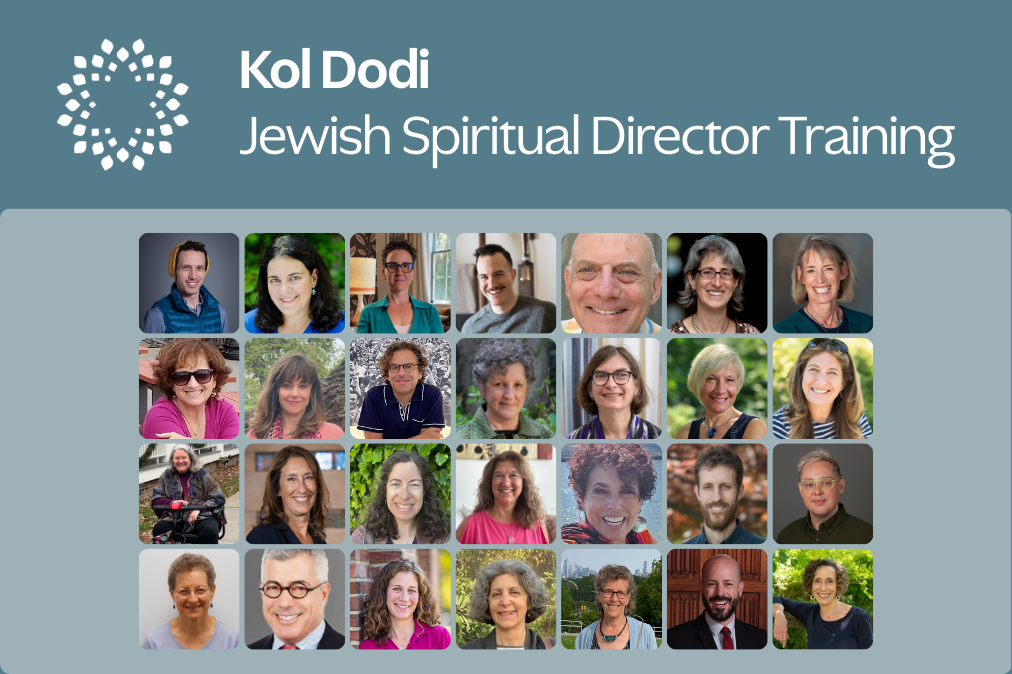
In the fall of 2023, IJS launched Kol Dodi: Jewish Spiritual Director Training Program under the leadership of Rabbi Myriam Klotz. Kol Dodi is grounded in IJS’s contemplative and contemporary core spiritual practices for cultivating awareness of mind, body and heart, and for attuning to the Kol Dodi, which means “voice of the beloved.”
Recently, we celebrated 28 graduates of the 18 month spiritual direction training program. Current Program Director, Rabbi Elisa Goldberg notes that: “Many participants came to the program with significant professional accomplishments and commitment to their own personal practice. It was a blessing to work with individuals on such profound spiritual journeys and to know that they will be sharing their gifts with others.” Among the participants in the first cohort of Kol Dodi were rabbis, cantors, therapists, wellness practitioners, lawyers, doctors, chaplains, and Jewish communal professionals.
Spiritual directors offer seekers opportunities to pause in the midst of our busy lives to focus on the still small voice within. Meeting regularly with a spiritual director over time can help one to live a richer, more authentic life aligned with their deepest values, to cultivate compassion and resilience, and to develop spiritual tools to face life’s inevitable challenges. The practice of spiritual direction helps one to connect to life’s mystery, explore our deep interconnection with life’s mysteries, and deepen one’s unique experience of faith.
Kol Dodi provides opportunities to grow both personally and professionally. As one recent graduate of the program noted: “The Kol Dodi program has renewed my vocation as a spiritual caregiver and given me a greater appreciation of all that I have to offer… If only my work life had changed as a result of this program, dayenu. I’ve also been blessed to find great joy and purpose in offering spiritual direction to others. I’ve discovered what a life giving gift spiritual direction is, how simple the premise and yet so profound the results.”
Want to get involved? Looking to nourish your soul?
The individuals listed here have completed Kol Dodi: Jewish Spiritual Director Training Program and are available to provide direction to individuals. Please contact anyone on the list to schedule a free 30-minute introductory session to see if Spiritual Direction is for you.
The next cohort of IJS’s Kol Dodi: Spiritual Director Training Program will begin in fall of 2026. If you are interested in finding out more about the training program, please contact Rabbi Elisa Goldberg, Program Director at elisag@jewishspirituality.org
In the fall of 2025, we will be offering a Taste of Spiritual Direction and an opportunity to participate in time limited Spiritual Direction Groups. Sign up to be notified when registration opens.
Hi friends. I hope this message finds you well.
This month, we’re focusing on preparing spiritually for Shavuot—the festival that commemorates our collective receiving of the Torah at Sinai.
Many of us were taught to relate to that experience as a one-time event in the distant past. And while this historical moment continues to reverberate through Jewish life, Sinai can sometimes feel far away—almost like a relic.
But there’s another way to see it—one that views revelation not as something that ended, but as something still unfolding. This isn’t as radical as it might sound. After all, Jews who pray daily recite a blessing over Torah study, which reads:
Barukh atah Adonai, noten haTorah.
“Blessed are You, Timeless Presence, for giving us Torah.”
The Hebrew word noten, ‘giving,’ is in the present tense—suggesting that revelation is happening right now.
The Hasidic tradition takes this proposition seriously, teaching that we can receive chidushim—fresh Torah insights—from within, here and now. But this requires quieting the noise of the mind and listening deeply for the sacred wisdom bubbling up deep inside.
I call this paradigm ‘Torah from the well,’ because it doesn’t require us to climb to the mountaintop to experience revelation. Instead this paradigm invites us to dig down—to peel away layers of conditioning, fear, and confusion until we reach the clear, refreshing waters of our inner Torah.
What might we discover if we truly believed that new Torah is available to us here and now? How might we cultivate the habits of heart and mind that allow us to receive it? How could this inner Torah guide us toward greater wholeness, wisdom, and connection—and breathe new life into our relationship with our inherited tradition?
To explore these questions together, I invite you to join me for a 5-part meditation series that I offered through the IJS Daily Sit in May 2021: Standing (or Sitting) at Sinai, Here and Now. It’s available on demand, free of charge, on our YouTube channel. You can find the five sessions by clicking on the link in this blog post.
I hope this offering helps you tap into the Torah that’s already alive within you. I’m wishing you a meaningful journey toward Shavuot.
Take good care.
We are grateful to Rabbi Shira Stutman for sharing her insights with us. Please enjoy the conversation recording.
Rabbi Shira Stutman is a nationally known faith-based leader and change maker with more than twenty years of experience motivating and inspiring groups large and small. She is the senior rabbi of the Aspen Jewish Congregation and co-host of the top-ranked PRX podcast Chutzpod! in which she provides Jewish answers to life’s contemporary questions and helps listeners build lives of meaning. She also teaches Torah and speaks nationally on topics that include growing welcoming Jewish spiritual communities; building the connective tissues between different types of people; and the current American Jewish community zeitgeist.
As founder of Mixed Multitudes, a consultancy that exposes diverse groups of Jews and fellow travelers to the beauty and power of Jewish life, tradition, and conversation, she currently is working on a variety of projects: running programs that support Jews in having less reactive and more heart-centered conversations about Israel; teaching in progressive institutions about antisemitism; and serving as scholar-in-residence for projects that build the next generation of philanthropic leadership. She was the founding rabbi of Sixth & I Historic Synagogue in Washington, DC, in addition to a number of other start-up Jewish life initiatives.
Her new book, The Jewish Way to a Good Life, is now available for purchase: https://theexperimentpublishing.com/catalogs/winter-2025/the-jewish-way-to-a-good-life/
Each month offers an opportunity for a tikkun (“repair”), a rectification of some aspect of our being. The month of Nissan, this season of spring awakening and liberation, invites us into the tikkun of speech.
Pesach literally means “mouth speaks,” and it is known that how we utilize our voices, words, songs, and speech is key to our redemption from mitzrayim, from the narrow places of our lives.
I deeply appreciate a teaching from Reb Nachman via his disciple Reb Nosson that there are four levels of speech associated with the four cups of wine we drink at the Passover seder. Thus, the seder can be a journey through our rectification of these four levels, which both build upon each other and are interpenetrating.
The first level is adam b’tzalmo – a person and their self. This represents our self-talk. Are we speaking to ourselves with love and kindness? When we notice highly critical or self-shaming voices, can we pause and actually think or speak kinder words to ourselves?
The second level is adam v’chavero – a person and their friend. This is how we talk to one another. Are we doing so with love, honesty, clarity, and respect, seeing the other person as b’tzelem Elohim, created in the divine image? When someone says something upsetting, can we practice pausing to better support ourselves in responding wisely and thoughtfully rather than reacting?
The third level is tefillah – adam v’makom – this is how a person talks to the divine, what we call prayer. How might we rectify our prayer lives this season? Are we speaking to God as if our prayers matter, as if they are truly being received? Are we speaking from our hearts, from authenticity, or just engaging in liturgical recitation by rote? Are we praying at all?
The fourth level is nevuah – this is when the divine speaks through us, what our tradition calls prophecy. What does it mean, what does it take, what does it feel like to make oneself available as a tzinor, a channel for a greater loving intelligence to flow through us? How do we become an instrument of the divine? Perhaps when we attend to those first three levels of speech, we can be better prepared for the deeper listening that makes possible the channeling of truth in ways that others can fully receive.
Our tradition teaches that words create worlds. Bringing attention and renewed energy this month to our speech is a profoundly important spiritual practice if we are to co-create the more beautiful world for which our hearts yearn.
As we approach Pesach this year, may we remember to slow down enough to listen before we speak. May our words be fitting vessels for the truth of our hearts so that they may be received by those who need to hear them. And may we each know the delight of expressing our truth in authentic, beautiful, and healing ways.
Traditionally, the month of Adar is a time to increase joy. But how can we authentically celebrate this month during such troubling times? Rabbi Jordan Bendat-Appell’s teaching helps us reframe this invitation in a way that feels more authentic to the current moment.



We are grateful to Andrés Spokoiny for sharing his insights with us. Please enjoy the conversation recording.
Andrés Spokoiny, CEO of the Jewish Funders Network, is a longtime Jewish communal leader with a history of leading successful organizational transformations. He served as the CEO of Federation CJA in Montreal and, prior to that, for the American Jewish Joint Distribution Community (JDC) in Paris. As Regional Director for Northeast Europe, he was responsible for a number of pan-European projects.
Before his Jewish communal work, Andrés worked for IBM and was responsible for training, development, hiring, and recruitment for IBM’s Latin America Southern Region during a period of major restructuring. Originally from Argentina, Andrés has a multidisciplinary academic background including business, education, and rabbinical studies in different institutions around the world. He is fluent in Hebrew, English, French, Spanish, Portuguese, and Yiddish, and is proficient in Russian. He’s the author of the novel El Impio (Penguin, Random House – Mexico) and a non-fiction book, Tradition and Transition: Jewish Communities and the Hyper Empowered Individual (Gefen Publishing).

We are grateful to Joshua Leifer for sharing his insights with us. Please enjoy the conversation recording.
Joshua Leifer is a journalist, editor, and translator. His essays and reporting have appeared widely in international publications, including The New York Times, The New York Review of Books, The Atlantic, The Guardian, The New Statesman, Haaretz, The
Nation, and elsewhere. A member of the Dissent editorial board, he previously worked as an editor at Jewish Currents and at +972 Magazine. He is currently pursuing a PhD at Yale University, where he studies the history of modern moral and social thought.

At this time of year, where I live in Toronto, the trees have shed almost all of their leaves and their branches stand bare against the grey sky. Day by day, the hours of sunlight shorten while darkness holds on longer to the mornings and rolls in earlier and earlier in the evenings. Overhead, skeins of Canada geese honk their way south, and I almost take their leaving personally, abandoning me along with the snow and cold. With the loss of light and warmth, I find myself habitually focused on what I am losing, fighting against the changing season and its natural impact on me. When I face these outer and inner changes unmindfully, I fall into habits of either pushing myself to resist rest, forcing myself to be busy and social, or collapsing into fatigue as thoughts of loneliness and lack curl in next to me on the couch.
To respond to the depletion and sense of lack that many of us feel at this time of year, there are abundant Jewish teachings for Chanukah and the whole Hebrew month of Kislev about bringing light into the darkness. But I want to invite us to linger in this month’s long nights, to explore making ourselves spiritually at home in the darkness and to learn from its gifts.
Rebbe Nachman of Breslov, the great Hasidic sage of the late 18th century, teaches that the medicine for this season is a practice of sighing. He quotes the famous verse from Zekhariah (4:6), from the Haftarah we read on the Shabbat of Chanukah -“Not by might and not by power, ki im be’ruchi – but only by My ruach (spirit/ wind/ breath)”. The repair for what is lacking cannot be found through force or fighting. Instead, we consciously, gently, engage with ruach.
Rebbe Nachman explains that because everything that exists has come into being through Divine ruach, vital lifebreath, and because the secret of renewal lives in that same enlivening ruach, when there is lack, it is because there is a lack of ruach. Healing, therefore, needs an infusion of flowing, vitalizing ruach. While the winter earth becomes dormant and many animals hibernate, drawing their ruach inward until they are renewed in the spring, we humans, teaches Rebbe Nachman, can meet the lack or depletion of ruach within us with a conscious and soft flow of breath.
He teaches:
“See how precious is the sigh and groan {the krekhtz } of a Jewish person. It provides wholeness [in place] of the lack…And sighing is the extension of the breath. It corresponds to erekh apayim (patience)—i.e., extended ruach. Therefore, when a person sighs over the lack and extends their ruach, they draw ruach-of-life to that which they are lacking… Therefore, through the sigh, the lack is made whole” (Likutei Moharan, Torah 8:1).
We might think that the practice that is called for in response to the lack of light and lows of this season would be to generate strong and powerful breath, bracing against the cold, or quick and activating breath to overcome the darkness and our impulses to collapse under the covers. But the quality of ruach that we nurture in the month of Kislev, preparing for Chanukah, needs to be distinct – different from the fresh aliveness of spring or the luscious vitality of summer. For this time of year, Rebbe Nachman prescribes long, extended ruach-of-life breaths that share the qualities of the darkness outside – slow, heavy, spilling and spacious with soft and blurred boundaries. Between the poles of fighting and collapsing, we access this clear and gentle ruach-aliveness.
Let yourself sigh a few times. Notice what the release feels like in your body. Feel how air tumbles out of your body, uncontrolled, unmeasured. The chest softens and falls, in and down. With the palms of your hands resting heavily against your chest, a sigh can partner with gravity to move stagnant ruach out of your body. Sighing is assisted by an open mouth and open throat so the fluff and flow of breath can pour out, unhindered.
And of course, each sigh is fed by the inhalation that fills the body before and after it. The deeper and fuller the inhalation, the more fluid and restorative the sigh can become. Instead of pulling the next breath in, you can allow your belly to expand softly, patiently, allowing fresh air to fill and expand your lungs, to widen your ribcage, to let your mouth fall open, expanding from the inside out, becoming more available to release the next sigh. As you continue this sighing practice (and as some yawning might unfurl with the same qualities of soft expansion, quieting and release), you might notice a gentle increase of energy that is restful and warm but not sleepy or forced.
You can let your vocal cords vibrate so that some sound rides on the flow of breath, just enough to give voice to what is felt within – sadness or ache, relief or pleasure. Rather than opening into big emotional catharsis, this is a practice of permission and presence so that feeling can move through us, supported and comforted by the movement of air through our whole bodies. With each holy sigh, ruach and emotion roll from the dark cave within to the darkness that surrounds. And from the darkness outside, enlivening ruach expands and fills the dark and wondrous galaxies within. Tehom el tehom koreh – Deep calls to deep (Psalm 42:8).
Just as the small, flickering Chanukah candles enable us to be present with the stretch of night outside our windows, the practice of sighing embodies spiritual wisdom gleaned from the darkness. It doesn’t alter the weather or the slant of the sun but it fosters a sense of wholeness within us, breath by divine breath, so that we are increasingly at home in the darkness, lacking nothing.
As we enter the darkest season of the year, Jewish tradition teaches of the or haganuz, a hidden light revealed through presence and righteous acts. Legend says 36 hidden righteous ones—the Lamed Vavnikim—sustain the world. This Hanukkah, as we light 36 candles, we’re called to embody their spirit, revealing the light within ourselves and the world.

We are grateful to Rabbi Adina Allen for sharing her insights with us. Please enjoy the conversation recording.
Rabbi Adina Allen is a spiritual leader, author, and educator who grew up in an art studio where she learned firsthand the power of creativity for connecting to self and to the Sacred. She is cofounder and creative director of Jewish Studio Project (JSP), an organization that is seeding a future in which every person is connected to their creativity as a force for healing, liberation and social transformation. Adina’s first book, The Place of All Possibility: Cultivating Creativity Through Ancient Jewish Wisdom, was published in July 2024 (Ayin Press). She is also a national media contributor, popular speaker, and workshop leader, and her writing can be found in scholarly as well as mainstream publications. Based on the work of her mother, renowned art therapist Pat B. Allen, Adina developed the Jewish Studio Process, a methodology for unlocking creativity, which she has brought to thousands of activists, educators, artists, and clergy across the country. Adina was ordained by Hebrew College in 2014 where she was a Wexner Graduate Fellow. Adina is the recipient of the Covenant Foundation’s 2018 Pomegranate Prize for emerging educational leaders. She and her family live in Berkeley, California.