Making Plans (Vayakhel-Pikudei 5786)

Making Plans (Vayakhel-Pikudei 5786)

“It’s hard to make plans these days.” In the years preceding her Alzheimer’s diagnosis (perhaps in a sign of things to come) I remember my mother saying these words regularly. I’m sure there was truth to it: the effects of aging on the body made it harder to know how she or my father would feel about traveling, or even just going someplace, when the time came. It was harder to make plans.

I’ve been hearing my mother saying these words in my mind recently as we’ve begun a new strategic planning effort at IJS—because it does, indeed, feel hard to make plans these days. We had a quarterly board meeting this week and I thought about so many big things that have changed in the world just since our last meeting three months ago: the return of the last of the Israeli hostages from Gaza; the violence in Minneapolis; US military action in Venezuela, and now a bona fide campaign against Iran; saber rattling about Greenland; not to mention the continuing saga of the Epstein files, the latest advances in AI and increasing worries about its effects on employment; the Supreme Court ruling the President’s tariffs illegal, and uncertainty about what happens next; oil at $120 a barrel and concomitant economic effects. Oh, and ever-present and seemingly increasing worries about threats to Jewish safety, whether in the form of missiles in Israel or violence directed at synagogues, including yesterday’s events in West Bloomfield, not far from my home town of Ann Arbor.

That’s just a partial list, yet reading it I can’t help but hear my mom: It’s hard to make plans. As a not-for-profit, we rely on fundraising for about 40 percent of our revenue. A lot of that depends on the economy. The more volatility there is in the market, the harder it is for us to plan. Likewise, as a Jewish organization serving a broad range of folks, we have to be mindful of the assumptions we bring into our work: about what Jewishness means to our participants, about whether and how they relate to Israel or experience antisemitism. And as an organization serving human beings, we have to be aware of AI, and other technologies, and the effects they have—and might have—on those we aim to serve and support, as well as how safe they feel: physically, emotionally, intellectually, or otherwise. All of that is churning amidst this typhoon of change.

I’ll add one more wrinkle to all this. Our organizational tagline is, “Grounded in mindfulness. Guided by wisdom.” Mindfulness, of course, invites us to let go of planning. The only thing we can really know in any given moment is our experience of that moment. When I’m meditating and notice my mind starting to plan, I’ll often say to myself, “Oh, planning is arising. Got it. Let me set that aside for the moment and return my attention to my breath.”

That can perhaps lead to the mistaken notion that mindfulness eschews planning—or its twin, thinking about the past. I don’t think that’s right. It’s mindless not to plan—whether we’re going to the grocery store or going to war (though it goes without saying that the stakes of one of those are immeasurably higher than the other). It’s also less than mindful to overinvest our plans with a feeling of firm knowledge. The problem is not planning per se; the problem is when we allow planning to become an escape from this moment, which is the only thing we can genuinely know.

Parashat Vayakhel opens with a final mention of Shabbat in the context of building the Mishkan: “On six days work may be done, but on the seventh day you shall have a Shabbat Shabbaton, a sabbath of complete rest, holy to YHVH” (Exodus 35:2). Throughout this series of Torah portions, the text has consistently juxtaposed the workweek activities of building the Tabernacle with the sacred rest of Shabbat. This impresses upon us the inverse relationship of the two: Not only is the specific labor involved in constructing the Mishkan prohibited on Shabbat, but Shabbat in its fullest manifestation is the absence of that labor.

“When Shabbat arrived, rest arrived,” says the Midrash. Building on this, Rabbi Mordechai Twersky of Chernobyl (1770-1837) observes, “Rest is an aspect of wholeness, of completion—which one arrives at after much effort. And so too the opposite: Something that requires effort reflects an element of lack. Thus, those things which we regularly experience as missing in our lives, like money or personal honor, are spiritually akin to the workweek. But not so Shabbat, which instructs us about wholeness.”

The six days of the workweek are not just a time. Like Shabbat, they are a mindset—and the two mindsets exist in relation with each other. Or, better yet, they are two parts of a single mindset. Just as on Shabbat the Torah prohibits us from planning or preparing (hachana), during the workweek we invest our planning and preparation with an awareness of Shabbat, with purpose and intention (melechet machshevet). In an ideal world, the rhythm of planning and pausing, doing and resting, helps us invest whatever moment we’re in with awareness and presence. When we can live in that way, our planning and our doing become our own versions of the sacred service to build a home for the Divine in the world.

For Reflection & Conversation

How do you experience planning? Is it easy or hard, enjoyable or unpleasant? Why? Has your relationship with planning changed over time? If so, why? How might your Shabbat practice support a healthier relationship with planning?

Limitless (Ki Tissa 5786)

Limitless (Ki Tissa 5786)

I can remember a period of my life when the melancholy of a waning Shabbat afternoon really hit me hard. This was in my early twenties. I was single, just back from a year studying in yeshiva in Israel, and most often spending Shabbat with friends on the Upper West Side (in a desire to end my singlehood and find a partner). As the sun would sink into the western sky and the shadows of those Manhattan apartment buildings would grow longer, I would often feel a kind of heartache, some combination of yearning to be elsewhere (back in Israel, perhaps) and longing for Shabbat not to end.

While not as intense and qualitatively different, I still feel a bit of creeping wistfulness late on Shabbat afternoons. I often find myself drawn to our family photo albums (among the gifts of finding that partner many years ago: she is a scrapbooker by nature). Or I’ll go find a book from the shelves that store the books of my younger years—sometimes that even results in taking out an old orchestral score from my musician days and mentally working my way through it. But the impulse is most often the same: a desire for this not to end, a reluctance to confront what I sense awaits me the moment I dip the havdallah candle into the kiddush cup and listen as the flame sizzles out.

In recent years, I feel like that anxiety has taken on a new, more urgent color, as coming out of my Shabbat cocoon has thrust me into a world turned upside down. October 7, of course, was Shabbat. The assassination attempt against Donald Trump happened on Shabbat. Just two months ago, the U.S. military went into Venezuela and took its president on Shabbat. And, of course, just last week the United States and Israel began a massive air campaign against Iran on Shabbat.

There are practical issues for those of us who don’t use our phones and computers or watch TV on Shabbat: how to get caught up, for instance. (There’s a niche market for a news summary just for shomer Shabbat people.) But, more seriously, I find that the increasing feeling that big things are happening in the world over Shabbat has an effect on my experience of Shabbat itself. I feel a greater urge to check the news. I find it harder to access the feeling that Shabbat is the sacred island that I’ve long known it to be.

And, of course, these are a version of “First World problems.” To my relatives and friends in Israel, for instance, this is not some aesthetic question of the flavor of Shabbat—it’s about running from missiles and reporting for army service, about life and death. As Maimonides teaches, Shabbat is pushed aside (dechuya) in the face of danger to life, i.e. physical existence, just as all other mitzvot (Laws of Shabbat 2:1). The very fact of my reflecting about Shabbat in this way, worrying about… worrying, is a reminder of my privilege of living in a nuclear armed superpower bounded on either coast by an enormous ocean. But still, it has an effect.

Parashat Ki Tissa mentions Shabbat in the midst of the instructions for building the Mishkan. Rashi offers a reason: “Even though you may be bound up in the mitzvot of building the Tabernacle, do not push away (al tidacheh) Shabbat” (Rashi on Exodus 31:13). That’s a remarkable statement, actually. Because building the Mishkan is not, I imagine, work we would wish to escape from. It’s holy, sacred service, work with purpose that connects us to the Divine and one another—an ideal form of labor. And yet, the Torah comes to tell us that even then, or perhaps especially then, we can’t push away Shabbat.

In an 1886 homily, the Sefat Emet infers a lesson from Rashi: “So great is the spiritual level of Shabbat that it exceeds even the six days of God’s original Creation.” And, he adds, “The ideal form of Shabbat has no limit,” a mystical, poetic comment which I register as an invitation to ground ourselves in the infinite through Shabbat, even as we are limited, material beings in a limited, material world. Shabbat, the Sefat Emet repeats so many times in his writings, is the means by which we experience, and even prepare ourselves for, the limitlessness of the World to Come. In the midst of these Torah portions devoted to the paradoxical, profoundly challenging idea that the Infinite could be at home in the finite, of course Shabbat must be at the center.

The world is heavy these days. There’s yet another war on (or perhaps it’s really just one long war). Institutions, our repositories of trust, are fraying and breaking. As are the boundaries that many of us have come to take for granted: between nations, between home and street, between land and sea, between Shabbat and the workweek. All of which makes practicing Shabbat feel like an even greater act of resistance.

Many Buddhist teachers I know will conclude a meditation sit with some version of the blessing, “May all beings be happy, safe, peaceful and free.” There are a lot of ways I might translate that in the language of Torah, but the simplest might be: May it be that our world allows all of us to practice Shabbat. Or, even shorter: Shabbat shalom.

For Reflection & Conversation:

Our tradition describes Shabbat as “a taste of the world to come.” What does that mean to you? Does your Shabbat practice help you experience it? Why or why not? What might you want to adjust in your Shabbat practice to strengthen it?

Role Playing (Tetzaveh 5786)

Role Playing (Tetzaveh 5786)

Three of my happiest moments as a parent have come at our local men’s clothing store, as I have taken each of my sons to find a suit for his bar mitzvah. For starters, the trip strikes a deep chord of familiarity, as I remember shopping for a suit or a sport coat with my own father at the long since closed Ann Arbor Clothing. That’s a warm memory. For another, it has generally marked a milestone, as we don’t live in a community in which kids (or even adults) are expected to wear fancy clothes to shul. Thus, in all three cases, this was the first time they had worn something more upscale than an oxford and khakis. 

That’s seemingly part of a generational shift (likely multi-generational) away from formal dress. These days my youngest will sometimes wear pajamas to school, and when I protest he just gives me the side eye. It’s as though asking him to put on a pair of jeans and a t-shirt was the equivalent of ordering up a top hat and tails.

And yet clothing still makes a difference. Developing a wardrobe has been part of the young adulthood of each of my older children, and while my youngest is only 13, he is now equipped with a full line of t-shirts, sweatshirts, and sweatpants, courtesy of his friends’ b’nai mitzvah. In my own life, I find that, even when we’re not going out or having company over for Shabbat dinner, I still feel a need to put on bigdei shabbat, clothes that remind me—or, even better, help me inhabit—the spiritual zone of Shabbos. (In my case that means a white button-down shirt and dark trousers. A suit is still reserved for more rarified occasions.) To me, that’s an interesting marker, because it signifies that my clothing isn’t only about performing a role for others, but also about performing for myself and/or for the Holy One—which is a fascinating idea.

Commenting on Parashat Tetzaveh, Rabbi Avrohom Bornsztain of Sokochov (1838–1910) observes, “The priests require their special clothes, and if they aren’t wearing their holy garments then their sacred service is invalid.” Yet the Levites have no such special requirement. Why so? Because unlike the Levites, whose service was externalized through song, the spiritual work of the kohanim was penimit, internal. “For everything which is internal requires covering: The soul, when it comes into this world, requires a covering—the body. An angel that is sent to this world likewise needs to wear bodily garments.” And, he continues, this is the very notion of wearing special Shabbat clothes, “for Shabbat is itself internality.” He cites the midrash’s gloss on the story in which Naomi tells Ruth, “Wash and anoint yourself, place your garment upon you, and descend to the threshing floor” (Ruth 3:3). “Was she not already wearing clothes?” asks the Midrash. “Rather this is to tell you that she put on Shabbat clothes.” At this moment of her spiritual conversion, the Sokochover teaches, Ruth accessed a new inner life and thus required new clothing—not just physical garments, but spiritual covering. So, too, with the priests—and with all of us (“You shall be unto me a kingdom of priests and a holy nation,” as God says in Exodus 19:6).

At the same time, we can’t ignore the social dynamics of clothing. Rashi (on Exodus 28:3) notes that Aaron becomes the High Priest by virtue of the clothing he wears, i.e. if he doesn’t wear the uniform, he simply can’t inhabit the role. With spring training underway, Rule 3.03(c) of Major League Baseball comes to mind: “No player whose uniform does not conform to that of his teammates shall be permitted to participate in a game.” If a player refuses to wear the “garment,” even if it’s Shohei Ohtani hitting a 500-foot home run, they essentially cease to exist in the eyes of the game. 

All of which raises questions about authenticity and a critique we hear invoked frequently these days, performativity. These questions are present for anyone, but they are more acute in the age of social media, in which it’s not always clear—even to the person posting—whether and how these dynamics are at play. Am I sharing this beautiful photo of my family because I feel good and warm and want to invite others into that sensation, or am I not so subtly saying, Look at me and my wonderful family (which, as Tolstoy reminds us, is either just like every other happy family or unhappy in its own special way)? Or, if I’m making a political statement, am I doing that because I genuinely believe it, or to conform to some expectation I sense from others to say something? (And, I might add, we can add an additional layer of questions: What, if anything, is wrong or right in either of those?)

Purim, which always follows Parashat Tetzaveh, invites us even further into these questions not only with its tradition of costumes, but in the deep ways in which Esther’s story plays with dynamics of concealment and revelation, authenticity and role-playing. Those dynamics are perhaps embodied in Mordechai’s pivotal question to Esther, “Who knows if it was not for just such a moment as this that you became Queen?” (Esther 4:14) In response, Esther not only musters her courage—that is, tends to her inner life—but, critically, puts on her royal clothing to plead for her people before the king (5:1). She would seem to be both authentic and performing at the same time, a model for all of us to study.

For Reflection & Conversation

  • Noting that this can be a very intimate question for some folks, please handle it with care: When, if ever, have clothes helped you feel more “like yourself?” What changed about you as wore those clothes? How did it affect your sense of yourself?
  • When, if ever, do you think about being authentic or genuine versus being performative? What, if anything, helps you to stay grounded and true to yourself?
Making Space (Terumah 5786)

Making Space (Terumah 5786)

Conventional wisdom tells us you shouldn’t make too many big life changes at once. Two weeks after I finished rabbinical school in the summer of 2005, Natalie and I welcomed our second child. And two weeks later we moved halfway across the country so I could start a new job. We bought our first home, we bought a new car. All to say that we made a lot of big life changes all at once. Sometimes, it seems, you just can’t abide by conventional wisdom.

A lot goes into furnishing a new place. Up until that time, we had eaten our Shabbat meals at a desk-cum-table from Ikea that could seat six in small folding chairs if you really smushed. But knowing that we’d be hosting students from campus, and generally just feeling like it was time, we splurged and purchased a beautiful chocolate brown dining room table and eight chairs (with leaves in, it seats 12). Over two decades later, it’s still the table we gather around for Shabbat and holiday dinners, for playing board games and making craft projects, and, in the age of Zoom, for a good chunk of my workday. 

Yet of all the memories that have been formed around our table, the most lasting one is the earliest: when we sat down to our first Shabbat meal there and I looked around at everything—our family, this new place that was ours, this life that now felt less precarious and more secure, and this table that felt solid and real and lasting. I sighed, and said out loud, “Now I feel at home.” (My mother-in-law, who was there, likes to remind me of this story whenever she visits. I can’t blame her.)

Beginning with Parashat Terumah, the Torah invites us into an extended reflection on many of these same themes: furniture, yes, but more generally objects, place, the material world, home. Numerous commentators point out the significance of the verse, “And they shall make me a sanctuary, that I may dwell among them” (Exodus 25:8)—among them, not it. From the very outset, the Torah is clear that we avoid the delusion that the Holy One resides inside the Mishkan or the objects within it. Its ultimate purpose is to help us recognize and manifest the Divine in our midst—something, perhaps, like my experience with our Shabbat table.

This meta issue of spiritual orientation reflects the story hovering in the background, namely that of the Golden Calf. While Nachmanides and many others follow the chronological order of events and thus understand the Mishkan as God’s original plan, Rashi draws on a midrashic tradition that inverts the sequence. This sees the Golden Calf as having taken place before the commandment to construct the Mishkan. If that’s the case, then the Mishkan can be understood more as a concession to our human need for physical places and objects through which to experience the divine Presence. 

Yet according to either reading, the calf represents a profound warning about the spiritual and moral dangers that lurk in our relationship with material things. Rabbi Marc-Alain Ouaknin writes, “The temptation of idolatry is strong—one need only remember the golden calf, made right after the Revelation; it is the temptation of appearances, of Presence… The idol… reassures; the idol brings things closer.” In a similar vein, Avivah Zornberg quotes Jacques Derrida, who writes about the notion of caressing, i.e. holding neither too tightly nor too loosely, somewhere between seizing and letting go: “The caress, like contact, is sensibility. But the caress transcends the sensible… The caress consists in seizing upon nothing, in soliciting what ceaselessly escapes its form… in soliciting what slips away as though it were not yet. It searches, it forages. It is not an intentionality of disclosure but of search: a movement unto the invisible.” 

There is a profound seductiveness at either end of the spectrum: The seeming permanence of physical objects can offer the reassurance of presence in a world in which presence is fleeting; the non-physical nature of an entirely spiritual life can offer transcendence from a world mired in physicality. Zornberg rightly suggests that this registers the depth of the human struggle. Reminding us of the Israelites’ cry at Massah (Ex. 17:17), “Is there (yesh) God in our midst or not?” (literally, “or else nothingness [ayin]“), she writes, “Beneath all the fluctuations, the myriad shapes of desire, this is the radical question.” At root, she suggests, it is our desire to both hold the Divine and be held in the Divine embrace that drives us—and, potentially, consumes us.

My last two reflections have named specific issues and people in the news. Regular readers will know that that’s a bit unusual for me. Following the halakhic principle that three times makes a hazakah, i.e. a presumption, I’m going to avoid directly commenting on current events this week for fear that that will become my default M.O. But I would certainly suggest that we can and should read current events through this lens. Because I think Zornberg, and our larger tradition of Torah, are so profoundly helpful in offering this understanding. She writes that we seek lives of density or meaning; I say something similar, that we seek to feel profoundly at home in the universe. Given that we are this glorious and messy combination of both bodies and heart-mind-spirits, we engage in spiritual practices to help us do that—to avoid desecrating our “home” through our need to seize and hold, and simultaneously to avoid escaping the demands and joys of “home” through not engaging in the housework. 

For Reflection & Conversation

When, if ever, have you felt a profound sense of being spiritually at home? Do you feel that way in a place that’s also a physical home for you? Why or why not?

Common Decency Comes Before Religious Law (Mishpatim 5786)

Common Decency Comes Before Religious Law (Mishpatim 5786)

This week I remembered an event from many years ago when I was a young Hillel rabbi. I was in a session at the annual Hillel staff conference led by Rabbi Jim Diamond z”l, the sagely longtime Hillel director at Princeton. Jim was sharing some of his war stories, one of which went like this:

One year, the president of the student body turned out to be Jewish. Jim didn’t know this student, but he managed to get word to him that he would love to meet him. The student got word back to Jim that he had no interest in meeting. (It happens.) The student, unsurprisingly, went on to an illustrious career in state politics. But ultimately, he resigned in scandal. “And so,” Jim said, “I’ve been wondering whether history might have been different had Elliot Spitzer said yes to my offer to meet.”

I’ve been thinking about that story this week as more and more of the Epstein files are revealed to us. Not so much because I think meeting with the Hillel rabbi at Cooper Union or NYU would have changed history (Epstein attended both but didn’t graduate from either), but because I find it hard to ignore the Jews involved in the story, from Epstein himself and Ghislaine Maxwell to Howard Lutnick, Leslie Wexner, Ehud Barak, Noam Chomsky, and countless others. While Epstein and Maxwell’s crimes are horrific on their own, the presence of so many prominent Jews in the story compounds my sense of revulsion.

In the case of Wexner, I experience a deep personal sense of implication. Like over a thousand other Jewish professional leaders, it was the Wexner Graduate Fellowship that put food on my family’s table while I was in rabbinical school. The fellowship community has been an enormously important source of wisdom, companionship, and professional support throughout my career—as it has been for two generations of Jewish professional and volunteer leaders. The idea that all of that was, in significant measure, built on a core of moral rot is nauseating.

But for the moment, what most preoccupies me is this deep feeling of offense, anger, sadness, and even shame at the reality that so many Jews were, knowingly or unknowingly, part of this horrific web of rape, abuse, and dehumanization. Last fall I wrote about the culture of detachment and rootlessness described in the Epstein files. But this week I’m really feeling a sense of disgust at the idea that so many landsmen, fellow Jews, were not only part of that jet-setting culture, but seemingly turned a blind eye to profound injustice in their midst.

Because I feel like we all know we’re supposed to be better than this. “These are the laws which you shall place before them,” begins Parashat Mishpatim (Exodus 21:1). “Just as the preceding words [i.e. the Ten Commandments] were given at Sinai, so too were all of these laws given at Sinai.” So says Rashi, quoting the Mechilta. Rabbi Simcha Bunim of Peshischa adds, emphatically: “before them—the Torah teaches here that the civil laws, the commandments about how we treat fellow human beings, come before everything else, including the commandments about our relationship with God. Derekh eretz kadma latorahCommon decency comes before religious law.”

In another comment, Simcha Bunim goes further: “Mishpat tzedek, our basic sense of fairness and justice, must precede everything: every thought, every discernment.” And, he adds, this is foundational to what it means to be Jewish: “The rest of the world may teach that all law is established by human beings and thus may be changed, depending on the time and place, in response to various pressures. But we are taught, ‘Justice is the Lord’s’ (Deut. 1:17)… Just as we don’t change the Ten Commandments in response to the contingencies of our time, we also don’t change the fundamental laws of how to treat human beings.”

I hear this voice in my kishkes crying out: Even if one doesn’t know Reb Simcha Bunim or Rashi or the name of this Torah portion; even if one hasn’t been to shul in decades; even if you’ve eaten a ham sandwich on Yom Kippur every year, how is it possible that you don’t know the most fundamental elements of goodness and decency?! “You shall not oppress the stranger, as you know the heart of the stranger because you were strangers in the land of Egypt” (Ex. 23:9), or “Stay far from falsehood” (23:7), or “Do not pervert justice” (23:6), and “Don’t take bribes (23:8).” Beyond the horror of the crimes themselves, the seeming absence of these most basic elements of ethics from the hearts and minds of so many Jews in this story leaves me speechless.

Of course, these are not the first nor the last Jews to seemingly suffer from this moral malady. The violent abuse of Palestinian Arabs in the West Bank by Jewish Israelis, too often with a similar lack of disapproval or enforcement by the authorities as in the Epstein case, is yet another moral stain on our people. And again, my heart is a jumble of anger, sadness, and shame.

We can, of course add to that list. While Reb Simcha Bunim’s teachings may reflect a centrality of ethics that we like to think of as a distinguishing feature of Torah and Jewish life, our tradition is replete with counterexamples: Abraham allowing Sarah to be taken into Pharaoh’s harem; Shimon and Levi murdering the defenseless men of Shechem; King David abusing his office to bring about the death of Batsheva’s husband so he could marry her. When we recite the confessional at Yom Kippur (whether we ate that ham sandwich or not), we join a long list of Jews who have come up short—some of whom have been held to account in court, many of whom have not.

That is not an excuse, it’s an essential reminder. The emotions surrounding the Epstein case are powerful. To me, that makes it all the more important to rely on our spiritual practices grounded in mindfulness: so we can be aware of how those emotions may be activated within us; so we can look clearly at the wrongs and injustices; so we can have the clarity and courage to offer healing to the victims and rectify the harm; and so we can try to avoid falling into the same morally and spiritually vacuous pits ourselves.

For Reflection & Conversation

  • In your own life, who is a model of a person with a strong ethical core? What lessons of theirs have you tried to embody?
  • How, if at all, does your Jewish spiritual practice support your ethical life?
A Time to Act (Yitro 5786)

A Time to Act (Yitro 5786)

It has always been easy for me to know how old the United States is. I was a “Bicentennial Baby,” born in 1976. Add 200 to my age, and you get the age of the country. With God’s help, I’ll turn 50 in May, and my country, in turn, will be 250 in July.

I don’t know about you, but to me it doesn’t feel like a very happy birthday year for the nation.

Two and a half centuries ago, Thomas Jefferson and his comrades, however imperfectly, planted into the Western world’s collective political consciousness the ideas of human equality and government by the consent of the governed. (As David Graeber and David Wengrow demonstrate in their wonderful The Dawn of Everything, Jefferson and his European antecedents very likely learned some of these ideas from Native Americans. Add it to the many things on the list of what the rest of us owe the original inhabitants of this land.)

They grounded that claim in a conception of the Divine that we recognize from our own Torah: that human beings are endowed by their Creator with certain unalienable rights. Or, as my mentor, Rabbi Yitz Greenberg, so persuasively taught generations of Jews, human beings are created b’tzelem Elohim, in the Divine image. This, according to Ben Azzai, is klal gadol batorahthe Torah’s foundational principle.

That basic idea was and remains revolutionary. From the very founding of the republic, it challenged the practice of slavery—eventually leading to the country’s most catastrophic moment of rupture and, in the same breath, bringing about a profound moment of its redemption. Planted there in the Declaration of Independence, the idea of equality continued to challenge those with and without authority, leading eventually to women’s suffrage, the Civil Rights and Voting Rights acts, and legal equality for LGBTQ folks. And it undergirded the value that all human beings, regardless of their national origin or legal status, are entitled to equal protection under the law. Despite moments—sometimes long moments—of backsliding and repeated failures, increasingly large majorities of people came to trust that the United States and its institutions generally strived to live out the true meaning of its creed.

Rabbi Moshe Feinstein, one of the great poskim (halakhic authorities) of the twentieth century in America, identified the United States as a malchut shel hesed, a government that—unusually, and happily—was imbued with kindness. Rabbi Chaim Strauchler summarizes Rav Moshe’s view: “America, uniquely in Jewish history, embedded kindness into its legal and civic structures. Hesed was not dependent on the goodwill of a ruler or the mood of a mob. It was routinized, bureaucratized, and protected by law. For Jews, this was unprecedented: not perfection, but reliability.” Which is to say, the bank of trust that authorizes the government—the consent of the governed—rests on a foundation of Hesed. There have always been groups for whom this description wasn’t true, of course. But the seed of equality, planted at the root of the American project, summoned the country to rise to its challenge.

Thus one of the things that makes this such an unhappy birthday year for me, and perhaps for you, is that this description increasingly seems not to fit reality overall. Arms of the Federal government are flagrantly, even gleefully, violating these values and squandering this trust: ripping people from their homes in the dead of winter, imprisoning children, housing human beings in inhumane conditions, and even destroying images of the Holy One—i.e., killing people (who also happen to be citizens, but I’m not sure that should matter)—who get in their way. They are supported and justified by Administration officials who seem to delight in spreading hate and falsehoods, and have claimed absolute immunity for their actions. And all of them are ultimately authorized by a President who, at the most charitable, I might describe as suffering from incontinence in his speech. “What is worse than doing harm?” the Buddha taught. “To prompt others to do harm.” Or, in our own tradition: “Whoever causes the multitudes to be righteous, sin will not occur on this person’s account; And whoever causes the multitudes to sin, such a person is not afforded the ability to repent” (Pirkei Avot 5:18).

All of that causes me, and perhaps you, a lot of pain. It can lead to fear, to a sense of constriction, to moments of paralysis interwoven with moments of reactivity. And, perhaps most significantly for we who practice Judaism as a mindfulness practice, it can lead to “spiritual bypass,” when we use the tools of mindfulness to acknowledge our fears, but not to take responsibility for doing anything about the state of the world.

To me, this is one of the hardest parts of our practice—and, even more so, of leading a Jewish organization devoted to this approach to Torah in this moment. At IJS, we begin all of our retreats and courses by creating a trust bank, a container in which participants feel safe enough to be vulnerable. We gather deposits into that bank by reading a set of shared norms that we call Making Safer Spaces. The third item in this document reads, “Know that there is genuine freedom in this program. Every invitation to speak and participate is just that: an invitation. Passing or staying quiet is perfectly acceptable. You know best what you need.”

Which is to say, at IJS we mostly avoid using the word “should.” We don’t tell you what to do. We invite you to determine what is right and good for you right now.

That ethic has largely guided how we respond to public events. In 2022 I told our Board of Directors that I was worried about something big happening in the world and us feeling a lot of pressure to sign on to or make a political statement. We hadn’t really prepared for that, and I was concerned we could suffer as a result. So we spent the next year working together as a Board and staff, the result of which was our policy on making and signing statements. Consistent with our approach to “shoulds,” the upshot of our policy is that we generally don’t make or sign onto such statements. Rather, we see our role as holding the container within which all of us can “strengthen our innate sacred capacity to work towards a more just, equitable, and inclusive society and world, and to fulfill our sacred role as stewards of Creation.”

The Board adopted that policy in September 2023, less than a month before October 7. Generally speaking, it has served us well in the years since.

Yet the question of spiritual bypass is always lurking, and as the leader of this organization, I find myself thinking about it frequently every week. It is so important that we help folks to manage their stress and anxiety and to do so through the language and practices of Torah. And it’s so important that we help folks connect with their deep sense of purpose, experience a rich sense of community, and recognize the presence of the Holy One in their lives. I am incredibly proud of us for that. But are we also helping people (me, you) to get off the cushion and act?

One of the ways spiritual bypass can show up is when we tell ourselves, “There’s nothing I can do. Someone else will have to solve this problem.” Part of the clear perception that is a goal of our practice is to discern what the problem is and whether it is ours to solve. Some Jews, it seems, have adopted the position that, in a world where trusted institutions are breaking down, the first and overwhelming priority needs to be Jewish survival: “Let others worry about America, we need to focus on our own protection.” And honestly, I am sympathetic to this argument. As a student of Jewish history, I think that’s a completely reasonable position. Indeed, in many ways it informs the dedication of my life to Torah and the Jewish People. There is no one else to keep the Jewish people alive—it’s up to us.

And yet I cannot give up on America. I can’t seem to shake the belief that there is something profoundly special and important about this experiment that is two centuries older than me. In a remarkable series of essays, my colleague Rabbi Zachary Truboff suggests that it’s the radical notion that, in America, just as in the Torah, we have been born into a covenantal relationship with one another:

We must not forget what America offered Jews. For the first time in their history, Jews could live covenantally within a non-Jewish political community, not as tolerated guests, but as participants in sustaining a shared political world. America’s Constitution, like the Torah, rested on the fundamental principle that power must be restrained by law, for without this, those in charge soon act as if they were gods. But there is a second dimension to covenantal politics that is just as essential: responsibility. A covenant does not perpetuate itself automatically but only endures if those bound by it take responsibility for it again and again. At Sinai, all Jews were made responsible for the covenant with God, and in America, all citizens are responsible for the republic. Neither system functions if its members treat it as someone else’s problem.

Parashat Yitro tells us two stories. There is the story of the Revelation at Sinai, and, before that, the story of Jethro, Moses’s non-Jewish father-in-law, who helps him establish a system of law, judging, and governance. The very juxtaposition of these two stories teaches us about what it takes for a society of humans to live together: a sense of shared experience and purpose, institutions that can maintain the trust of the people, and wise and compassionate leadership, among others.

Jethro tells Moses that the leaders he appoints “will judge the people at all times,” in all moments, as it were. Commenting on this verse, the Seer of Lublin suggests a slightly different reading: “According to the time and the moment will they make judgments and decide the halakha,” the righteous path to take.

In a democracy, every one of us shares an equal piece of the sovereign. That is what makes the Declaration such a radical document, even 250 years later. Power does not reside in a king or an emperor far away, but rather within each and all of us together. And not only political power, but spiritual power: God is not off in some far away place, but within, between, and amidst us.

If we take the Seer of Lublin’s teaching seriously, then the responsibility devolves on each and all of us, individually and collectively: to know what the time and the moment are, to judge, and to act.

We practice so that we can perceive clearly, so that we can know what the time and the moment are. We practice so that we can acknowledge our fears and mindfully, courageously act in spite of them. We practice so that we can live a life of loving and compassionate purpose and devotion, and bring about a world in which every image of God can be safe, free, loved and loving in the deepest sense.

So when I say that IJS is here for you right now, that’s what I mean. If you need comfort, calm, and clarity we are here for you. If you need community, we’re here for you. If you or those you know and care about are afraid for your safety, we are here for you. And, if you’re ready to act, we’re here for you—and I’m glad you’re here for all of us.

For Reflection & Conversation

  • What do you notice arising in you as you take in this reflection? If you sit with it, does anything become clearer for you? If so, what and why? If not, why not?

  • What supports or inhibits you from engaging in civic life in this moment? How, if at all, does your practice help? How do you try to manage the dangers of spiritual bypass?

Walking Through the Waters (Beshallach 5786)

Walking Through the Waters (Beshallach 5786)

This week I’m thinking about three walks. I’ll talk about them in reverse chronological order.

The First Walk
On Tuesday I was walking the dog and listening to a talk by Gil Fronsdal, which he had given two days earlier. Gil prefaced it by saying that it would be a challenging talk, and it was clear he was going to address questions of citizenship and activism in the wake of the killing of Alex Pretti in Minneapolis.

I was struck by a Buddhist poem Gil started with:

Others will be cruel. We will not be cruel.
Others will be violent. We will not be violent.
Others will kill. We will not kill.
Others will steal. We will not steal.
Others will engage in sexual misconduct. We will not engage in sexual misconduct.
Others will lie. We will not lie.
Others will speak divisively. We will not speak divisively.
Others will speak harshly. We will not speak harshly.
Others will speak pointlessly. We will not speak pointlessly.
Others will be avaricious. We will not be avaricious.
Others will have hatred. We will not have hatred

This “poem” is actually a section of a chant drawn from the Sallekha Sutta of the Pali canon. There are 44 total lines, and in the ritual Gil discussed (but didn’t actually do on this recording), it is recited four times successively.

As I listened to this litany, my mind went to a (much shorter) parallel from our own tradition, the prayer of Rabbi Nehunia ben HaKanah, which is traditionally recited today upon completing the study of a tractate of Talmud:

I rise early, and they rise early. I rise early to pursue matters of Torah, and they rise early to pursue frivolous matters. I toil and they toil. I toil and receive a reward, and they toil and do not receive a reward. I run and they run. I run to the life of the World-to-Come and they run to the pit of destruction.

There are obvious differences, of course. But in both cases, what I sense is a kind of affirmation in the face of struggle: We can’t control what other people will do, but we can take responsibility for our own actions—even if great forces stand against us. We have faith in our teachings, our practice, our way of living.

The Second Walk
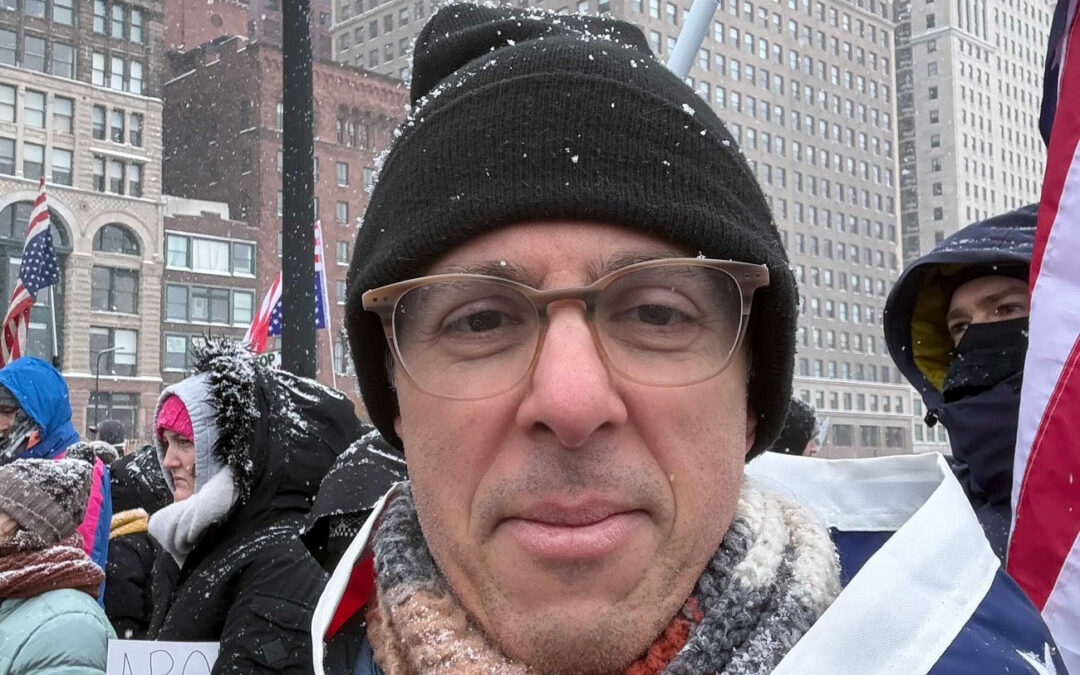
On Sunday I went with my cousin to a march in downtown Chicago. This was the day after Alex Pretti was killed, and I felt a need and desire to join others and make my own voice heard.

The rally was organized by several groups, not all of whom I necessarily identify with. But, to paraphrase Donald Rumsfeld perhaps, sometimes you go to the protest with the coalition you have. In the crowd of several thousand people, I could see a wide range of signs and sentiments. Some were mournful (pictures/names of Pretti, Renee Good, and others who have died or been abused by federal agents in the last year). Some invoked the American revolution (“no kings,” “don’t tread on me”). Some expressed anger and even rage (there was a lot of f*ck ICE). (I also feel a need to share here that the only foreign affairs issue I heard mentioned at the rally came in a chant: “From Minneapolis to Palestine, occupation is a crime.”)

I wore an American flag—literally. I tied it with some rope and donned it like a cape. Normally this is the flag I put up in front of our house on national holidays, and it’s a special flag for me: I received it when I became an Eagle Scout nearly 40 years ago and it had been flown over the U.S. Capitol before that. As I looked around, I observed that virtually the only other American flags I saw were upside-down ones held on flagpoles.

This reflected my experience of a lot of the tone of this particular rally. Unlike the ‘No Kings’ protests last fall, where organizers made a point to encourage people to bring and wear the Stars and Stripes, this one seemed to be more about expressing anger than inspiring a shared vision of the future. I say that without judgment—people are going to feel what they’re going to feel, and undoubtedly a lot of people were understandably experiencing a great deal of fear. I certainly had my own fears, and others were undoubtedly, and understandably, more afraid than me. I believe that for some, that manifested in anger. But my choice to wear a flag was quite deliberate, and I found myself wishing that there had been some more flag-wearers there too.

The Third Walk
The earliest of the three walks on my mind happened not this week, but over 3,000 years ago. It is, of course, our ancestors’ walk through the Sea—which I suspect I am not alone in thinking about in light of this week’s events.

Commenting on both their journey through the parted waters and on the Torah’s description of the Israelites’ constant accompaniment by “a pillar of cloud by day, and a pillar of fire by night,” Rabbi Mordechai Yosef Leiner offers the following in his Mei Hashiloach:

The pillar of cloud signifies Awe (Yirah), and the pillar of fire signifies Confidence/Trust (Bitachon). Sometimes a person feels great security and inner strength—this is the aspect of “Day.” In such a state, one must introduce the attribute of Awe. At other times, a person feels excessive fear—the aspect of “Night.” Then, one must strengthen their spirit with trust in the Holy One. This is the meaning of: “With a pillar of cloud by day, and a pillar of fire by night….” This is why it is written that the Israelites went “on dry land in the midst of the sea,” (Exodus 14:29) and elsewhere “in the midst of the sea on dry land” (Exodus 14:22). The Sea signifies Awe, while the Dry Land signifies Strength and Security. The essence of this strength is the Torah, which is the stronghold of Israel.

I hear in these words a deep and challenging teaching—for me, and I think for all of us. Part of our human condition is that we experience strong emotions: Joy, delight, ecstasy; sadness and melancholy; self-righteousness and anger, among many others. Fear is, perhaps, unique among these in the ways it can overtake us and short-circuit the connections between our heart-minds and our limbs. It can lead us to feel disempowered and immobilized. It can also lead us to rage and violence—whether we are government officials (who, as authorized agents of state violence, must, according to our tradition, be held to a higher standard than regular folks) or ‘merely’ human beings created in the Divine image.

Unlike Buddhism, Judaism is not a pacifist tradition. I don’t want to leave the impression that I’m conflating the two. But I know that for me, and I hope for you and all of us, this is a moment to call upon our spiritual practices to help us stay grounded, to mindfully touch our fears rather than try to force them away, and to choose responses grounded in trust, faith, and love. That is what our ancestors did when they crossed through the sea. May we walk together in their footsteps.

For Reflection & Conversation

  • What, if anything, is making you fearful these days? What, if anything, is grounding you in trust?
  • What represents the sea for you these days? How, if at all, have you found Jewish spiritual practice to be a source of strength as you walk through it?
Our Fine Furry Friends (Bo 5786)

Our Fine Furry Friends (Bo 5786)

I don’t know about you, but for me it’s been a stressful time of late. Not at work so much, but in life. There have been the normal stresses that come with being the “sandwich generation”—parenting kids, caring for aging parents. It’s been oppressively cold in Chicago, which means spending less time outside, and thus feeling more cooped up. And then there’s witnessing what’s happening in my mom’s hometown of Minneapolis, what’s happening in the streets of Iran, what’s happening to big things I—and, I expect you—took for granted, like NATO. So, stress—and understandably so.

It should not surprise you to hear that, despite my regular meditation practice, I’m not perfect. Far from it. While I strive to be a kind, compassionate, and wise person, I have my fair share of short-tempered moments. To be sure, it would be a lot worse without mindfulness. But, human being that I am, I can still get snappy, especially when I’m stressed.

One of the places I’ve noticed that of late has been with our pets. Last summer our cat Trixie (11 years old) had to take liquid antibiotics. The vet gave us a syringe to try to squirt the meds into her mouth. She wasn’t having it. So, while she had eaten dry cat food before, we started giving her wet food, into which we put the antibiotics. That did the trick, but she got hooked on the wet stuff—and she started getting quite vocal about her desires, meowing at us insistently until she got her food. Cats have different types of meows, but frankly none of them are particularly pleasant to my ear. And the behavior has only intensified.

Now, Trixie is just a cat. I could, and probably should, try to “mindfulness” my way to transposing her cries from annoying sounds into something that can evoke my compassion. But I’ve been falling short, and have been kind of pissy with her. (Honestly, I think I’m sharing this with you as a way of making myself accountable to that intention. I’ll let you know how it’s going.)

Similarly with our dog, Phoebe. While I am of hardy midwestern stock, I’m not clueless. When the temperature gets below 20 degrees, I layer up and put on my snow pants to walk the dog. Which makes a dog walk closer to an inpatient procedure than an office visit. Which puts pressure on my time, which causes stress, which comes out in resentment toward the dog. Another opportunity for practice (and again, I’m sharing this in part to keep myself honest).

As Moses angrily tells Pharaoh about the final plague, he includes an intriguing detail: “But not a dog shall snarl its tongue at any of the Israelites, at human or animal—in order that you may know that YHVH makes a distinction between Egypt and Israel” (Exodus 11:9). The Hebrew word translated as ‘snarl’ here is from the root charatz, which means to cut or sharpen, as well as to decide. It would seem the Torah is aiming to evoke the sharp sound of a dog’s bark (like Phoebe’s anytime a siren goes by). 

Rabbi Israel Yitzhak Kalish of Warka (1779–1848) offers a wonderful Hasidic reading of the verse. It plays on the word kelev (dog), which can be revocalized as ka-lev, i.e. “like the heart,” and the word for tongue, lashon, which also means language. Thus: “For the children of Israel there will be no charitz, no division, between their hearts and their words—their language will be like their hearts. When we say in the Haggadah, ‘they did not change their language during their centuries in Egypt,’ this is what we mean, and this is why our ancestors were redeemed.”

One reason I love this teaching is that it reminds us of the truth of dogs, cats, and other animals: they don’t lie. Their expressions are genuine. Phoebe’s happiness when I return home from a trip is unadulterated joy. Trixie’s excitement to be fed—even though the sound of her meow hits me like nails on a chalkboard—is pure. No more and no less.

But a deeper message here is the call to learn from our furry friends: to align our words with our hearts, yes, but also to align our hearts with our words. This is not a merely technical matter of choosing our words carefully. It’s about something more inward: softening our hearts, loosening ourselves from the grip of the external stressors, the meitzarim/forces of constriction, that generate those barriers between our hearts, our bodies, our minds and our words. That is the constant, ongoing spiritual practice of leaving Egypt.

Questions for Reflection & Conversation:

  • Is there anyone in your life who has been a model of aligning heart and words? Why are they a model for you? 
  • In your own life, how do you experience the relationship between heart and language? What helps you to align them? What prevents you from doing so?
The Price of Chicken (Vaera 5786)

The Price of Chicken (Vaera 5786)

There’s a classic Yogi Berra-style Jewish joke that goes something like this:

A woman walks into her local butcher shop and sees a sign for chicken at $1.50 a pound. (Note: You can tell just how old this joke is by the prices mentioned here.) She looks at the butcher indignantly and says, “A dollar-fifty? The butcher across the street is selling chicken for only 30 cents a pound!”

The butcher shrugs and says, “Nu? Go buy it from him.”

“I can’t,” the woman replies. “He’s out of stock.”

The butcher smiles and says, “Lady, when I’m out of chicken, I sell it for 10 cents a pound!”

One of the things that makes the joke work is the brutal honesty (perhaps it’s chutzpah) of the butcher. But deeper than that, I think, is that it brings into high relief the insincerity of the marketplace. After all, what does it mean to charge money for a product you don’t actually have? And yet, any of us who has ever bought something that turned out to be a fraud can probably relate. So we laugh at the joke because we can recognize something of ourselves in it.

On an even deeper level, I think the joke is going further and can take us to a place that might be helpfully understood by—wait for it—the thought of Ludwig Wittgenstein, the 20th century Jewish philosopher of language. 

A little refresher in case you haven’t thought about him recently (which is totally fine—most of us have probably had other things on our minds recently): One of the most famous aspects of Wittgenstein’s work is the change in his thinking about language between his early and later periods. In his earlier thought, Wittgenstein posited that language should fundamentally work like a map: for a word or a sentence to mean something, you must be able to point to something that it’s trying to signify. When we can’t do that—for instance, if we’re talking about concepts like God or love—then there’s a gap between the signifier and the signified. At that point, we’re in the world of the mystical, and we should enter it through silence rather than speech.

Later in life, Wittgenstein came to the view that this focus on the concrete versus abstract was misguided, perhaps because these kinds of gaps are ever-present. Language rarely works perfectly like a map. A better way to understand it, he argued, was to think of it as a game, or collection of games. Words don’t have fixed, inherent meanings. Instead, they work based on the social rules of the context in which they’re deployed. For instance, “chicken” in the joke above means a kind of meat the woman wants to prepare. But “chicken” as uttered by Michael J. Fox in Back to the Future (“Nobody calls me chicken!”) means something very different. His focus shifted from minding the gap between signifier and signified to swimming in the stream of language. 

Commenting on Moses’s self-assessment in Parashat Vaera that he is of “uncircumcised lips” (Ex. 6:12), Avivah Zornberg, invoking Nachmanides, observes, “There is no escape from the imperative of language, because only [Moses] has seen and heard. The burden of revelation lies directly on him: only he can speak of what he knows. This means a project of translation: he must make God’s words heard by others. This is the essential role of the prophet.” Yet, Zornberg continues, “To speak always means to translate, to transform; even the most faithful translations are betrayals: il traduttore e traditore—’To translate is to betray.'” (The Particulars of Rapture, 94)

“Translation” here does not mean merely expressing one idea in another language. Zornberg is saying something far deeper: translation is the basic act of communication itself, even within a language nominally shared by the speaker and the listener, or the writer and the reader. (For instance, at this very moment, though I’m quite sure you’re understanding the English I’m writing, I’m understandably concerned that you may not be getting what I’m trying to say!)

Zornberg goes on to analyze Moses as potentially wracked by a fear of shame inherent in speaking, “a fear of being despicable in the eyes of Pharaoh” (who was, she reminds us, a family figure to Moses). She sums him up at this stage as experiencing “a continuing resistance to language, to entering the world of others… resisting the embarrassments of language.” For this reason, God assigns Aaron, who has not directly experienced the revelation that Moses has, as a kind of press secretary to aid him in the work of translation and communication.

I don’t know about you, but for me, this challenge of language, the enormity of trying to express fully and honestly the totality of an experience or an idea, resonates deeply. I feel like I experience it all the time. Like the early Wittgenstein, I have found, especially in recent years, wisdom in the idea that it is often better to remain silent, particularly when speaking is likely to generate more heat than light. To speak or write these days, especially in public, always requires a high degree of trust: that one’s listeners or readers will engage in good faith; that our words will be given the benefit of the doubt (provided we are, in fact, communicating in good faith). That trust often requires a great deal of courage. And if Moses had a hard time mustering that courage, then I’m willing to be a little more compassionate with myself if I don’t rise to the bar.

And yet, as our tradition makes equally clear, the liberation of the Exodus is not merely a political one. The midrashic and Hasidic traditions make much of the idea that just as the Jewish people were in exile in Egypt, so was their language. The redemption was not only of Israelite bodies, but of our words, our Torah, our culture. As Zornberg, paraphrasing Kierkegaard, writes elsewhere, “Between silence and speech, silence is the more dangerous: its very safety endangers the self.” She sums up, “Between finitude and infinitude, possibility and necessity, the human being struggles for an authentic freedom.” (15)

Particularly in an age when each of us has access to a megaphone, and when, despite countervailing forces, we still have deep connections to the idea of speaking out in the public square, these are more than academic or aesthetic ruminations. How and when we choose to speak, to listen, to engage with one another through our words—these are still the questions of the Exodus, and they are still the questions into which our spiritual practice is meant to help us live.

Questions for Reflection & Conversation:

When you think about “speaking up” these days, what sensations arise for you? What, if anything, do you find helps you speak when you might rather be silent? What, if anything, helps you be silent when you might have an urge to speak? 

Natalie has wanted to do this for a long time. All of her grandparents were survivors of the Shoah and/or Russian gulags during World War II. And while many folks are interested in tracing their genealogy, Natalie has always been particularly eager to gather as much of the stories of her lost relatives as possible–not just knowing their names, but who they were and how they lived. That’s what she’s helping other people to do too.

For one client, she has spent dozens of hours learning about the family’s history through archival records, and she has uncovered some amazing things: The names of lost aunts and uncles, and post-Shoah testimonies about the town they lived in; a footnote in a memorial volume that mentioned a cousin’s best friend; an oral history in which a survivor recalled that the way they used to evaluate whether a celebration was really great was by how good the sponge cake was.

What Natalie is doing with her clients is helping them push through some of the veil that historical narrative can place over the lived experience of our ancestors: Yes, bubbie’s citizenship was stripped by the Nuremberg Laws; she also made a fabulous sponge cake that used 16 eggs. In the former telling, Bubbie becomes something of a heroic symbol; in the latter, she was a woman who wasn’t so different from us. Both are important to know, remember, and relate to. (And one is much more delicious than the other.)

“And because the midwives revered God, God established households for them.” (Exodus 1:21) Shifra and Puah, who the midrash identifies as Yocheved and Miriam, Moses’s mother and sister, are heroic historical figures. Their resistance to Pharaoh is pivotal to the survival of Israelites–and because their story is retold in this way, they are symbols for all who resist tyranny and oppression.

But the language of “God established households for them” invites questions. What’s going on here? Rashi comments that the “households” refer to literal lineages: Yocheved becomes the ancestor of Moses and Aaron (and Miriam); Miriam, through her marriage to Caleb, becomes the ancestor of King David.

In his Mei Hashiloach, Rabbi Mordechai Yosef Leiner of Izhbitz offers a less historical, more spiritual reading: “It is human nature that when we fear other human beings, we don’t experience yishuv hada’at, a settled mind–for fear is the opposite of a settled mind. However, with the fear or reverence of the Holy One, one experiences menucha, rest and comfort. ‘And God made them houses,’ teaches of this, for ‘houses’ symbolizes an organized, settled mind. It follows that when they had a settled mind, in awe and reverence toward the Holy One, they had no fear from the decree of Pharaoh.”

To me, this is a deeply perceptive reading on the workings of fear and confidence–one I find to be true in my own spiritual practice. When my mind is scattered and unsettled, I find my breath is shorter, my adrenaline is up, and I am much more susceptible to the unhealthy ways fear can operate within me. That’s true whether I’m walking on a busy street or reading the news on my phone. But when I take the time to enter a state of yishuv hada’at, to settle my mind through meditation or other conscious effort, I generally experience a sense of calm, comfort, and confidence–and, ultimately, a sense of yirat Hashem, reverence for the Creator.

To bring us back to Shifra and Puah, or to our closer ancestors whom we might treat at a historical distance, I find it a wonderful invitation to imagine how these very basic forces of fear, reverence, breathing, adrenaline, attention and awareness operated within them. What kind of self-confidence must they have had to do what they did? What kind of fear might have operated within them, and how did they manage it? When I ask these kinds of questions, I find greater insight in the story than when I treat the characters as heroes on a pedestal.

One of the fundamental teachings of Hasidism is that yetziat mitzrayim, the Exodus, was not merely an historical event. The forces of constraint–physical, psychological, political, spiritual–regularly press inward towards constriction. Egypt, mitzrayim, is that constricted place, and thus, simply to stay alive and able to serve the Holy One, we are constantly leaving Egypt. To be truly, deeply at home is to experience spiritual liberation. And so, to borrow the word of our passage in the Torah, our spiritual practice is here to help us experience ourselves as babayit, at home–in our minds, our bodies, the planet, and the cosmos.

For reflection and conversation:

  • Do you have an ancestor, biological or spiritual, who is a hero to you? What, if anything, do you know about their spiritual life? What, if anything, do you imagine they might have done or experienced to enable them to take heroic action?
  • In your own life, does your spiritual practice help you feel more settled and at home? If so, how? If not, why not–and is there anything you might want to shift as a result?

Homes of our Heroes (Shemot 5786)

Homes of our Heroes (Shemot 5786)

In the last few months, my wife Natalie has launched a new business called The Story Archivist. (This is not meant as a promotional email, I promise–you get plenty of those from me for IJS courses already!) Natalie is a journalist by training, a published author by experience (five young adult novels), and an educator by career. Her work today brings that all together by helping families preserve and tell their family stories: interviewing elders, doing archival research, and writing it up in a way that will allow future generations to know who they are and where they come from.

Natalie has wanted to do this for a long time. All of her grandparents were survivors of the Shoah and/or Russian gulags during World War II. And while many folks are interested in tracing their genealogy, Natalie has always been particularly eager to gather as much of the stories of her lost relatives as possible–not just knowing their names, but who they were and how they lived. That’s what she’s helping other people to do too. 

For one client, she has spent dozens of hours learning about the family’s history through archival records, and she has uncovered some amazing things: The names of lost aunts and uncles, and post-Shoah testimonies about the town they lived in; a footnote in a memorial volume that mentioned a cousin’s best friend; an oral history in which a survivor recalled that the way they used to evaluate whether a celebration was really great was by how good the sponge cake was.

What Natalie is doing with her clients is helping them push through some of the veil that historical narrative can place over the lived experience of our ancestors: Yes, bubbie’s citizenship was stripped by the Nuremberg Laws; she also made a fabulous sponge cake that used 16 eggs. In the former telling, Bubbie becomes something of a heroic symbol; in the latter, she was a woman who wasn’t so different from us. Both are important to know, remember, and relate to. (And one is much more delicious than the other.)

“And because the midwives revered God, God established households for them.” (Exodus 1:21) Shifra and Puah, who the midrash identifies as Yocheved and Miriam, Moses’s mother and sister, are heroic historical figures. Their resistance to Pharaoh is pivotal to the survival of Israelites–and because their story is retold in this way, they are symbols for all who resist tyranny and oppression. 

But the language of “God established households for them” invites questions. What’s going on here? Rashi comments that the “households” refer to literal lineages: Yocheved becomes the ancestor of Moses and Aaron (and Miriam); Miriam, through her marriage to Caleb, becomes the ancestor of King David. 

In his Mei Hashiloach, Rabbi Mordechai Yosef Leiner of Izhbitz offers a less historical, more spiritual reading: “It is human nature that when we fear other human beings, we don’t experience yishuv hada’at, a settled mind–for fear is the opposite of a settled mind. However, with the fear or reverence of the Holy One, one experiences menucha, rest and comfort. ‘And God made them houses,’ teaches of this, for ‘houses’ symbolizes an organized, settled mind. It follows that when they had a settled mind, in awe and reverence toward the Holy One, they had no fear from the decree of Pharaoh.”

To me, this is a deeply perceptive reading on the workings of fear and confidence–one I find to be true in my own spiritual practice. When my mind is scattered and unsettled, I find my breath is shorter, my adrenaline is up, and I am much more susceptible to the unhealthy ways fear can operate within me. That’s true whether I’m walking on a busy street or reading the news on my phone. But when I take the time to enter a state of yishuv hada’at, to settle my mind through meditation or other conscious effort, I generally experience a sense of calm, comfort, and confidence–and, ultimately, a sense of yirat Hashem, reverence for the Creator. 

To bring us back to Shifra and Puah, or to our closer ancestors whom we might treat at a historical distance, I find it a wonderful invitation to imagine how these very basic forces of fear, reverence, breathing, adrenaline, attention and awareness operated within them. What kind of self-confidence must they have had to do what they did? What kind of fear might have operated within them, and how did they manage it? When I ask these kinds of questions, I find greater insight in the story than when I treat the characters as heroes on a pedestal.

One of the fundamental teachings of Hasidism is that yetziat mitzrayim, the Exodus, was not merely an historical event. The forces of constraint–physical, psychological, political, spiritual–regularly press inward towards constriction. Egypt, mitzrayim, is that constricted place, and thus, simply to stay alive and able to serve the Holy One, we are constantly leaving Egypt. To be truly, deeply at home is to experience spiritual liberation. And so, to borrow the word of our passage in the Torah, our spiritual practice is here to help us experience ourselves as babayit, at home–in our minds, our bodies, the planet, and the cosmos.

For reflection and conversation:

  • Do you have an ancestor, biological or spiritual, who is a hero to you? What, if anything, do you know about their spiritual life? What, if anything, do you imagine they might have done or experienced to enable them to take heroic action?

  • In your own life, does your spiritual practice help you feel more settled and at home? If so, how? If not, why not–and is there anything you might want to shift as a result?


Vayeshev 5786: “You’re Still Here!”

Vayeshev 5786: “You’re Still Here!”

Many years ago, during my first job out of college, I wound up at a meeting in the Fifth Avenue apartment of Paul Newman and Joanne Woodward. It’s a long story for another time. But this was roughly 2000, and according to the internet that means they had been married for 42 years.

The meeting was with Joanne (she was the board chair of the Westport Country Playhouse, and I was on a consulting team helping them with a business plan). Fresh-squeezed orange juice was served.

At some point during the meeting, the apartment door opens and in walks Paul Newman, just returning from a run in Central Park. He had a towel around his neck.

But what I most remember is the buzz of electricity that visibly passed through the air as their eyes connected. They gave a cute little wave to each other that felt like a kind of intimate sign language. After four decades, it certainly felt like they were still very much in love.

My wife Natalie and I are coming up on our 25th wedding anniversary this spring. For as long as we’ve known each other, we have had different biorhythms. I have always been an early riser (I’m writing this reflection, as I often do, before 6 am), which means I also like to go to bed early. Natalie is the opposite.

This means that many mornings, after I’ve been up, had my coffee, done my morning routines, and am now ready to get dressed, I come back to our bedroom to find her waking up. At which point I say, with a delight that is both genuine and a little playful, “Look who’s here!” Our own daily Paul and Joanne moment, perhaps.

Naturally, perhaps, the approach of this anniversary leads me to reflect on our marriage and, more broadly, what supports longevity in relationships. Yes, there’s Tevye and Golda (“After 25 years it’s nice to know”), and there is a great deal of literature on the topic. In my own experience, there is some alchemic combination of both familiarity and freshness, routine (we have many) and spontaneity, known and unknown, that seems to have served us.

That, of course, can describe not just marriages, but other kinds of long-term commitments—including the ones we have with Jewish prayers, texts, rituals, mitzvot. As my father’s yahrtzeit approaches this coming week, I remember how supportive the framework of Jewish mourning practices was for me when he died, providing an infrastructure in the chaos of emotional quicksand. And yet at other times in my life that same Jewish infrastructure has felt like a straitjacket.

Rabbi Avrohom Bornsztain (1838-1910), the first Sokachover Rebbe, offers a beautiful reflection on this theme in connection with a verse from our parasha this week. He bases it on a midrashic understanding of the verse, “And he [Jacob] sent him Joseph] from the valley of Hebron” (Gen. 37:14). Rashi, quoting the midrash, reads emek not as valley, but as “depths” (amok means deep). “He sent him out from the deep wisdom of the one who is buried in Hebron (Abraham), to fulfill what had been promised to him… ‘Your descendants will be strangers’ (Gen. 15:13).”

The Sokochover elaborates: “Abraham realized that, unlike him, his descendants would grow up with an awareness of the Divine sanctity in the world. He was concerned that they would eventually lose the sense of freshness in their service of the Holy One, and that little by little they would cool off and leave the holy path. Thus he had the insight that his progeny should experience exile… so that the sense of desire for holiness would renew and grow within them” (quoted in Itturei Torah).

This is potentially a provocative comment, particularly in light of some deep debates happening now about Zionism and diasporism (if this is new to you, a Google search will yield plenty). Because I expect you’ll ask, I’ll summarize my own view as: 1) the Jewish people’s cultural homeland is the land of Israel; and, 2) in the very same breath, there are clearly deep creative possibilities in diasporic life, which is a great deal of Jewish history; and, 3) still in the same long breath, the precariousness of Jewish life in the diaspora is painfully real, and, 4) finally, the possibilities and challenges of Jewish sovereignty are enormous, as the contemporary state of Israel demonstrates on a daily basis. End breath.

But that isn’t really where I’m aiming this reflection. There are plenty of other people and organizations whose work focuses on those kinds of historical-political questions. For our purposes, I’d like to bring us back to the more everyday, personal, embodied ways we experience the Sokochover’s Torah. That moment of, “Look who’s here!” after 25 years; that bolt of spiritual lightning that passed between Joanne Woodward and Paul Newman; the feeling of (with apologies to Kellogg’s) “tasting it again for the first time”—these are personal moments of leaving and coming back, of galut and teshuva. They are moments of hitchadshut, renewal, or “beginner’s mind.” They are daily lived enactments of this Torah.

Hanukkah is about many things, but one of them is certainly this experience. The simple act of lighting a candle in the darkness, and of sharing that light with others—that itself is miraculous. As we begin the holiday next week, my blessing for all of us is that we might attune ourselves to the miracles that abound within our lives, that we be able to taste and savor and appreciate them. Nes gadol haya sham—a great miracle happened then and there, and, as Israeli dreidels say, nes gadol haya po—a great miracle happened, and happens, here too.

Vayishlach 5786: Snowy Day

Vayishlach 5786: Snowy Day

Last Shabbos was a snow day in Chicago. A big storm moved through and dumped nearly a foot on us. The weather folks said it was the biggest November snowfall in a decade.

On Sunday I dug out the snow blower from the back of the garage (we’ve had pretty light snow in recent years) and joined the lovely civic ritual wherein neighbors say hello to one another, commiserate a little bit, and help each other keep our driveways clear as the city trucks plow us back in while clearing the streets.

The days since have been cold, so the snow is still on the ground. And I’ve noticed that on my walks with the dog, I am drawn to keep the air pods out of my ears and just listen. It’s quieter when there’s snow, almost like there’s a blanket muffling the usual noises of cars and wildlife. Most of all, my ears are drawn to the sound and sensation of snow crunching under my boots. Combine that with the special kind of air that can follow a snow storm, the smell of a winter hat on my head and a scarf around my neck, and it transports me right back to being a little kid walking to elementary school in Ann Arbor. It’s fabulous.

As it happens, I spent my Shabbat snow day reading Rodger Kamenetz’s new book, Seeing Into the Life of Things. (I was cramming for the exam: I interviewed Rodger about the book on Wednesday night, ahead of his teaching an online IJS course about the book next month. I’ll be taking it, and I hope you will too.)

While I read plenty of books, and while many of them are wonderful, this one stood out. Why? I’ve been trying to put my finger on it.

It’s a smart book, for sure: There are discourses on Wordsworth (the source of the title) and Freud and Einstein. The Ba’al Shem Tov and Rabbi Isaac Luria make appearances, alongside Rumi and the Dalai Lama and other deep wells of insight. I like that kind of intellectual stimulation. And as one who writes myself, Rodger’s writing is like a cup of chamomile tea with honey on a cold day—warm and smooth and sweet, the kind of thing you drink in slowly and savor. (He said Wednesday he’s much more of a “re-writer”—revising and sculpting and crafting every page over and over again. I wish I had that kind of patience.)

But ultimately I think what drew me in was what Rodger invites us all to do: be present with our experiences without rushing to label and analyze them with words right away. When we do that—when we slap a label onto something or someone, when we reactively move to interpret a dream rather than lingering with the ineffable sensations it beckons us to dance with—we forfeit something precious: our imaginative capacity. As Rodger writes in his introduction, “The sacred takes place in the imagination. A poetic state of mind is the ground of visionary experience.” (Like I said, tea with honey.)

This week we reach the climax of the Jacob and Esau story, a story that is so much about this human challenge of knowing and not knowing—and how to hold, or even embrace, the not-knowingness. We sensed it in Isaac’s not-quite-knowing encounter with Jacob-dressed-as-Esau last week, and this week we touch it again with Jacob’s profound uncertainty about Esau’s intentions as he approaches with a small army.

“And Jacob feared greatly, and it troubled him, and he divided the people who were with him… into two camps.” (Gen. 32:8) Rashi, in one of his most famous comments, says: “He feared—that he would be killed; and it troubled—that he might kill others.” This is an ethical reading, highlighting what I certainly like to think of as a classically Jewish approach. It holds the fullness of the stakes without minimizing the positions.

Yet Rabbi Yaakov Yitzchak HaLevi Horowitz, the Chozeh or Seer of Lublin (d. 1815), offers a different reading: “And Jacob feared—he experienced fear because of Esau, but immediately ‘and it troubled him’—the fact that he was fearful, particularly after the Holy One’s promise, ‘and I will protect you wherever you go’ (Gen. 28:15).” Jacob’s initial fear is a perfectly understandable one: It seems like his brother is coming to kill him. Yet the Chozeh turns the “troubling” of the verse into something like the “second arrow” in Buddhist teachings: Jacob is aware of his fear, and the fact that he’s afraid makes him even more upset—because he should be trusting in God.

I didn’t ask Rodger, so this is just me, but I sense an opening here to understand Jacob as struggling in the space between reactivity and wisdom, which might also be the space between analyzing and being-with, or between the illusion of knowing and the reality of not-knowing. Yes, Jacob needs to make a decision, and he needs to be careful—mindful, even. Can he do so in a non-reactive state?

I think that’s what the Seer of Lublin is asking of Jacob—and of we who are his descendants. As Rodger and I discussed on Wednesday, the age and world we live in is built on so much reactivity. (Jane Eisner told me this week that the Oxford English Dictionary’s word of the year is “rage bait.” Q.E.D.) But we are so much more than that. So maybe stay close to your breath a little more. Linger with the taste of your coffee or the light of the Shabbat candles. And maybe take out the air pods when you’re walking and listen to the sound of the snow under your feet.

Vayetzei 5786: Up in the Air

Vayetzei 5786: Up in the Air

I recently downloaded an app called Flighty. As Ben Cohen described it in the The Wall Street Journal, “Flighty was built by aviation geeks for aviation geeks.” It uses all kinds of data to predict whether your flight will be on time or late, and if so by how much. It often beats the airline apps with updates. As an app it’s beautifully designed. And it’s insightful, showing your most frequent airports, the number of miles you flew last year—and how many times around the Earth (or the Moon) that represents. I’m hooked.

While I expected to travel a lot when I took this job nearly six years ago, the first couple of years I didn’t go anywhere because of the pandemic. But now the world has largely returned to its pre-Covid pace, and Flighty tells me that my 47 flights so far this year (and there are still a couple to come in December) have taken me 47,012 miles, which is 1.9x around the Earth. I’ve also evidently spent 10 hours in flight delays (which frankly ain’t bad given those numbers)—and 48 percent of my flights have actually landed early!

So that’s fun and all. But for a perhaps unexpected question, I want to ask you: How do you feel reading all that? What, if any, sensations do you notice arising?

There could be some judgment (“That’s a big carbon footprint”). There could be some envy (“You must have airline status”). There could be some pity (“Oy, that must suck to travel so much”). It could be something else, or a combination of multiple thoughts or feelings.

The French sociologist Pierre Bordieu coined a term he called “habitus.” Here’s a fairly standard definition of the idea: “A set of attitudes and beliefs embodied in how people think, feel, speak, and gesture. The habitus conditions and shapes how individuals perceive the world around them, their sense of place, and life choices.” Where a “vibe” in our contemporary parlance is a superficial, momentary feeling about the atmosphere in a particular setting, “habitus” gets at deeper structural stuff: the ways we’re conditioned to act and speak, the things we’re conditioned to value, within cultural structures from families to communities to societies.

Applying habitus to an analysis of Flighty, one might start to think about the culture (or cultures) of frequent flierdom. One can start to ask questions like, “What are we really talking about when we talk about this culture of airports and flights and airline rewards programs?”

Perhaps because of Flighty, perhaps because last week I was in fact on four flights in four days, all of this was in the background when I encountered Anand Giridharadas’s essay about the Epstein emails in the New York Times. Giridharadas has been issuing some deep and blistering critiques of philanthropy and elite culture for years, and he analyzed the situation with that in mind. While not undermining the culture of rape and abuse at the heart of the story, Giridharadas also aimed to flesh out the habitus illustrated in the emails. Here’s his central point:

What [Epstein’s] correspondents tended to share was membership in a distinctly modern elite: a ruling class in which 40,000-foot nomadism, world citizenship and having just landed back from Dubai lend the glow that deep roots once provided; in which academic intellect is prized the way pedigree once was; in which ancient caste boundaries have melted to allow rotation among, or simultaneous pursuit of, governing, profiting, thinking and giving back.

I will be honest and say that I felt myself implicated in that, if not directly—I’m not jetting into and out of Davos or Aspen on a private jet; I fly commercial between O’Hare and LaGuardia; and I have told philanthropists directly when I thought they were misbehaving—then indirectly. I went to an elite private university (Yale) and received a Wexner Graduate Fellowship that paid my way through rabbinical school and had a large (and overwhelmingly positive) influence on my career. I’ve rubbed shoulders with people like the folks Giridharadas describes and, like many other nonprofit leaders, I have felt the gravitational pull of their philanthropy—again, if not directly, then indirectly.

But there is something about this depiction of flying around constantly, jetting in and out of cities and making that the basis of valuation, that is both a little familiar and a little icky. (“Many of the Epstein emails begin with a seemingly banal rite that, the more I read, took on greater meaning,” Giridharadas notes: “The whereabouts update and inquiry… ‘Just got to New York — love to meet, brainstorm,’ the banker Robert Kuhn wrote to Mr. Epstein.” And later: “Whereabouts are the pheromones of this elite.”) Again, I don’t generally text people when I land and ask if they’re free—that reflects a pretty phenomenal level of presumptuousness/entitlement—but I recognize the conversation that involves a sentence like this: “I was in Manhattan to do a talk, then I went up to Westchester for an event, then back to Riverdale for a meeting, then flew back to Chicago in time for bedtime, and was on a plane to DC the next day.” That, in fact, was my first half of last week.

Where does the ick factor come from in all this? At root, I think, it’s the sense of rootlessness—the constant moving about, never being truly being at home anywhere, and the sense that these very powerful people were trying to fill the related spiritual abyss in their soul with power and domination. And that, of course, butts up against an antisemitic trope, most powerfully deployed by Josef Stalin against Russian Jews, who the Soviets referred to as “rootless cosmopolitans.” So on top of the original ickiness, there are layers of additional complication.

Jacob, whose story we come to focus on centrally in Parashat Vayetzei, is notable for many reasons, one of which is that he is our ancestor who struggles the most to be at home—with himself, his family, and his geographic place. Even more than his grandfather Abraham, Jacob moves around—from his childhood home in Be’er Sheva to his uncle’s home in Padan-Aram, then back to the land of Canaan, then finally to Egypt. His name Yisrael, of course, connotes his constant struggle: to come to terms with his twin brother, with himself, with his wives and children, with the Holy One. He is never settled, never at ease.

All of that can sometimes make it feel like Jacob is a rootless character. Yet our tradition suggests that Jacob’s lesson is precisely the opposite: What Jacob figures out is that, wherever he is, he can in fact be deeply rooted. This is the reading that Rabbi Aharon of Karlin offers on the words vayifga bamakom, which the Torah uses to describe Jacob’s encounter with Mount Moriah when he first sets out on his journey: “Pegiah connotes prayer [as the Talmud posits], but it also connotes a genuine, sudden, deep encounter. Thus a person should pray that they find the ‘place’ that is particularly their own… Here, in this world, we should try to be at one in whatever place we find ourselves… Your heart should not be separate from the actual place you are standing or sitting.”

A few years ago historian James Loeffler published a book about the creation of human rights law, which was largely led by Jews. In a rejoinder to Stalin, he called it “Rooted Cosmopolitans.” It’s a great phrase to consider, particularly at a moment when our community, our people, is engaged in deep and often contentious reflection about particularism and universalism—or, more simply, where and when we feel at home.

Here in the United States, many of us, including me, are celebrating Thanksgiving this week. As it does like clockwork every year, the holiday causes me, and perhaps you as well, to reflect on some key questions: Where, when, why, and how do we feel at home here, if at all? Do we feel at home as Jews today? If so, why? If not, why not?

But the holiday also offers us an opportunity to experience some deeper at-homeness, perhaps: The spiritual rootedness that’s available to us when we can gather with family and friends, when we can take a walk among trees whose leaves are falling away, when we can, in moments of stillness, express gratitude for the blessings in our lives. If we allow it to do so, Thanksgiving might remind us that we can, in fact, be spiritually at home in whatever moment we find ourselves. And there is nothing more Jewish than that.

Toldot 5786: Hearing Voices

Toldot 5786: Hearing Voices

Before my recent weeklong retreat, I was worried about a few things. As I wrote recently, being off the grid for that long is a significant absence for all involved, a rehearsal of death. So I was worried about the effect that would have on my family. And I was a little worried about being away from work for a week. But those were ultimately not major sources of concern. What had me really worried was my mother.

As I have shared in this space before, my Mom has Alzheimer’s, and it is now at a more advanced stage. She’s still her cheerful self, but her world is pretty small and focused at this point. The conversations, like her day to day activities, don’t take her very far.

My worry came from the fact that I have become something of a tether for her. I recently downloaded her cell phone activity and analyzed it with the help of AI. I found that over half of her outgoing calls are to my number. While that tracks with my experience, it didn’t do anything to allay my concern: If the main person you talk to outside your living quarters isn’t there to answer the phone, and you can’t remember why they’re not there, how would you feel?

I contemplated some solutions. The most elaborate started with the reality that we really do have the same conversation multiple times a day. So I thought that perhaps there was an AI out there that could record my voice and impersonate me while I was away. I mean, on the one hand, it’s not so crazy: If it could help allay her anxiety, then there’s a case to make. On the other, ick: there is something gross about the inauthenticity.

The central drama of Parashat Toldot revolves around Jacob’s deception of his elderly father Isaac. As Avivah Zornberg observes in her classic study of Genesis 27, the axis of tension lies in the collective worry—Jacob’s, Rebecca’s, Isaac’s, and the worry of we the readers—that Jacob is dissembling, and/or that he’ll be found out. “If my father touches me, I shall appear to him as a trickster,” Jacob frets when Rebecca introduces her plan (v.12). Isaac, suspicious that something is afoot, tells Jacob (who is dressed as Esau), “Come closer that I may feel you, my son—whether you are really my son Esau or not” (v.21). And then, when Jacob comes in for inspection, his father exclaims, “The voice is the voice of Jacob, yet the hands are the hands of Esau” (v.22).

Zornberg quotes a midrash from Pirkei d’Rebbe Eliezer: “When Jacob left his father’s presence, he left adorned like a bridegroom and like a bride in her ornaments. And there descended on him reviving dew from heaven, and his bones were covered with fat; and he, too, became a champion fighter and athlete.” She comments: “The description suggests a radiant awareness of new possibilities that springs from deep within the self. The bones that are covered with fat evoke the text in Proverbs 15:30: ‘Good news puts fat on the bones.’ The ‘good news’ of the blessings — considered as an existential event, rather than merely as words spoken — gives Jacob a sense of health and power that affects his very bones. In Hebrew, the word for “bones” — atzamot— is closely related to the word for “self” — etzem. What is nourished — even created anew — in Jacob is the essence of his selfhood.” (Zornberg, 178) As she observes earlier on, Jacob “must enter the world of seeming, of enactment, of performance, in which authenticity can be defined only retroactively” (154).

For many people, the work of defining and understanding ourselves is the project of a lifetime. And as the story of Genesis 27 illustrates so profoundly, it is not work that belongs only to us: It is interpersonal, intergenerational, social, existential. That is, it isn’t only up to us. We do not want to understand ourselves to be tricksters, deceivers—and we don’t want to be seen that way by others. But the work of attuning our own voice to the voice of Divinity working within us is not easy, nor always necessarily pleasant. Much of life takes place within that tension. And as my colleague Rabbi Marc Margolius might say, “What an opportunity for practice!”

Ultimately, just before my retreat, I recorded a new voicemail message: “Hi, this is Josh. I’m away on a silent retreat and will be back on November 2. If this is my mother, this is to remind you that I’m away and to tell you I love you very much. If it’s anyone else, leave a message.” She was fine. And I felt better knowing that it was my voice she’d hear.

Questions for Reflection & Conversation:

  • Is there a moment (or moments) in your life when you struggled to discern something about your etzem, the “true you?”

  • What was difficult about that moment?

  • Who or what, if anything, helped you navigate it?

  • Is there anything you wish you had done differently?

Chayei Sarah 5786: The Heart Wants To Be Open

Chayei Sarah 5786: The Heart Wants To Be Open

A pretty cool moment occurred the other day while I was walking the dog. It was a sunny but cold day and I was listening to a talk by Gil Fronsdal about Metta practice (Pali for lovingkindess, or perhaps what we would call Hesed). All fairly normal—for me, at any rate.

Early on in the talk, Gil uttered a casual line that, probably without intending it, lit me up. He observed that it generally just feels better when our hearts are open. They don’t naturally want to be constricted.

As I said, this was a casual line in a 45-minute talk. But it literally stopped me in my tracks. Why? Because it took me back to a podcast interview I did with Rabbi Shai Held a few months ago. The topic of that conversation was the Rabbinic phrase rachmana liba ba’ei, which is usually translated from the Aramaic as, “The Merciful One desires the heart.” Shai and I had a long and rich conversation unpacking that phrase. But here on the sidewalk on a cold day in November, it was like a lightning bolt shot through me with a new understanding.

That’s because just the night before I had been reading French rabbi-philosopher Marc-Alain Ouaknin’s The Burnt BookNow, a warning: This is not a simple read. At all. There’s a lot of 20th century French philosophy—thinkers like Emmanuel Levinas and Maurice Blanchot (I happen to love that stuff, but I admit it’s an acquired taste). And there’s a lot of amazing but fairly esoteric Torah. This is not a beach read.

For the last few months I’ve been in a wonderful havruta about the book with two soul-friends. And the night before this dog walk I read a passage in which Ouaknin discusses Rebbe Nachman of Bratslav’s understanding of tzimtzum, or Divine self-contraction, which in Lurianic Kabbalah is essential for the creation of the world. Ouaknin points out that Rebbe Nachman introduces some slightly different, but quite significant, terminology in his rendering of this idea.

Significantly, he teaches that the Infinite One performed tzimtzum and created the universe out of rachmanut, i.e. rachamim, which we often render as “compassion.” But, Ouaknin observes, “Rachmanut comes from the term Rechem, the ‘womb,’ ‘uterus.’ He goes on to quote the French-Jewish thinker Shmuel Trigano: “It describes the uterine nature of the womb, that is to say, the capacity of the uterus to be what it is: to conceive the fetus… It is the capacity of the rehem to open up, to make an empty space in the heart of fullness of the person and to make room for the embryo, for a being Other. Rachmanut is essentially the ability to conceive someone other than oneself.” (273)

In Lurianic Kabbalah, the result of the tzimtzum is an empty space, within which creation occurs. For Ouaknin, the fact that Rebbe Nachman adds the dimension of rachamim, this “uterine” capacity to expand and be the bearer of something wholly other is monumental. It sets up an entire way of seeing the world, and an ethics that honors and makes space for the Other in a profound way (a la Levinas).

So all that was going through my mind as I walked the dog and heard this line about the heart naturally wanting to be more expansive than constrictive. And it made me re-think the line that Shai had started with: rachmana liba ba’ei. Yes, the most basic understanding of those words is that rachmana is Harachaman, the Merciful One. But a good Hasid would also be open to playing with the meaning slightly, in which case you might get: the heart wants to embody this quality of rachamim, i.e. the heart itself wants to be expansive, rather than constricted. To me, anyway, that was a hiddush, a new insight. Cherry on top: I delightedly recorded a voice memo and texted it to Shai to tell him, and we had a lovely exchange about it.

Isaac, about whom we read in Parashat Chayei Sarah, is the first character in the Torah who directly expresses love. While God assumes that Abraham loves his son (“Take your son, your only, the one whom you love” in Gen. 22:2), the Torah tells us explicitly that Isaac loved Rebecca: “Isaac then brought her into the tent of his mother Sarah, and he took Rebecca as his wife. Isaac loved her, and thus found comfort after his mother’s death” (Gen. 22:67).

Rashi, quoting Bereshit Rabbah, offers some additional color: “While Sarah was living, a light had burned in the tent from one Sabbath eve to the next, there was always a blessing in the dough (a miraculous increase) and a cloud was always hanging over the tent (as a divine protection), but since her death all these had stopped. However, when Rebecca came, they reappeared.” The midrash paints a picture of the re-emergence of openness and growth after a period of narrowness and constriction, and we extrapolate that, perhaps, the characters and their hearts likewise opened and expanded.

Rachmana liba ba’ei: The heart wants to be expansive. As Sylvia Boorstein told me once, “I don’t like how I feel when I’m pissed.” Yet it is so easy for our hearts to enter the metzarim, a state of closed-offness, a place of anger and pain. Sadly, we see that in abundance in our world.

May our mindful practice of Torah help us cultivate more rachmanut, more compassion and more expansiveness in our hearts. May those who are hurting be comforted, and may all who are in narrow places emerge into greater freedom, joy, and love.

Questions for Reflection:

  • In your own life, when do you notice your heart feeling more constricted? What contributes to it? How does it feel in the rest of your body? What about when your heart is more expansive? 
  • What, if anything, helps you to move from a constricted heart to an expansive one? 
Vayera 5786: Extended Yom Kippur

Vayera 5786: Extended Yom Kippur

Last Shabbat fell on the tenth day of the Hebrew month of Marcheshvan, exactly a month after the tenth of Tishrei—which is better known as Yom Kippur. And while it was entirely a coincidence that last Shabbat was the culmination of a weeklong silent retreat I attended at the Insight Retreat Center in Santa Cruz, CA, the voice of Albert Einstein is chuckling inside my head, saying, “Coincidence is God’s way of remaining anonymous.”

At a certain point, it started to occur to me that this kind of retreat was a lot like an extended Yom Kippur. How so? The Mishnah lists five prohibitions we observe on Yom Kippur: 1) No eating and drinking. Okay, we do eat and drink on these kinds of retreats. But it’s a very different kind of consumption: Slow, mindful, intentional, and as a result a lot less than I normally eat at home. 2) No bathing. Again, yes there was bathing. But it was much less, and much less hurried or casual, than usual. Most folks showed up in the meditation hall in simple, baggy clothes—which reflected the general vibe that we don’t need to concern ourselves with appearance so much.

3) No anointing (wearing perfume). Like many retreat centers, this one stocked scent-free soaps and shampoos out of an inclusive sensibility, as there are folks who find those smells difficult to sit with. 4) No shoes. While most folks would wear shoes when going outside or working in the kitchen, one definitely does not wear shoes in the meditation hall or frankly in most of the retreat center. Just like on Yom Kippur, the idea here is to try to have direct contact with the ground. 5) No sexual activity. This is an explicit part of the expectations of the retreat—both for the safety and well-being of everyone participating, and as part of the practice. It’s an opportunity to notice, perhaps, when erotic or sexual impulses might arise—and then to let them fade away and not act on them.

Yom Kippur also includes the prohibitions of Shabbat, and in this case the parallel was most notable by way of refraining from technology use. We were off phones and screens for a week. We didn’t drive in cars or listen to music or podcasts or the radio. It was only on my long plane ride back to Chicago Sunday morning that I found out anything about the (truly epic!) World Series that had taken place that week—or any of the week’s other news. And while I’m used to doing that once a week from my own Shabbat practice, it’s quite a detox to do it seven days in a row.

Beyond all of this, the retreat evoked Yom Kippur most substantially in the fact that we spent virtually all of our waking hours in meditation of some kind. Each day there were nine or ten formal sits in the meditation hall, lasting 30 to 45 minutes. In between we did walking meditation indoors or on the beautiful grounds outside. For those of us who, like me, spend most of the day of Yom Kippur in shul, there can be a feeling of connection.

By Shabbat, the effect of all of this was that my sitting meditation had reached a really wonderful place. I was able to be very close and present with the breath, without a sense of mental noting (“I’m breathing in, I’m breathing out”) or intruding words or thoughts. I felt a deep sense of wholeness of body, mind, and spirit—perhaps what in Buddhism is termed samadhi, or what we might call yishuv hada’at (a settled mind) or meshivat nefesh (restoring the soul). During one of my sits on Shabbat afternoon, that closeness with the breath was such that I became aware that, when we get to the end of our lives, this is really all there is: just this breath, and then it will stop. It felt like I was rehearsing my own death—in the best possible way.

As Andrea Castillo, one of the retreat teachers, pointed out in a dharma talk that evening, that is exactly what we were all doing. Leaving everything and everyone behind for a week—loved ones, coworkers, pets—is a way of preparing them and us for the fact that eventually we will be gone. And getting to a point like that in meditation practice is a way of doing that for ourselves. If a retreat is about letting go, then this is the foundational letting go that all of us will eventually have to do.

Abraham is more associated with Rosh Hashanah than Yom Kippur, yet the word hineni, “I am here,” has become associated with both holidays. Hineni shows up three times in Genesis 22, the Binding of Isaac, which we read this week. Rashi, quoting Midrash Tanhuma (on Gen. 22:1), comments that Abraham’s hineni in response to the Divine call is a model for us: “Such is the answer of the pious,” he says. “It is an expression of humility and readiness.” Yes, hineni connotes fullness and even courage—but at its core, I think, Rashi is saying that hineni also evokes a kind of appropriate absence or emptiness too: We’ve let go of our clinging, of things that might delude us, and we’re able to see clearly that we are simply here. And then, just on the other side of hineni, will be einini: I am not here. The line is preciously thin.

This prompts me to pose two questions for all of us to consider:

  1. When you are able to get quiet enough to really sense it, what, if anything, do you find yourself clinging to? What might you need or wish to let go of in order to live more simply and fully?

  2. Does your practice of Torah and Judaism support you in that process of letting go? If so, how? If not, why not? And is there perhaps one practice that could help you do so a little more?

Lekh Lekha 5786: Crossover Episode

Lekh Lekha 5786: Crossover Episode

By the time you read this, I’ll be several days into a weeklong silent meditation retreat. Full disclosure: This isn’t a Jewish retreat. It’s at the Insight Meditation Center in the mountains above Santa Cruz, California, and it’s being led by Gil Fronsdal, a teacher I’ve come to deeply appreciate and learn from.

That may come as a bit of a surprise. Why is the head of the Institute for Jewish Spirituality going on a meditation retreat that isn’t Jewish?

There are a couple of reasons. The first is that I find that it’s hard for me to really quiet my work mind on a Jewish meditation retreat. There’s a loud voice in my mind that compares the experience with the retreats we teach at IJS. I can wind up thinking about whether there’s a partnership to be developed, or how a teacher might mesh in our lineup. So I decided that, if I really want to be as fully present on a retreat as I can be, it helps to be in more neutral territory.

But of course I’m also learning from the experience, even in an environment that isn’t Jewish. And that’s the second reason for me to go: In addition to my own experience, there is so much to learn from the wisdom of a master teacher like Gil. Yes, learning about myself. But also learning, through observing and experiencing, some ways I might improve my own teaching and leadership.

The relationship between Torah and wisdom from other sources and traditions has been a topic of conversation in Jewish life pretty much for as long as Jews have been around. It isn’t simple. For instance, the tradition honors Jethro as a great sage from outside the people of Israel, but it views Balaam as a sorceror who is part of a dangerous attempt to harm the Israelites. This reflects similar conflicting impulses about leaders of peoples and nations beyond our own: Cyrus (whose name is back in circulation these days) is celebrated as a great and wise king because of his magnanimity towards the Jews, while Nebuchadnezzar and Pharaoh are vilified because of their violence and cruelty.

Why does the Torah refer to Avram as Avram ha-Ivri, Abraham the Hebrew (Gen. 14:13)? The Midrash quotes Rabbi Yehudah: “All the world stood on one side (me-ever echad) and he stood on the other (me-ever echad).” According to this strain of thought, part of the essence of being a Jew is to be distinct and different—willing to stand over and against the world if necessary. In more recent times, this approach finds expression in the words of, for instance, Rabbi Boruch Ber Leibowitz (1862-1939), one of the great Torah scholars of the twentieth century: “There are two peoples in the world—Jews and non-Jews.” From there, it’s a hop, skip, and a jump to Lenny Bruce.

Yet there’s a more complex picture that emerges from another midrash on the same verse: “A fugitive brought news to Avram HaIvri,” that his nephew Lot had been taken captive. Who, according to the midrash, is this news-bearing fugitive? None other than Og, future King of Bashan, who would wage war against the Israelites in the time of Moses. Surprising, yes. And in order to make sense of it, the midrash adds that what Og really wanted was that Avram would go to battle and be killed, leaving Sarai available for himself.

Rabbi Yosef Zundel of Salant (1786-1866), who was the rabbi of the Ashkenazi community of Jerusalem, further complicates the picture here. Before the Israelites’ war against Og, God reassures Moses, “Do not fear him” (Numbers 21:34). What would Moses and the Israelites have to fear? The Talmud answers: “Perhaps the merit of our forefather Abraham will stand for Og and save him” (Niddah 61a). Rabbi Zundel comments: “There is important mussar to learn here. If Og, who did just one good deed—and even then, had bad motivations—earned the merit of a great mitzvah to the point that it caused Moses and all of Israel to fear that they couldn’t stand against him, how much greater is the merit of one who does something good with good intention!” Note that Rabbi Zundel doesn’t limit the possibility of that merit only to Jews—it applies to anyone.

Our current moment is deeply inflected with this cultural legacy: What does it mean to be a Jew today? How do we understand, talk about, and act on the possibilities of threats and violence against Jews—and the possibilities of alliances, solidarity, and goodness? How do we hold the cultural legacies of traumas recent and ancient—and how do we try to live with them mindfully, wisely, skillfully?

These are not new questions. They have been our people’s questions since Abraham and Sarah. Just as in their time, the work of living these questions is, yes, work of the body—but also work of the heart and mind. While Abraham smashed the idols of his day, he also had spiritual friends and allies. As the rest of Genesis 14:13 points out, when the fugitive brought news to Abraham, he was dwelling “at the terebinths of Mamre the Amorite, kinsman of Eshkol and Aner, these being Abram’s allies,” who, according to Rashi, had “entered into a covenant with him.” They were, perhaps, the first allies of the Jews.

So I’m on my way to a meditation retreat with a wonderful Buddhist teacher, with the intention that what I learn and practice can deepen my life of Torah and mitzvot. I’ll look forward to sharing some reflections with you when I’m back.

Before I sign off, here are a couple of questions you might reflect on:

  • I expect some of this conversation lands differently for different folks. What sensations, if any, did you notice arising as you read it? What do you think may have contributed to those feelings or responses?
  • Consider Rabbi Yehudah’s comment, that to be an Ivri, a Hebrew, means to stand against the world. Consider also that another meaning of Ivri is “one who crosses over.” When, if ever, have you resonated with one, the other, or both?
Noach 5786: One for All

Noach 5786: One for All

One morning this week, on a visit to New York, I was walking down Broadway on Manhattan’s Upper West Side, en route to a fundraising meeting. A significant part of my job involves offering wealthy people the opportunity to support our work at IJS, and in this case I was headed to the apartment of one such person—who, I hasten to add, is not only a wonderful supporter, but also, unsurprisingly, a wonderful, caring, and generous soul.

It was a beautiful fall morning. The air was crisp and there wasn’t a cloud in the sky. It was one of those mornings when, in my experience, New York itself can feel a little more generous.

That atmosphere of abundance may have contributed to a mitzvah I witnessed. An elderly man in an ill-fitting suit and a golf cap was walking slowly, pushing a cart. He appeared to be on his way to the drug store. As he came in my direction, he turned aside to another man who was camped out in a sleeping bag above the exhaust vent of a building. The old man took out a dollar bill and gave it to the man on the ground and said something kind to him.

I noticed this interaction as I kept walking towards my fundraising visit in a fancy apartment building with a doorman. And the questions began to churn: I wonder what motivated the old man to do that. I wonder how the guy on the ground felt. I wonder what that dollar means to each of them (given that there’s not a lot you can buy with a dollar these days).

And then some bigger ruminations began to take shape: The building whose grate was providing heat to the man on the ground cost tens of millions of dollars. The price of an apartment in that building is itself millions of dollars. And what am I doing? I didn’t stop to offer the guy a dollar. In fact, I’m on my way into one of those fancy apartments to perform what some of our donors lovingly refer to as a “cashectomy,” moving (with the patient’s consent, of course) dollars out of their account and into that of the not-for-profit I lead—a portion of which goes to pay my own salary.

The thoughts spun for a while, swirling around capitalism and inequality and the ways I’m personally caught up in the whole system. And then I took a breath, let the thoughts settle, and decided to keep a mental snapshot of the moment.

While I don’t live in Manhattan now, I did as a young adult. And the sense I get whenever I visit these days is a feeling of a hollowed out middle. You can see it in the skyline. You can certainly see it in the mayoral election, which is making the news well beyond the Hudson River. Before I moved to New York as a young person, a mentor of mine told me, “To live in New York you need to be young or wealthy.” From what I can tell, today it can feel like even the “young” part of that statement isn’t so true.

While we think of it as a story about an ark during a flood, if we read a little more deeply we may find that Parashat Noach is a reflection on what it takes to maintain a shared society. What does it mean to be created in God’s image? How do we think of human beings in relation to other species, and to the planet itself? What are the basic norms by which we’re going to live? And, in the story of the Tower of Babel that comes after the flood, how do we maintain the languages and cultures that make us unique while also abiding in a sense of shared humanity?

At the outset of the Torah portion, the Holy One tells Noah, “the world is filled with violence because of human beings” (Gen. 6:13). The Midrash comments that this verse teaches that the generation of the flood took corruption to a particularly sophisticated level, stealing from one another not only through brazen acts, but in less detectable ways: “This is what the members of the generation of the Flood would do: One of them would take out a basket filled with beans [to the marketplace]. Another person would come and take less than a peruta worth [of beans] and another one would come and take less than a peruta worth [i.e. less than the amount for which one would be able to collect compensation in court].”

The Saba of Slobodka, Rabbi Nosson Zvi Finkel, observed that this midrash teaches how deeply we have to work on our character, our spiritual core: “How very much are we obligated to improve our actions!” On the one hand, it means letting go of the desire to hold on to even a peruta, the smallest amount of wealth. And on the other, I might suggest, and as the old man I saw on Broadway embodied, it could mean recognizing the value of that peruta to another—and freely and generously giving it away (much less giving many perutot).


The beginning of the verse from Genesis that I quoted above reads: “The end of all flesh has come before Me.” Perhaps on the deepest level, we read the story of the Flood to remind us that, while we may delude ourselves, ultimately we can’t take any of it with us. We are gifted the opportunity to sojourn on the planet for a short while. The question for each of us individually, and for all of us collectively, is, How can we be the best possible custodians of that gift—not only for ourselves, but for us all?

Bereshit 5786: Tearing Up

Bereshit 5786: Tearing Up

Perhaps, like me, you shed tears this week.

My first tears came as I watched video of the living Israeli hostages reunited with their families. I wept along with Einav Zangauker, one of the most outspoken advocates for the hostages, as she repeatedly cried out, “Chaim sheli!” “My life!” while embracing her son Matan. I cried as the father of Yosef-Chaim Ohana finished saying his prayers and emerged to tearfully embrace him. I sobbed at the cries of the parents of Eitan Mor as they were reunited with their son, and then again as I witnessed Eitan’s mother, Efrat, illuminate the deepest meanings of the shehechiyanu blessing.

The tears came again while reciting Hallel on Shemini Atzeret. Every line seemed to take on new significance. While I have recited these verses lines all my life, they revealed a new, visceral dimension on this day against this backdrop. Hodu ladonai ki tov, ki l’olam hasdo: Give thanks to YHVH for this goodness, God’s abundant love endures forever. Tears again.

And then we danced on Simchat Torah. If Heschel described marching for civil rights as praying with his feet, then this was the same theme in a different register. I had such an urge to dance, because just sitting or standing and praying or singing simply wasn’t enough. My body needed to move in order to express what I was feeling. When the circle moved slowly, I scooted to the center and found other people to dance faster. My eyes again filled with tears—of relief, of gratitude.

What added poignancy to everything, of course, was the fact that all this was happening precisely two years after we cried while dancing—a different dance and different tears. On Rosh Hashanah each of the last two years, I have choked up while reciting the prayer to the Holy One to “turn all our troubles and afflictions into joy and gladness, to life and peace.” And now there were tears that, after so much suffering and loss, so much war and death, at least for this moment, at least on some significant level, that prayer had indeed come true.

My last tears came the morning of Simchat Torah. Even though I know it’s coming, reading the death of Moses always pulls me up short. I get a lump in my throat. We have spent the last four books of the Torah with Moshe Rabbeinu, and every year I experience a pang of loss as we recite the final lines of the Torah. A tear comes.

And then, right away, we begin again with Bereshit.

The Midrash teaches that the word Yisrael is an acronym for Yesh Shishim Ribo Otoiot Latorah: “There are 600,000 letters in the Torah.” Bereshit, the first word of the Torah, is a related acronym: B’shishim Ribo Otiot Sheyisrael Yikablu Torah: “Israel will accept the Torah with 600,000 letters.” From these teachings, the Hasidic masters expounded the idea that every member of the Jewish people has a letter in the Torah. “Each Jew is connected to one letter in the Torah,” writes Rabbi Menachem Nachum of Chernobyl in his Meor Einayim. “Each letter represents the divine element in each person. It is actually the very letter from which their soul derives. It is this letter that pours forth divine blessings and holy vital force.”

In my experience, we often explore this teaching with an emphasis on its personal nature: There’s a unique place for each one of us, and our avodah, our sacred service, is to find and inhabit it. I think that’s true. But at the same time, I might suggest that we’re only getting half the teaching through that understanding. Because here’s what the Meor Einayim says next: “A Torah scroll that is missing one letter is unfit for use. Indeed, it is not even considered a Torah, since each and every letter is considered a Torah, connecting with the others to make a complete unity… All Creation is a complete unity, like the Torah, which can only be called a Torah when all of its letters are present and united.”

The second part of the teaching here, I might suggest, is that our personal self-actualization is only part of the story. Yes, we need to find and be at home in our letter. But our letter is only truly our letter when it’s beside all the other letters in the Torah. We need every letter in order to make a Torah scroll. And we need every member of our community to constitute the Jewish people.

To put it another way: Torah and Jewish life are not things we can do on our own. We need the other 599,999 letters in order for our letter to mean something. So while we each have our special, unique individual journeys, those journeys are individual paths on an extraordinary highway that extends through space and time—back to the creation of the world and forward to its eventual redemption.

That brings me back to one more moment of tears. It came during the sixth of the seventh hakafot (dance sets) on Simchat Torah night. For the past two years, our synagogue has used the sixth hakafah as a moment to slow down the dancing a bit—in fact to stop. We form a large circle and sing slow songs, and we focus on the profound sense of connection and community that binds us and our entire people, not only in the synagogue, but across the world.

This year, as that singing took place, my 12-year old son Toby was on the bimah with a circle of kids spontaneously leading the hundreds of us in shul in singing a slow version of Am Yisrael Chai. Toby has come to love Simchat Torah, and he has come to love our special community in Skokie. Watching him up there with his friends, enacting the very words he was singing, I felt this incredible mixture of joy and pride, sadness and relief. As I welled up again, I spotted the parent of another of the kids on the bimah, and she had the same look on her face.

Over the coming months, I’m sure we will be unpacking a processing what the last two years have wrought for Jews and for Judaism. There’s a lot to work through. But one thing I hope we might be able to do is tap into the extraordinary spiritual power of our people. I hope we might be able to make space for every letter our collective Torah scroll. Indeed I believe we must do that. Because just as Torah lives, the Jewish people lives—in our uniqueness and our connectedness.

Before I sign off, I want to try out a new feature in these weekly messages: an invitation for you to reflect for a moment. Here are a couple of questions that can help you do so. You might consider them as journaling prompts or even as questions you can pose at your Shabbat table:

  • As you think back on this fall holiday season, or even on these last two years, are there moments that stand out to you as particularly significant? Why?
  • How do you relate to the teaching that every member of the Jewish people has a spiritual root in a letter of the Torah scroll? In particular, how does the idea of the Jewish people make you feel these days?
Shabbat Sukkot 5786: Who Knows?

Shabbat Sukkot 5786: Who Knows?

When I ask how the day is going, my friend Marvin, who is older and much wiser than me, often likes to say, “Good—so far.” By which he means something like: The day isn’t over yet, and while thankfully things have been good so far this day, who knows what might come next.

In the world of Torah, we generally associate the question “Who knows?” with Mordechai, who uses those very words to encourage his niece Esther to go to King Achashverosh and plead the case of the Jews before him: “Who knows if it were not for such a time as this that you became Queen?” (Esther 4:14)

Writing on the Book of Esther, Avivah Zornberg notes that it represents a hinge moment in not only Jewish history, but also our people’s collective understanding of our relationship with the Divine: “The world of the Bible, where God directly intervenes in history, has come to an end; even the restoration of Israel and the rebuilding of the Temple follow no clear pattern of fulfillment… No longer one simple, consequential story, history divides into the age of Scripture, of the sacred texts, on the one hand, and present time, when Rabbinic Judaism arises to interpret those texts and detect the ways in which they may be seen to intersect with this quite different time.” (Zornberg, The Murmuring Deep, 114)

Zornberg fleshes this out some more: “After Esther, the world of prophecy and miracles yields place to the world of chokhmah, of wisdom, of hints and interpretations. Instead of the overwhelming revelations of Sinai—with its visual, perhaps blinding manifestations of God’s presence—there is the world in which God and the human are separated and linked by a third force—by the text, the messenger, the transmission.” (Ibid., 126)

According to my quick search, Esther marks the last instance in which the phrase mi yodeah, “Who knows,” occurs in the Bible. Of the eleven other times we find this phrase, five of them appear in Kohelet, the Book of Ecclesiastes, which we read on the Shabbat of Sukkot. Of course, we might say: it tracks with the book’s deeply existentialist vibe. In case you need help getting in the mood, I’ll list them:

“Who knows whether he will be wise or foolish?” (2:19) 

“Who knows if the lifebreath of humans does rise upward and if the breath of animals does sink down into the earth?” (3:21) 

“Who can possibly know what is best for people to do in life—the few days of this fleeting life? For who can tell what the future holds for them under the sun?” (6:12) 

“Who is like the sage, and who knows the meaning of the adage: ‘Wisdom lights up a person’s face, so that deep discontent is dissembled’?” (8:1) 

“Indeed, what is to happen is unknown; even when it is on the point of happening, who can tell?” (8:7)

When I asked Gemini AI to suggest some adjectives to describe Ecclesiastes, its number one recommendation was “pessimistic.” Here’s how it fleshed out its thinking: “The main speaker, Qoheleth (the Preacher), investigates virtually every human pursuit—wisdom, pleasure, wealth, labor, and power—only to conclude that they are all transient, empty, and ultimately fail to provide lasting significance under the sun. This general outlook on life’s lack of ultimate meaning and the inevitability of death is the very definition of a pessimistic viewpoint.”

That’s hard to argue with.

Yet if you go back a couple of paragraphs, you’ll see I didn’t choose “pessimistic,” but rather Gemini’s number four suggestion, “existential,” perhaps because it’s a notch or two less dour. Perhaps I was thinking of Marvin, who, as anyone who knows him will attest, is the farthest thing from a dour person I could imagine. Rather, he’s a realist who has acquired a good deal of wisdom through his many years on the planet—and that wisdom also enables him to be one of the most joyful, loving, and spiritually attuned people I know (it also helps that he’s got a million-watt smile that can light up a small city).

The precariousness of the sukkah, its ephemeral quality—here today, gone tomorrow—is of course deeply linked with Kohelet. There’s a reason we read this book on this holiday. It’s the harvest holiday, and while we are hopefully happy with our crop, we also know that winter is coming. Yet Sukkot is also zman simchateinu, the time of our rejoicing—not in spite of, perhaps, but actually because of the clearer lenses through which we can perceive our lives, especially on this side of Rosh Hashanah and Yom Kippur. We are, hopefully, a bit clearer on what we can truly know and what we can’t—and we can let go of the resistance we grip (or that grips us?) in both past and future.

I write all of this at what feels like another hinge moment in Jewish history, as we mark the second anniversary of October 7 and hold our collective breath that the remaining hostages will come home, the killing will stop, and the dust might begin to settle. It is a moment of many mixed emotions, many conflicting realities, many truths we will have to work to hold and inspect simultaneously. (I include in those mixed emotions those we may feel about the President, to whom I certainly feel an enormous dose of gratitude for this—even as I strenuously object to so many of his other actions.)

Just a week ago, on Yom Kippur, we read the story of Jonah (who, my friend Rabbi Hody Nemes pointed out in a lovely sermon this week, builds a sukkah of his own—see Jonah 4:5). Among other things, Jonah is the survivor of a shipwreck. And that brings me to a passage from José Ortega y Gasset, which Avivah Zornberg quotes in her essay: “And this is the simple truth—that to live is to feel oneself lost—he who accepts it has already begun to find himself, to be on firm ground. Instinctively, as do the shipwrecked, he will look round for something to which to cling, and that tragic, ruthless glance, absolutely sincere, because it is a question of his salvation, will cause him to bring order into the chaos of his life. These are the only genuine ideas; the ideas of the shipwrecked.”

Whether our sukkot have survived the holiday thus far intact or, perhaps, have experienced their own version of shipwreck, I expect we can probably all relate to the metaphor on some level. May this moment be one that brings the shipwreck to a close, may it be a moment that enables healing to begin.

Haazinu 5786: Building our Sukkah

Haazinu 5786: Building our Sukkah

The emotional summit of my spiritual year comes at the end of Yom Kippur. The liturgy for that moment is utterly unique, something we do at no other time of the year: Responsively crying out the Shema and then, seven times, “Adonai hu haelohim,” “YHVH is God.” Then, when we’ve reached the peak, the shofar sounds for a final time and we break out into an ecstatic dance as we sing, “L’shanah haba’ah b’yerushalaim habenuyah,” “Next year in a rebuilt Jerusalem.” 

While I and the people surrounding me have been fasting for 25 hours, we don’t seem to feel exhausted, but rather exultant: light as air, high on the palpable spiritual energy and presence we’ve tapped into. It’s a moment I try to savor every year.

Your own Yom Kippur experience may be like this, or it may be different. I’m in a privileged position of being deeply literate and familiar with the liturgy, having a Jewish spiritual practice in which this peak experience makes complete sense to me, and being physically able not only to sing and dance, but to fast and stand for much of the day. That’s not the case for everyone. 

Yet if we do it right, that final moment of Yom Kippur can be, and often is (I think), extraordinarily inclusive. The energy doesn’t just radiate out from the center, but suffuses the whole room. For this moment, perhaps, divisions can fall away– we can sense equality, we can feel embraced: Not so much “me” or “you,” “God” and “human,”  but rather a whole lot of “us.”

In his commentary on the Shulchan Arukh, Rabbi Moshe Isserlis (1520-1572) notes the custom to begin building one’s sukkah immediately after Yom Kippur, “so that we may go from one mitzvah to the next.” On one level, that might strike us a cute thing to tell children–because how could we imagine being so physically exhausted and then coming home and putting up a sukkah? It’s a nice idea, we might say, but no one really does that. (And, truth be told, I don’t know too many people who do.)

And yet I think the idea reflects a much deeper spiritual sensibility: Once we have reached this amazing point, the state we might analogize to the end of a spiritual retreat, we want to keep it alive–and we want to bring it into the world with us. 

In his Sefat Emet, Rabbi Yehudah Leib Alter of Ger (1847-1905) comments on the Torah’s instruction that “every citizen of the people of Israel will dwell in sukkot” during the holiday (Leviticus 23:42). He cites the Talmud, which says that this verse teaches that “every member of the people of Israel is fit to reside in one sukkah.” The Sefat Emet elaborates: “For there is emunah (faith and trust) and there is bechira (choice and will). On the level of emunah, everyone is equal: we can all have faith and trust in the Creator. But when it comes to choice and will, each of us has our own abilities. In the Zohar, the sukkah is called ‘the shade of emunah,’ because when it comes to emnuah we are all fundamentally equal.”

We live in a time, of course, of profound division–in the Jewish people, in our nations and communities, even in our families, and perhaps even within ourselves. And while we can’t simply will into being the softening of divisions or the deep structural work of reform and renewal, this transition between Yom Kippur and Sukkot can remind us of how a repaired, renewed Jerusalem–by which we don’t only mean the physical city, but the spiritual vision it represents–might feel. May we continue on the journey toward it.

My Fiftieth High Holidays: A Personal Jubilee (Shabbat Shuva 5786)

My Fiftieth High Holidays: A Personal Jubilee (Shabbat Shuva 5786)

As I was walking to shul on Rosh Hashanah morning, I did some personal accounting (’tis the season and all). My first “High Holiday gig” was blowing shofar in our minyan in Ann Arbor around age 14. The first time I led Rosh Hashanah Musaf was at the Hebrew Home for the Aged in New Haven in the fall of 1999, and I’ve continued doing that in various places nearly every year since.

But then it occurred to me that this year is my fiftieth experience of the High Holidays. (My father, may he rest in peace, always used to love wishing us a happy birthday by saying, “Mazal tov on entering your Xth year,” referring not to the number signified by our birthday, but by that number plus one: the year it ushers in.) And that kind of interrupted my nostalgic trip down memory lane (High Holidays version) and brought things into a different focus.

Fifty is traditionally thought of as one of life’s bigger birthdays, of course. While my own birthday is still more than six months away, my Rosh Hashanah realization led me to this association:

You shall count off seven weeks of years—seven times seven years—so that the period of seven weeks of years gives you a total of forty-nine years. Then you shall sound the shofar; in the seventh month, on the tenth day of the month—the Day of Atonement—you shall have the shofar sounded throughout your land and you shall hallow the fiftieth year. You shall proclaim release throughout the land for all its inhabitants. It shall be a jubilee for you: each of you shall return to your holding and each of you shall return to your family. (Leviticus 25:8-10)

It occurred to me that this is my Yovel, my jubilee year.

Now the Yovel is, of course, a communal enterprise. It really isn’t meant to be significant primarily for individuals. But I also thought of one of my favorite teachings of the Maharal, Rabbi Judah Loew of Prague (d. 1609), who addresses a good question: Why does the Torah prescribe blowing the shofar to proclaim the Yovel on Yom Kippur, and not on Rosh Hashanah? “The Jubilee and Yom Kippur—the two are really one,” he says. “For the Jubilee is the return of each individual to their original place of security, to be as it was in the beginning. And so too with Yom Kippur: everyone returns to their original place of security as the Holy Blessed One atones for them.” (Gur Aryeh Behar, s.v. “Mimashma”)

The Maharal’s phrase that I’ve translated as “original place of security” is hezkat rishonah, which has a flavor that’s a little hard to capture in English. On a literal level, it’s probably better rendered as “original holding,” as in land holding, which is what the JPS Bible translation cited above does. But the word hazakah connotes something strong (hazak)–i.e. an assumption in which we can place our faith, a place of security.

So what does it mean that on Yom Kippur–whether it’s our first or our fiftieth–each of us returns to our original place, our place of security? Obviously we’re not making a physical return (that is left, in theory, for the Jubilee year). And it’s not as if we forget all that we have experienced and learned in the preceding year.

What I imagine the Maharal is getting at is the idea that Yom Kippur is a day of rebirth, a day the Rabbis understood to be a mikvah in time. At the conclusion of Tractate Yoma in the Mishnah, Rabbi Akiva quotes Jeremiah 17:13: Mikveh Yisrael, “O hope of Israel! O eternal one!” He then plays with the the similarity between the Hebrew root signifying hope, kaveh (like Hatikvah), and the word for ritual bath, mikvah. “Just as a ritual bath purifies the impure, so too, the Holy Blessed One, purifies Israel.” And just as someone who emerges from a mikvah is considered a renewed being–clean and pure–we, upon our emergence from Yom Kippur, are clean, pure, and renewed.

During these ten days from Rosh Hashanah to Yom Kippur, we make reference to the Talmud’s teaching that the books of our lives are open and being written. That can sometimes feel disempowering: It’s all up to God. Or it can feel transactional: If I do good deeds now, then God will write me in the Book of Life. In my experience, that’s a theological posture likely to result in disappointment, if not shattered faith.

A perhaps more helpful alternative comes from the Maggid of Mezritch: “On Rosh Hashanah and Yom Kippur the ‘writing’ is the thoughts that we think” (Torat HaMaggid Rosh Hashanah). That is, the book is our book, the story of our lives. We are writing it. And the beautiful opportunity of this season is that, no matter what the story has been until now, it really can change with this new chapter.

Gemar chatima tova – May the chapter you write now be one of blessings for you and for all of us.

Rosh Hashanah 5785: Everybody’s Talkin’ at Me

Rosh Hashanah 5785: Everybody’s Talkin’ at Me

Reading my friend Jane Eisner’s wonderful new biography of Carole King, I learned about the Brill Building, which sits at 49th and Broadway in Manhattan and, in the 1960s, was the center of the American pop music world. There was King herself, of course, but reading through the list of songwriters and bands that centered around the building one gets the sense of just how extraordinary a place it was: Paul Simon, Burt Bacharach, Neil Sedaka, Neil Diamond, Sonny Bono, Liza Minnelli, Dionne Warwick, and many many more.

(A plug: I’ll be doing a public book talk with Jane on October 23, a couple of weeks before we start teaching our IJS online course “Don’t Turn Away: Reading the News Without Losing Your Mind,” which begins November 3.)

One of the writers at the Brill Building not on the Wikipedia list is Fred Neil, whose song “Everybody’s Talkin'” was made famous by Harry Nilsson, whose version was featured in the 1969 movie “Midnight Cowboy,” and then again in “Forrest Gump” (1994). The song has been covered by over 100 other artists, from Stevie Wonder to Leonard Nimoy (!). (My personal favorite is sung by Jacqui Abbott with the English band The Beautiful South.) Here are its opening words:

Everybody’s talkin’ at me
I don’t hear a word they’re sayin’
Only the echoes of my mind
People stoppin’, starin’
I can’t see their faces
Only the shadows of their eyes

On one level, of course, this is just excellent social commentary. Already by 1966, when Neil wrote the song, the modern world had produced such a cacophony for so many people that millions of Americans could identify with this sentiment. There was just so much noise in modern life, and people understandably longed for some kind of escape:

I’m goin’ where the sun keeps shinin’
Through the pourin’ rain

Goin’ where the weather suits my clothes
Bankin’ off of the northeast winds
Sailin’ on a summer breeze
And skippin’ over the ocean like a stone

Of course, the cacophony only feels like it has grown louder since. When I get on public transportation or an airplane these days, I, like so many others, pop in my noise-cancelling headphones to listen to a podcast, or a guided meditation, or, yes, this very song. Everybody seems to be talkin’ at me—in spoken words and flashing ads and emails and social media and notifications—and I just want to mentally take myself to a place where the sun keeps shining, skipping happily over the noisy ocean like a stone.

Yet Fred Neil knew, as you and I do, that simply escaping the noise isn’t really what we’re really trying to do. What I really want to do—and I expect you, as well—is hear our own voice. As the song’s first words say, it can often feel like we’re hearing only the echoes of our minds—but not the voice of our mind itself. In order to do that, we have to get quiet. And while escaping to someplace less noisy certainly helps with that, it’s no guarantee. Getting quiet is one thing; hearing the still, small voice within us is another.

The seventh Mishnah of the third chapter of tractate Rosh Hashanah reads as follows (based on Koren/Steinsaltz emended translation):

If one sounds a shofar into a pit, or into a cistern, or into a large jug: if they clearly heard the sound of the shofar, they have fulfilled the mitzvah; but if they heard the sound of an echo, they have not fulfilled the mitzvah. And similarly, if one was passing behind a synagogue, or their house was adjacent to the synagogue, and they heard the sound of the shofar… if they focused their heart, i.e. they established an intention to fulfill the mitzvah, they have fulfilled it; but if not, they have not fulfilled it. (It is therefore possible for two people to hear the shofar blasts, but only one of them fulfills the mitzvah.) Even though this one heard and also the other one heard, nevertheless, this one focused their heart to fulfill the mitzvah and has therefore indeed fulfilled it, but the other one did not focus their heart, and so has not fulfilled it.

There would seem to be two related big ideas here. The first is that, in order to fulfill the mitzvah of hearing the sound of the shofar we have to make sure we’re hearing the actual sound and not an echo. Yet stop and think about that for a moment: How do we know what the “actual” sound is? Sound reverberates off the wall, the ceiling, the floor. Unless our ear is right up against the shofar, aren’t we always taking in some aspect of the sound that isn’t “pure?” (And even then: If our right ear is next to the shofar, our left is still picking up sounds that have reverberated around the room.) What is the voice, and what is the echo?

Perhaps the Mishnah is thus already inviting us to a broader conception of “hearing”—one that isn’t strictly limited by physical dimensions, and thus also opens up broader potential meanings. Thus the second, related, idea in the Mishnah: To truly fulfill the mitzvah of the shofar, it’s necessary to engage in kivvun halev, directing the heart. While the Talmud debates whether or not, in general, doing mitzvot requires intention, in the case of hearing the sound (literally the kol, the “voice”) of the shofar, it certainly does.

What does it take to direct our hearts? For some it might be pausing before the shofar blasts to make a mental note: “I’m experiencing these blasts in order to fulfill the mitzvah.” But I would suggest there is a more expansive opportunity for us if we choose to take it.

The language the Mishnah uses, here and elsewhere, to describe one who has fulfilled a mitzvah is yatzah yedei chovato, which literally translates to “has left the grip (yad/hand) of one’s obligation,” or, in abbreviated form, simply yatzah, “has left.” There is motion here, an act of leaving, of going somewhere. On one level, of course, it’s leaving the state of still being obligated to fulfill the commandment of hearing the shofar: once we’ve heard it, we have discharged the obligation, and thus “left.”

But on a deeper level, I think there’s an invitation here to transcend the noise-drenched world in which we live, to go deeper, to go inward. In the voice of the shofar we can, for a moment, leave the cacophonous din of this world and hear other kolot, other voices: The voice of the Divine that called to us at Sinai and, according to the Talmud, still calls to us every day; the still small voice that remains after the storm (to borrow from I Kings 19); the voices of joy and delight, of brides and grooms, in a comforted and spiritually renewed world (Jeremiah 33:11).

“The Torah is not in heaven,” Moses tells us, “nor is it across the ocean… It is on your lips and in your heart that you may do it” (Deuteronomy 30:12-14). Already in Moses’s time, it feels like the world could be a noisy place. It certainly is today. It often feels like so much work to attune to the genuine signals amidst the haze of so many siren songs. The shofar is our people’s ancient spiritual technology for cutting through the noise. This year, may we direct our hearts to hear it, to sense its vibrations deep inside. May the voice of the shofar help us attune to the compassionate, loving Divine voice within each of us.

Ki Tavo 5785: Perceiving Blessings Clearly

Ki Tavo 5785: Perceiving Blessings Clearly

Many years ago when I was a young rabbi working at Northwestern University Hillel, I went to meet Patti Ray at her home. Patti was the longtime director of Hillel at Loyola University, one of our neighboring campuses in the Chicago area. After this long time, I don’t really remember why I went to her house, but that visit has had a lasting impact—because the day that I came, Patti was having her windows cleaned before Rosh Hashanah.

This wasn’t something I had grown up with. While I can definitely remember using Windex and a rag to clean the windows in our house as a kid, that was only on the inside. Patti had hired professionals to clean not only the inside, but the outside. And, having never seen this, I got to experience the dramatic difference it made. With apologies to Joni Mitchell: You don’t know how much schmutz you’ve got til it’s gone. (Or, alternatively, Johnny Nash: “I can see clearly now.”)

This week the window cleaners came to our house and the result is, as ever, transformative. But, of course, it’s not only the physical aspect that makes such a difference. There’s also something about cleaning the windows, and thus being able to see clearly, that is particularly evocative during Elul. For me, it’s a kind of embodied metaphor for the self-accounting, purification, and renewal that the season invites and demands of us.

“When all of these blessings pursue you and overtake you” (Deuteronomy 28:2). This is a frankly strange verse in our Torah portion: There’s the unusual notion of blessings almost physically chasing us—how does that happen? And there’s the odd juxtaposition of this active, subtly violent language (rodef, pursue, is the word the Torah uses to describe Pharaoh’s army chasing after the Israelites, for instance) with the abundant tone of the rest of the verse. How to make sense of it?

One answer comes from Rabbi Mordechai Yosef of Izbicsza: “When one becomes wealthy,” he says, “one changes—they become a different person. Thus this is a special blessing: If all of these blessings of material success come upon you, they will find you as you are—not “puffed up” (nechmetzet, like chametz) and not unmoored.”

Wealth can take many different forms—yes, financial, but in other ways too. “Who is wealthy? One who is happy with what they have,” as Ben Zoma teaches. So one invitation of this reading might be to ask ourselves: How have we grown wealthy—and what changes might that have brought about in us? How may our perception have shifted? How, if at all, might we need or want to re-attune ourselves with our deepest values?

A second reading comes from Rabbi Chayim Ephraim of Sudilkov: “When one is in a more constricted state of mind, one can wind up fleeing from the good—for they don’t realize that it is in fact good for them. Thus King David prayed, ‘May goodness and hesed pursue me’ [N.B. again, the word rodef], for there are times when I don’t realize I should pursue goodness and hesed myself—in such cases, may they chase after me and find/overtake me. Thus the Torah assures us: ‘When all of these blessings pursue you and overtake you’ — that is, they will come upon you and greet you.”

This is a related but slightly different lesson: We can’t always perceive clearly what is actually the good in a given moment. Sometimes—especially when we are harried, when our consciousness is constricted—we can miss the goodness that’s right in front of us, or we only come to appreciate the goodness that was present long after our encounter with it. So the invitation of this reading is to recognize the good that’s present when it’s present.

Elul is a time of spiritual cleaning: clearing off the schmutz both inside and out. One of our goals for that cleaning is to gain greater clarity of perception, to behold what needs change and realignment and the many blessings that are often already present but that we fail to acknowledge. May our practices support us in doing so—for ourselves and for our communities.

Ki Tetzei 5785: Two Funerals and a Story

Ki Tetzei 5785: Two Funerals and a Story

On Monday I had the rare opportunity to attend two funerals of women who died well into their 90s. They happened to know each other, they were both matriarchs of families with whom I’ve enjoyed long friendships, and they even shared the same first name (though spelled differently: Rheta Shapiro and Rita Mendelsohn). It’s not every day such a thing occurs.

I have always found funerals in Elul to be particularly poignant. Many of us are already engaged, to a greater or lesser degree, in spiritual reflection as we prepare for the High Holidays. As the seasons change, as children head back to school, as the sense of so many different new years arises, I find myself entering some deep grooves of memory—thinking and feeling backwards and forwards, feeling the legacies of ancestors and considering what I’m creating and bequeathing as an ancestor myself. In other words: Heshbon hanefesh, spiritual accounting. ‘Tis the season, after all.

Rita Mendelsohn’s funeral was led by her son-in-law, Rabbi Marty Lockshin. In his eulogy, he spoke of the mitzvah of sending away the mother bird when gathering eggs from a nest, which we find in this week’s parashah. Marty cited the 19th Century Italian commentator, Rabbi Shmuel David Luzzato (known by his acronym, Shadal), who observes that most of the time a bird will fly away when humans approach. (Any child who has ever playfully shooed away pigeons in the city will know that.) But a mother bird won’t fly away: She’ll stay to protect her eggs, a reflection of the deep bond to which we might all aspire in our loving relationships.

In his comments on the verse, Rashi focuses on the unusual assurance that observing this mitzvah will result in “lengthening of days.” If a “simple” or “light” mitzvah (mitzvah kalah), which involves no element of expense on your part, yields such a reward, all the more so with a mitzvah that does. Rabbi Avraham Mordechai Alter of Ger (1865-1948) observes that there are many other mitzvot that don’t involve expense, yet they are not referred to as “simple” or “light.” So why is this one? “Because it involves no preparation,” he says. As the Torah puts it, this mitzvah applies “If you chance upon a bird’s nest” (Deut. 22:6). Thus the definition of a “light” or “simple” mitzvah is one that requires no preparation—while weightier ones do.

Of course, the lines can become blurry. Yes, building a sukkah requires preparation and intention. So does making Shabbat dinner, or blowing the Shofar, or reading from the Torah. But one could argue that sending away the mother bird itself requires some preparation: moral preparation, to recognize the situation and not simply kill the mother bird—cruelly taking advantage of her own vulnerability which is the result of her innate desire to protect her chicks—and then take the eggs. And, in the reverse, there can be moments of illumination and epiphany, moments when we haven’t prepared, but life seemingly summons us to do something of significance.

Yet the Talmud reminds us, Ein somchin al hanes, “We don’t rely on miracles.” That’s why we plan and prepare. In Elul “the King is in the field,” the atmosphere is laden with the spirit of reflection and preparation. It’s a time to be considering the stories we hope will be told years from now as we’re remembered by loved ones, to make changes in our lives to live in alignment with those stories, and to repair the relationships with those who might tell them long into the future.

Shoftim 5785: First National Trust

Shoftim 5785: First National Trust

One of the most delightful parts of being a parent has been studying parts of the Mishnah with each of my children. With my older kids, who are now both in college, it has been a little while. But my youngest is still at home, and our synagogue recently began a new collective project to study two mishnayot (individual teachings) per day, with the goal of completing the entire Mishnah in five years. If we stick to it, Toby and I will finish before he graduates high school. In the meantime, the shul is incentivizing teenagers with the lure of a gift card for each tractate we finish. That was enough to whet his appetite.

I was on the road a couple of nights this week, but Toby and I Facetimed for 15 minutes each evening to study the tractate of Rosh Hashanah together. While the later chapters discuss the shofar (as one would expect), the opening chapters focus on the mitzvah of kiddush hahodesh, the sanctification of the new moon. In ancient times, the Jewish calendar—which remember, is lunar—depended on the monthly declaration of the new moon by the Sanhedrin, the rabbinic high court. In order for the court to proclaim the date of the new moon—and thereby establish the dates for the holidays and festivals, which had a significant effect on individual and communal life—the court had to receive testimony from two witnesses who saw the new moon. The opening chapters of Rosh Hashanah deal with the whole procedure.

The first teaching of the second chapter reads as follows:

Initially, the court would accept testimony from anyone. But when the Boethusians corrupted the process, the Sages instituted that they would accept testimony only from those they knew to be valid.

The Boethusians were one of the groups that opposed the Rabbis. Much of their disagreement centered on the notion of the Oral Law, the set of customs and interpretive traditions that particularly distinguished Rabbinic Judaism. In several places the Talmud (which was, of course, written by the Rabbis) relates stories of these disputes: Over the proper dating of Shavuot, for example, or over the way the High Priest was supposed to perform the rituals of Yom Kippur. This results in an emotional scene in Tractate Yoma, when the Rabbis make admonishing the High Priest part of the regular part of his preparation: the text relates that everyone cried at this, presumably because of the breakdown in trust that it represented.

Toby and I caught a whiff of that sad sensibility in this Mishnah too. The Boethusians, it seems, were not only committed to their version of ordering time, but went so far as to undermine the institution of testimony—that is, truth-telling that establishes a common reality—by sending false witnesses to the Sanhedrin. While the Rabbis would generally have been very expansive in trusting those who came to testify, they ultimately had to presume distrust, and limit testimony only to those whom they knew. We reflected together that it’s much more comfortable to live in a world where you feel like you can trust people, and it’s painful to feel otherwise. It’s kind of the bedrock of safety.

Parashat Shoftim begins with the commandment to appoint judges and magistrates, v’shaftu et ha’am mishpat tzedek, “and they shall govern the people with due justice” (Deuteronomy 16:19). Rashi, following the Sifrei, interprets: “This means, appoint judges who are expert and righteous to give just judgment.” The Torah expects a combination of both expertise and righteousness: Judges need to know the law—that is, they need to be experts—and, in the same breath, they need to understand how to apply the law with fairness and equity.

Why does the Torah feel the need to articulate this? Perhaps because a society ultimately depends on our collective trust that our judges and leaders know their stuff and will apply the law fairly, balancing the needs of individuals, society, and the law itself. Yet as the Mishnah reminds us, all of us are part of maintaining that trust. Even those of us who aren’t appointed leaders or judges have to be trustworthy to offer testimony. When any aspect of this collective trust begins to erode—whether our trust in our leaders’ expertise and ability, or our trust in one another as reliable narrators committed to the collective welfare—that is, at a minimum, an occasion for sadness and regret. At maximum, it jeopardizes our ability to live together in peace.

One of the greatest judges in the Bible is King Solomon. Famously, upon assuming the throne, he asks the Holy One to grant him a lev shomeah, a listening heart, “to judge Your people” (I Kings 3:9). In this season of spiritual attunement, and in this time of so much distrust—between communities and their leaders, between neighbors, between fellow Jews—may our spiritual practices help us to open our hearts, that we might be trustworthy to one another.

Re’eh 5785: Inch by Inch, Row by Row

Re’eh 5785: Inch by Inch, Row by Row

Ever since we moved into our home 12 years ago, we have faced a challenge whenever there’s a heavy rain: our backyard turns into a small pond. Thankfully the water has not posed an issue for our basement (though the presence of three sump pumps in the house tells me that it probably did for the previous owners). Mostly it has just been a wet inconvenience. Depending on the amount of rainfall, it can put our backyard out of commission for a week or more—and in the Chicago area, every day that isn’t winter is a precious chance to be outside.

We’ve looked into various solutions. The one that would most effectively solve the problem is regrading, but it’s expensive. So for years, every time there’s a big rain, I have donned my rubber boots and schlepped an electric pump that sends the water through a hose out to the drain in the street. Not pretty, not fun, but effective.

This spring we tried a new solution: We planted a rain garden. Our neighbor Ron runs a landscaping business that specializes in native plants. He came over and designed an L-shaped garden of beautiful flowering plants that are indigenous to this area of northern Illinois: Rose milkweed, white turtlehead, cardinal flower, brown-eyed susans. It didn’t take long for them to grow, and by the middle of summer there were beautiful reds, yellows, blues and pinks throughout, along with monarch butterflies and hummingbirds and even a pair of goldfinches.

Earlier this week the garden got its first real test: 2.5 inches of rain in the span of about 4 hours on Monday night. The next morning I was eager for the dawn so I could get a look. And lo and behold, while there was water in the garden, much of it had been sopped up by the plants—and it was much prettier to look at than the muddy pond that would have been there otherwise. Success!

“There shall be no needy among you” (Deut. 15:4) declares Moses as he explains the mitzvah of shemittah, which involves both cancelling debts every seven years—and continuing to lend to those in need, even with the knowledge that the loan will be cancelled. (N.B. This is what led Hillel the Elder to come up with the pruzbul, whereby debts could be sold to the Rabbinic court and carried over through the sabbatical year—thereby ensuring that those with capital would lend to those in need.)

Yet despite this categorical statement—”There shall be no needy among you”—just a few verses later Moses contradicts himself: “There will never cease to be needy ones in your land, which is why I command you: open your hand to the poor and needy kindred in your land” (15:11). The medieval commentator Abraham Ibn Ezra observes this seeming contradiction and suggests a resolution based on the language of verse 6: “For YHVH your God will bless you as promised: you will extend loans to many nations, but require none yourself.” Ibn Ezra says, “Moses knew that a generation will arise that will not be mostly meritorious. He therefore said, ‘For the poor shall never cease out of the land.'”

I would suggest an additional way of resolving the contradiction: Moses’s first statement is an aspirational one; his second is realistic. We should aspire to a society in which everyone has what they need. Yet we know from our own experience that our desire not to see need can lead us, through motivated reasoning, to overlook it altogether. Thus we hold the vision on the one hand while perceiving clearly and honestly on the other. Living in that tension between ideal and real enables us to make progress—however partial and incomplete it may be.

The rain garden isn’t going to stop the storms that will continue and intensify. As I found when the morning finally came, it’s not even going to soak up all the water. But it undoubtedly makes things better than they were, providing beauty for us to enjoy and a habitat for plants and creatures to live in their glorious interdependence.

In a casual line of conversation years ago, Rabbi Nancy Flam pointed out that “contemplative” means “with time.” I think about that observation nearly every day. These days I find myself thinking about how we who engage in and teach contemplative practices approach questions that seem to have great urgency: How do we end suffering right now? How do we bring about action before it’s too late? I’m still working on my answer to that. But I know that a key element is continuing the practice so that we can live in this tension between ideal and real, to plant and tend the garden as best we can.

Ekev 5785: Dance Like Nobody’s Watching

Ekev 5785: Dance Like Nobody’s Watching

I was at a wedding the other night when an elderly woman collapsed unconscious on the dance floor. It happened last Sunday.

The wedding was beautiful. My wife and all of our kids and I were there together. We sang and danced and celebrated at this wonderful simcha of a family who have been our collective friends for many years. As my father, may he rest in peace, said after our own wedding: “To make a wedding really festive, it helps to have great music—and a lot of young people.” This one had both.

Like so many of our people’s rituals, a Jewish wedding typically incorporates multiple and contradictory themes. There is of course the joy and hopefulness of a couple who have found each other and are coming together to build a home and a life. The language of the sheva brachot, the seven special blessings recited at a wedding, reminds us of this: “Bring great joy to these loving friends, just as You brought joy to Your creations in the ancient Garden of Eden.” A wedding is a rebirth, a renewal, the creation of something wholly new and wonderful in the world—and that’s a cause for celebration.

The counterpoint, of course, comes from our recognition that not all is or can be wholly joyful in a world so broken. The Talmud records that since the destruction of the ancient Temple, Jews have tempered the festivities at our weddings. Most famously, we do that by breaking a glass. At this wedding, as at many others, the glass-breaking was introduced by the singing of im eshkakhekh Yerushalayim, “If I Forget Thee, O Jerusalem,” (Psalms 137:5), as well as a prayer for the return of the remaining Israeli hostages in Gaza and an end to the war.

All of which is to say that we are used to the simultaneous presence of these major and minor keys. But this experience was a deeper lesson in holding it all.

I was standing just behind the woman as she collapsed. The band stopped playing. For a moment it felt like time stood still. I found myself shocked and momentarily paralyzed. The father of the bride called out, “Is there a doctor in the house?” Two people raced over. They determined she needed CPR. Someone called 911. I remembered that I had seen a defibrillator in the coat room and ran to retrieve it. By the time I came back, someone was doing chest compressions.

The rest of us moved out of the ballroom and into the foyer as we waited. Our festivity turned to worry and apprehension. Parents spoke to their young children about what was happening. And though I was one of many rabbis in the room, it occurred to me that this isn’t one of those scenarios most of us are taught to prepare for, or, thank God, encounter in our careers. I found myself praying, and accessing my own mindfulness practice to try to calm my anxiety.

After a few minutes, the police, followed by the paramedics, arrived. The woman had, thank God, regained consciousness. As she was wheeled to the ambulance, we all clapped. And then, because the mitzvah of bringing joy to the newlyweds was still the evening’s prime directive, the band struck up again, we set aside the heaviness for a moment, and danced again.

One of the big themes of Parashat Ekev is practicing anava, humility. Moses exhorts the Israelites not to be deluded into thinking that they have brought success upon themselves. “Remember that it is YHVH your God who gives you the power,” he says (Deut. 8:18). That’s the purpose of the mitzvah of birkat hamazon, reciting grace after meals; “When you have eaten your fill, give thanks to YHVH your God for the good land given to you.” (8:10) We cultivate an awareness that our food, like the rest of our lives, isn’t ultimately about “me, myself, and mine,” but part of a much larger whole.

Yet anava involves not just this act of self-limitation or even negation, but also self-affirmation. As Alan Morinis famously teaches, “No more than my space, no less than my place.” An unbalanced sense of humility can lead to a sense that “nothing is in my hands—it’s all in God’s—so therefore there’s nothing I can or should do.” And of course that’s not true. As I remarked when one of my children said, “Thank God” upon seeing the now-conscious woman wheeled out to the ambulance, “Thank God—but also thank the first responders.” (And, if you’re like me, let this be a reminder to renew your CPR certification regularly.)

One of our great challenges today is living in the gap between our feeling that we bear the weight of such large, heavy problems—on a national, international, and species-existential level—and the comparatively tiny amount of agency most of us actually have to respond to them. And while we undoubtedly have a responsibility to do everything we can to address those problems, this week reminds me not to lose sight of the ways each of us can and must be vehicles for making the divine Presence manifest in the world: in healing, in showing up in community, in dancing out our hopes at a wedding—even at a time of fear.

Vaetchanan 5785: That’s Why They Call It “The Present”

Vaetchanan 5785: That’s Why They Call It “The Present”

I think it’s safe to assume that you’ve heard of Yoda. If you’re not of a certain age, it may be a little less safe to assume that you’ve heard of another great animated spiritual master, Oogway. He’s a tortoise who appears in the Kung Fu Panda movies. But he has one of the best lines about spiritual practice in contemporary popular culture: “Yesterday is history, tomorrow is a mystery, but today is a gift: that’s why the call it ‘the present.'” As we say in the business: Gevalt.

It’s a heck of a quote because it cuts to the heart of mindfulness practice for many of us: Our attempt to stay present with what is happening now, in this moment, and then from moment to moment, while not getting caught in thoughts, judgments, or anxieties about what was or what might be. “Be Here Now,” as Ram Dass summed it up. For those of us who embrace such a practice, it indeed feels like a gift.

I think this approach, emphasizing sitting still and calm amidst the current of history, is one of the things that has attracted so many Jews to Buddhism in recent decades. Because Jewish history—especially in the last century, but stretching back considerably further than that—has been deluged by history, and we have been buffeted by it. Many of us carry, consciously and unconsciously, family histories, collective stories, and the residue of ancestral traumas. Practices like meditation and yoga offer us a way to be present in the moment, to re-ground in our actual lived experience rather than the realm of words and ideas—realms in which our people excels. That re-grounding and recentering offers healing. When framed and understood through the language of Torah and the ritual rhythms of our calendar, the result is a renewed relationship with Judaism.

This isn’t new, of course. Jewish mystical traditions, like other mystical traditions, offer something similar. And Hasidism in particular succeeded in offering an orientation of deep, present-moment spiritual significance in the words and practices of Torah. As Moses says in our Torah portion this week, ein od milvado (Deut. 4:35)—which the Hasidic tradition, based on the Zohar, understood not only as “there is no God but YHVH,” but that “there is nothing but YHVH.” Divinity is the substance of the universe, if only we can attune ourselves to that reality.

Yet, to quote the twentieth century Jewish poet Adrienne Rich, we frequently experience that, “The great dark birds of history screamed and plunged / into our personal weather.” Even as we are meditating and seeking to be present in the present, there’s a whole lot of history happening. Perhaps nothing testifies to this more acutely or painfully than the destruction of so much of Hasidic life, and so many Hasidic lives, during the Shoah.

Since I began the phase of my own spiritual journey involving Jewish meditation and a deeper lived relationship with the teachings of the Hasidic masters, two questions have nagged at me repeatedly: First, what is the place of history in this approach? Second, what is the place of tochacha (rebuke), and, more broadly, ethical and political speech and action? In reality, I think they’re two sides of the same coin, as they are both questions about what happens outside of the moments we’re in quiet contemplation. And, of course, they are both questions driven by dominant conceptions of Jewish life, conceptions that center knowledge and understanding of Jewish history on the one hand (Jewish Studies and much of liberal Judaism), and ethics and political activism on the other (other parts of liberal Judaism, along with the many political expressions of Judaism).

I will confess that I don’t have a neat synthesis to offer. I don’t think there is a single ethics or politics that flows naturally from this view. As Emory University anthropology professor Don Seeman writes in an essay entitled, “The Anxiety of Ethics and the Presence of God,” “To put it very bluntly… any religious phenomenology that is focused too closely on the immediacy of the Divine Presence will tend to undervalue the complicated human multiplicity that calls for balance and adjudication, that which might also be called ‘justice.'” That shouldn’t come as a surprise. The fact is that many folks who are committed Jewish spiritual practitioners wind up in different places politically, with different conceptions of history and different visions of the future.

Yet it bespeaks one of the most pressing and painful challenges for all of us in this particular moment: Our people is deeply, profoundly divided. We are living through a historical moment the likes of which we have scarcely, if ever, encountered in our many long centuries. It is a moment that raises what often feel like unprecedented questions about Jewish agency, sovereignty, peoplehood, and power—profound questions about our understanding of Torah itself, of ourselves as Jews, of what it means to serve the Holy One in this moment. Our responses reveal our enormous fractures, with large swaths of our people deeply feeling that other parts are not only wrong, but evil.

We have just observed Tisha b’Av, a day which marks our most profound divisions, on which we remember how our people’s baseless hatred for one another contributed to unfathomable pain and suffering and the exile of the Divine Presence from its home. The question I want to raise is not what our politics should be—many other good people are discussing that. My question is, How can we practice loving one another despite our deepest, most profound divides? And if love seems too strong, then at least goodwill. I think that’s a question to meditate on—literally.

As we turn from this low point on the calendar and begin the ascent towards our fall holidays, which ultimately culminates in the sukkah—a symbol of diversity and unity, of fragility and gentle strength—let’s not forget this foundational piece of our spiritual work. “Nachamu nachamu ami,” as Isaiah exhorts us: Extend comfort, extend gestures of goodwill, extend grace and compassion, even as we rebuke one another, even as we labor to make the Divine Presence more visible in the world.

Devarim and Tisha b’Av 5785: Language in Exile

Devarim and Tisha b’Av 5785: Language in Exile

If you’re a full-fledged grownup in a relationship with a younger member of GenZ (born mid-1990s to early 2010s) or GenAlpha (born since then), you may find yourself, like me, sometimes at a loss when it comes to language. Some of this is normal generational churn: words like “rizz” and “sus,” phrases like “no cap,” are just as foreign to me as the incessant interjection of “like,” or the casual use of “awesome” that characterized my childhood, were to my parents. (I have regular conversations with my kids about the correct linguistic deployment of “low key.” Alas, I fear I’m a hopeless case.)

But some of the intergenerational language barrier feels like it’s bigger than the normal way the generations naturally define themselves. The inundation of our society with screen technology, social media, and video reels has led to what seem like wholesale changes in not just what members of different generations say, but how they say it—and whether they (we) say anything at all.

And that’s to say nothing of the general sense that our political lives are taking place in different languages: not only do we not agree on facts, in some cases we can’t even agree on the meanings of words. It often seems that we’re living through a long cultural moment in which language itself is just breaking down.

This isn’t particularly new terrain for me. I’ve been writing about it since October 7, and probably before that. I have noted that it’s a particularly acute problem for Jews, because we believe so powerfully in the efficacy and importance of language: according to the Torah, the world itself was created through words (“And God said, ‘Let there be light,’ and there was light.”)

But recently I’ve been wondering if part of the vexing nature of this sensation of broken language might arise because, perhaps, we’ve actually over-invested in language.

What do I mean by that?

Over dinner with friends the other night, we were trying to imagine how our immigrant grandparents and great-grandparents would respond to the way we live our lives today—in particular the emphasis on words, labels, and identities that draws so much of our collective attention. We thought about how these ancestors—who overwhelmingly were not college-educated, and who we knew had survived all kinds of traumas—would respond to the way we process trauma today, much of which verbally—through words.

We considered the need so many of us have today to feel seen, heard, and valued. We talked about the expectation that that sense of belonging is conveyed through language, and the way the absence of the right words is sometimes (often) read as a failure to value people who feel like they need to read or hear it. To me, it seemed that this dynamic applied just as much to older folks today as to younger ones.

Our dinner group surmised that our ancestors would find it hard, if not impossible, to recognize much of this. I speculated that one of the reasons might be that our relationship with language itself has changed. There are many reasons why: the disproportionately large share of American Jews who, for generations, have attended universities, where so much of life takes place in words and ideas; the rise of psychotherapy and a broader therapeutic culture; the proliferation of media that was unimaginable a century ago.

What it all leads to is not just a belief but a lived experience that life itself takes place in language, that if we can’t narrate our experience or be identified by others with just the right words, then it’s as if we don’t fully exist.

I think a lot of people are exhausted by it—folks on both the left and the right, straight people and LGBTQ+ people, people identified in the culture as privileged and people identified as marginalized. I hear from folks on every end of the spectrum who are worn out from all this languaging.

And I think that exhaustion is one of the reasons so many folks today are trying to get off their social media accounts and are flocking to meditation, niggun (wordless song), yoga, hiking, farming, the gym, crafting, and other non-verbal practices. I think we know deep down that we have to get out of our heads, that we’ve put so much pressure on language that our minds and our collective lives—which we have constructed and maintained through words—are crumbling.

“Eleh hadevarim, These are the words that Moses spoke to the Children of Israel.” From these opening words of the book of Deuteronomy we derive the name of this Torah portion, Devarim: Words. It’s a paradox, of course: Earlier in his life, at the burning bush, Moses said of himself, “I am not a man of words” (Exodus 4:10). Yet by the end, he can produce an entire book of the Torah.

In her biography of Moses, Avivah Zornberg elaborates on the paradox: “From Moses’ own idioms, we understand that he experiences an excess of ‘feelings and thoughts,’ a kind of congested intensity, as sealing his lips… The irony is that Moses who cannot speak can articulate so powerfully a fragmented state of being… desire and recoil inhabit his imagination. An inexpressible yearning can find only imprecise representation. Language is in exile and can be viscerally imagined as such. This both disqualifies him and, paradoxically, qualifies him for the role that God has assigned him.”

This notion of “language in exile” finds acute representation on Tisha b’Av. The Book of Lamentations is an exquisite paradox of poetic expressions of desolation, of silence. Here is chapter 2, verse 10: 

Silent sit on the ground
The elders of Fair Zion;
They have strewn dust on their heads
And girded themselves with sackcloth;
The maidens of Jerusalem have bowed
Their heads to the ground.

The fact that each of the book’s chapters, save the last one, are Hebrew alphabetical acrostics only serve to heighten the irony: language is broken, language itself is in exile.

The day of Tisha b’Av itself is a day of this broken language. It’s the only day of the year when we’re not supposed to greet each other. We actively avert our gazes, consciously tear at the social fabric, to allow ourselves to sit and sense, and perhaps begin to reckon with, the pain that accompanies the destruction of the home of the Divine.

From Tisha b’Av, we can begin counting an Omer of sorts: seven weeks of consolation until Rosh Hashanah, 49 days until the broken language of exile is met with the whole-broken-whole blasts of the shofar—which are both before language and after it.

In an exquisite reflection on silence published last year at Tisha b’Av, writer Cole Aronson reflects on the tortured silences and words—the excruciating efforts at language—that arose in the wake of the Shoah. He concludes, “In Genesis 8:21, God laments that the tendencies of man are evil from youth. [God] doesn’t suggest a limit to the forms that evil might take. [God] says the capacity is ordinary to us. Experience shows that it does not, like a haunting menace, exceed our powers of resistance. It also does not, like an infinite being, defeat our powers of description. So we describe and lament.”

We have so much to lament this Tisha b’Av. Our language is so broken. Our people and our world are so broken. May our silence be deep and profound. May it awaken us to the words and actions of redemption.