A Major New Partnership Between IJS and Or HaLev

The Institute for Jewish Spirituality (IJS) and Or HaLev Center for Jewish Spirituality and Meditation (OHL) announced today a major new partnership to develop the next generation of advanced Jewish mindfulness meditation teachers in North America, Israel, and the United Kingdom. The initiative will be led by Or HaLev Founder and Executive Director Rabbi James Jacobson-Maisels and jointly developed and staffed by both organizations. It is planned to launch with a two-year cohort of fellows in the fall of 2021.

“Excited does not begin to describe how we feel about this partnership,” said Rabbi Josh Feigelson, Executive Director of IJS. “After two decades of pioneering the field of Jewish spiritual practice, we at IJS see not only an explosion in interest in Jewish mindfulness meditation, but the emergence of a field. The heart of that field is the development of master teachers for a new generation. And there is no better person in the world to lead this project than James. This is a landmark development.”

The new program is intended to help professional teachers of Jewish mindfulness practice, and Jewish professionals who incorporate mindfulness in their teaching, to become master teachers. “So many outstanding teachers now are leading Jewish meditation sits and teaching Jewish mindfulness practices,” says Jacobson-Maisels. “Now is the time to invest in developing the next generation of master teachers who can lead retreats, develop new Torah, and diversify the voices and perspectives of the field. Partnering with IJS, and their superb staff and faculty, is the perfect way to do this.”

The partnership brings IJS’s North America-focused work into dialogue with developments in Jewish spiritual life in Israel, where Or HaLev is based, and in the UK, where it has a substantial presence. “Even before the pandemic, Jewish spiritual practice was a rapidly expanding field” says IJS Chief Program Officer Michal Fox Smart. “Recent events have only accelerated that. This partnership between IJS and Or HaLev will help Jews all over the world now and for years to come.”

Jacobson-Maisels has served as Rosh Yeshiva of the Romemu Yeshiva in Manhattan and has taught at the Pardes Institute of Jewish Studies and Hadar. As part of the new agreement, he will also become a visiting member of the IJS faculty and teach in IJS programs. Feigelson and Jacobson-Maisels both view the partnership as an initial step in what they hope is a deepening relationship between the organizations.

Mindfulness Practice for Election Night

Mindfulness Practice for Election Night

I remember election night 2016, which coincided with an IJS meditation teacher training
retreat. At first glance, it might seem dissonant to bring an election with all of its
emotion, spin, and hype into the retreat experience. However, at the Institute we have
the conviction that if our practice is going to be real it must be accessible and operative
in real life--no matter what the circumstances.

We sat at Brandeis Bardin, and watched the PBS coverage of the election. Every 20
minutes or so I rang a bell, we muted and covered the projection, and just sat together
for a few minutes. It was quite surreal and challenging to be in that strong container of
practice while also watching the election coverage. We all felt an intensity of emotion
that evening, compounded by the long hours of meditation leading up to election night.

However, as I’ve understood upon reflection, it was importantly and truly in the spirit of
our practice. It would have been easier and in many ways preferable to have not been on
retreat for that election, but it was also a powerful way of meeting the moment as it is,
with bravery and integrity to the principles of our practice. I am proud of the courage
and dedication of all the participants in the JMMTT program that year, as well as of our
staff. We all held each other up in real ways.

I believe that the fundamentals of what we did that night are good guidelines for all of
us to practice in the midst of this season, including on election night.

Keep reading

Mindfulness Practice for Election Night

Prayers to Recite Before Voting

Below we offer three prayers for you to choose from, to be recited before voting. We recommend reciting your prayer(s) of choice immediately before casting your ballot as a way to ground your kavvanah (intention) for voting. The first was written by Rabbi Sam Feinsmith of the Institute for Jewish Spirituality. The second, an improvised variation on the Kaddish, was composed by the beloved eighteenth-century Hasidic teacher Rabbi Levi Yitzchak of Berdichev as a protest against the Czar. The third is a prayer for peace composed by Rabbi Nachman of Breslov, another influential Hasidic teacher and a contemporary of Rabbi Levi Yitzchak. If the length of the first prayer is a hindrance, you may choose as your prayer a few paragraphs that speak to your heart.

Read the three prayers

Reflections on Sukkot

I’ve been thinking a lot lately about dwellings and about containers -- about the temple whose destruction we mourn on Tisha B’av at the start of the holy day arc and about the sukkah that we celebrate at its end. About the houses and apartments we’ve all been largely cooped up in these past many months, and about the way we can lock up our emotions, especially the painful ones, in our bodies.

A week or so after my dad died, many years ago, I found myself standing in The Container Store, not far from our house but not a place I ever go. In the fog of grief, I wasn’t sure how I’d gotten there -- or why. I just knew I’d felt compelled to come to this place, with aisle upon aisle of containers and boxes and storage devices of all kinds. Surely, I could find here what I needed: something large enough to hold my overwhelming grief. I could find a way to contain it, tuck it away, if only for a while, so that I could see again and breathe. I bought so much stuff that day! My husband, Dennis, didn’t know what to say when I arrived home with blanket boxes, spice racks, drawer organizers, sweater bags, you name it. Of course none of it worked as a way to hold my grief but somehow, in the midst of all that organizing, I began the long, slow process of feeling my sorrow and integrating it.

I’ve had a similar response to the pandemic and everything that’s followed in its wake: marches, murders, wildfires. In March, I threw myself into work, incredibly grateful to be doing something meaningful for a place I love, but also grateful for the guardrails that working long hours provided. On the weekends and at night, I became fairly obsessed with home projects. Like many Americans lucky enough to have a home, I painted, calked, and scrubbed. I rearranged the furniture. I re-stuffed the cushions on my grandmother’s sixty year old sofa. I organized all of the books in our house alphabetically by period and genre. I’ve wanted to do that for 20 years, but who has the time? Suddenly, home all day, every day, I did. (Worth noting: I no longer have small kids at home, like many of my friends, to whom I send prayers of blessing every single day.)

But clearly, it’s not just about having extra hours in my day. In the midst of this swirling, scary time I was trying to contain the chaos by fortifying my dwelling-- making it stronger, safer, more impervious to all the bad things out there. Like when my dad died, I was trying to find the perfect container for my grief and confusion, my anxiety and fear.

But hermetically sealed containers, of any kind, are spiritually dangerous. They might protect us from certain things, but they also cut us off from everything worthwhile. Dennis has joked to friends that living with me the past few months has sometimes felt like engaging with a toddler in parallel play. (Can’t he tell that I’m desperately trying to build our family a fortress with my blocks?) I know he’s right. I’m here, but I’ve cut myself off, too often preoccupied with my own toys to give him my heart’s full attention or to receive his. 

When I was in my twenties, I used to tell my friends that spiritually I aspired to be a colander -- so that everything superfluous and yucky just washed over me and away, with only the nutritious parts remaining. But then I converted to Judaism, and the metaphor shifted. Now I want to be a sukkah. It’s such a richer metaphor, because it’s not about just holding onto the good parts, but about letting everything in: the sun and the rain, the mist and the moonlight. The last warm days before winter, the chilly night air, and best of all -- God.

The Torah teaches us that if we are going to know God and become who we are meant to be, we have to leave our homes in Egypt for the wilderness and its sukkot. Neither are what they appear to be of course. Our brick homes in Egypt aren’t secure, and a sukkah in the wilderness isn’t fragile. When we live in a sukkah, we aren’t out in the elements alone. God is with us. And, as in all things Jewish, we have each other. It’s not enough to sit in a sukkah, though. We have to be a sukkah -- open, receptive, vulnerable, with faith that we are protected.

Last week, my colleague Rabbi Myriam Klotz led our staff through an embodied practice in which each of us situated and felt ourselves deep inside our bodies, our personal sukkahs. It was a powerful experience. For the first time, I felt cracks in walls I didn’t even know I’d built around my heart these past months. I FELT. I felt my sorrow and caught a glimpse of my real fear. I was so relieved. I was sad, absolutely, but also -- because paradox is always and inevitably at the heart of spiritual life -- I was joyful, to be fully present to the sukkah of my body and everything it’s holding.

That night, I dreamt that all of my worldly possessions were in the trunk of my car. I was driving on a dirt road through the woods, at dusk. My version of the wilderness? I pulled over and opened up the trunk -- only to discover that everything was gone, all of it. It hit me like a gut punch. I woke up suddenly, breathless. But then I felt this odd sense of both relief and deep connection. Yes, we can lose everything in a second, just like that -- as our ancestors did fleeing Egypt, or all the people in Oregon and California whose homes have burned to the ground. Like George Floyd on a Minneapolis street corner and Breonna Taylor lying in her own bed.

I want to keep feeling both the gut punches and the connections that are only possible when I live both in and as a sukkah. I am so grateful to my colleagues and teachers at IJS for showing me ways to keep tearing down the walls and letting God in.

The Shofar Project Adds Four New Partners

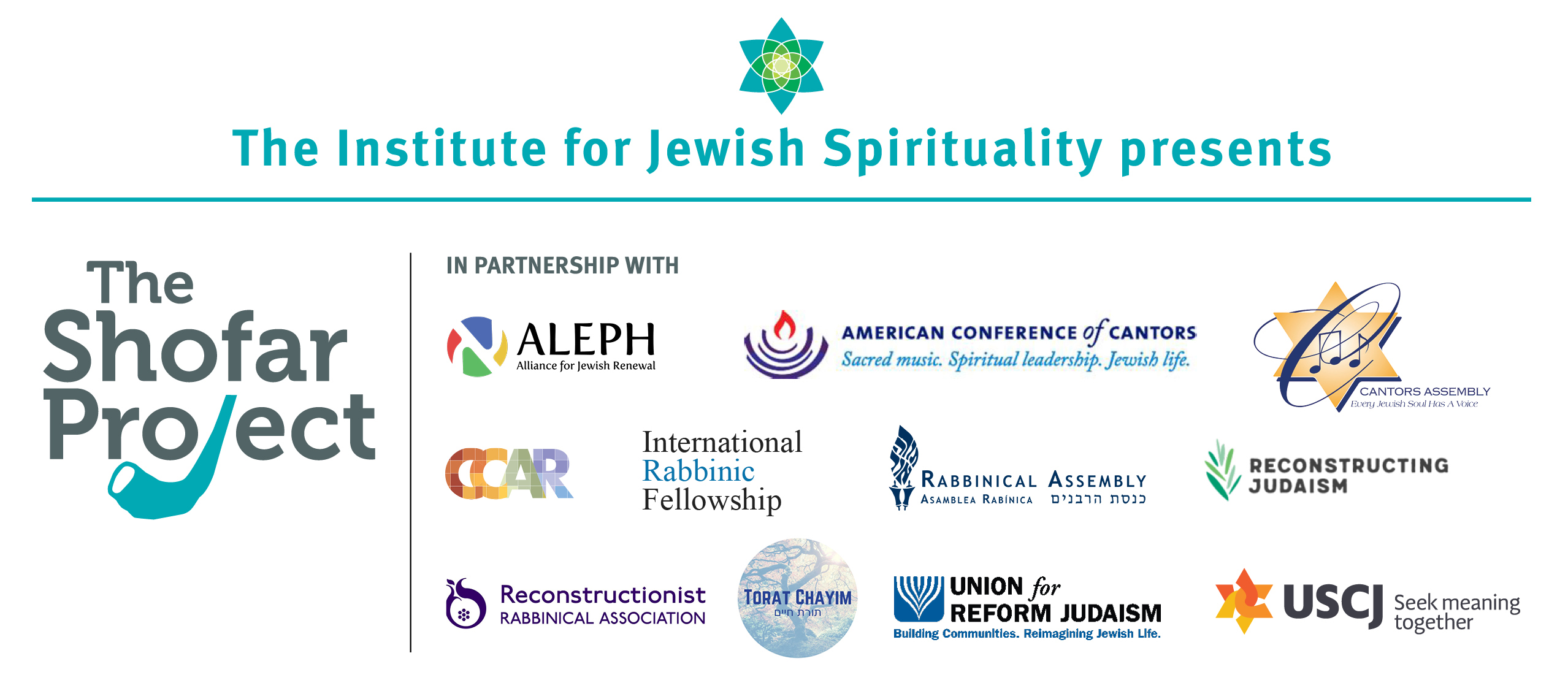
We are pleased to announce that ALEPH, the American Conference of Cantors, Cantors Assembly, and Torat Chayim have joined The Shofar Project as our newest partners.

These four organizations join the Central Conference of American Rabbis, International Rabbinic Fellowship, Rabbinical Assembly, Reconstructing Judaism, Reconstructionist Rabbinical Association, Union for Reform Judaism, and the United Synagogue of Conservative Judaism in this historic cross-denominational partnership with the Institute for Jewish Spirituality.

The Shofar Project is a free program that runs during the month of Elul (August 20 - September 18) and includes daily Jewish mindfulness meditation sits led by clergy from the partner organizations, weekly Torah study, and a twice-weekly Jewish yoga studio. IJS faculty will prepare short teachings to frame each week in a theme related to listening to the shofar. Upon registration at IJS’s website, participants receive email reminders about the weekly and daily events. Local communities can create weekly practice groups to reflect on the themes and build other programs around them.

For more information on The Shofar Project, including registration information, visit https://www.jewishspirituality.org/go-deeper/the-shofar-project/.

The Institute for Jewish Spirituality Collaborates with Movements in Historic Cross-Denominational Spiritual Partnership

In an historic cross-denominational partnership, the Institute for Jewish Spirituality today announced the Shofar Project, a program of spiritual preparation for the High Holidays in collaboration with the Central Conference of American Rabbis, International Rabbinic Fellowship, Rabbinical Assembly, Reconstructing Judaism, Reconstructionist Rabbinical Association, Union for Reform Judaism, and the United Synagogue of Conservative Judaism.

The free program runs during the month of Elul (August 20-September 18) and includes daily Jewish meditation sits led by clergy from the partner organizations, weekly Torah study, and a twice-weekly Jewish yoga studio. IJS faculty will prepare short teachings to frame each week in a theme related to listening to the shofar. Upon registration at IJS’s website, participants receive email reminders about the weekly and daily events. Local communities can create weekly practice groups to reflect on the themes and build other programs around them.

“What is most exciting to me about The Shofar Project is that it’s really an open-source platform,” said IJS Executive Director Rabbi Josh Feigelson. “Because it’s free, local communities can piggy-back on the programming and customize it. That’s a big paradigm shift and a wonderful form of collaboration and partnership.”

“IJS has pioneered the renewal of Jewish spiritual life in North America for over 20 years, and we are thrilled to partner with them,” said Rabbi Rick Jacobs, President of the Union for Reform Judaism. “Hundreds of Reform clergy have transformed their approach to Torah and Jewish life through experiences with IJS. I know—I was in the very first cohort of rabbis who studied with IJS two decades ago. So I’m thrilled that we can bring this Torah to so many more people through this partnership.”

Feigelson reflected that the cross-denominational collaboration potentially reflected a broader turning-point: “While I know the movements have collaborated in various ways over the years, I cannot think of a time when this wide a cross-section came together in the cause of spiritual practice. It’s profoundly heartening to witness, especially at a moment when so many people are awakening to the vital importance of spiritual life.”

For more information on The Shofar Project, including registration information, visit https://www.jewishspirituality.org/go-deeper/the-shofar-project/.

Rabbi Myriam Klotz Joins IJS Staff as Senior Program Director

The Institute for Jewish Spirituality (IJS) announced today that Rabbi Myriam Klotz will join the organization’s staff as Senior Program Director effective August 17.

Klotz, a major figure in Jewish yoga and embodied practice for decades, has been a faculty member at IJS since 2003. She has taught in the organization’s flagship clergy leadership training programs and recently helped to launch its online Jewish yoga studio. In her new position, she will lead the Institute’s development of embodied and somatic practices, with a particular focus on how attention to the body can aid healing, inclusion, and justice work on behalf of traditionally marginalized populations. Her position at IJS will be half-time while she continues her work as Coordinator of Spiritual Direction at Hebrew Union College-Jewish Institute of Religion and Director of Bekhol Levavkha: A Training Program for Jewish Spiritual Directors, also at HUC-JIR.

“I am thrilled that Myriam is joining our program staff,” said IJS Executive Director Rabbi Josh Feigelson. “So many of us are awakening to the ways in which our bodies are intimately tied up with our minds, hearts, and spirits—and how paying more attention to our bodies can help us heal from trauma, relate to ourselves and others with greater compassion and bring about greater inclusion, equity, and justice. We have an opportunity to expand and deepen the ways our Torah at IJS responds to these forms of awakening and ensures we collectively sustain and build on them into the future and Myriam is exactly the right person to help lead that effort.”

Klotz received her B.A. from Brown University and was ordained by the Reconstructionist Rabbinical College. She is a certified yoga instructor and yoga therapist. She lives in Philadelphia with her spouse Rabbi Margot Stein and their son, Raffi.