
I had a couple hours between the end of a senior staff offsite meeting in Atlanta and my flight home to Chicago. My colleague Firkins wanted to visit the National Center for Civil and Human Rights before, so we went together and spent 90 minutes there on the way to the airport.
This was my second trip to the museum. My first visit was eight years ago, before I began a regular meditation practice. Of the many powerful exhibits, the one I remembered the most was a simulation of the 1960 Woolworth’s lunch counter sit-ins, which the museum’s website describes thus: “Visitors are invited to participate in a lunch counter sit-in simulation and place themselves in the shoes of non-violent protestors in 1960.”
What does that mean? You put on a pair of headphones and listen as an angry mob yells at you, pushes you (the chair vibrates), and makes you feel increasingly unsafe. Though the simulation lasts 85 seconds, many visitors take off their headphones before that because it’s frankly really intense. There’s even a space with comfy chairs and kleenex to decompress after you’re done.
On my first visit, I definitely didn’t make it through the full time (which, of course, is a fraction of what the activists themselves endured). But on this visit, I sat through the whole thing, buoyed both by my knowledge of what was coming and also by preparing myself with a short meditation before putting on the headphones, which I continued as the simulated violence got more intense.
On a wall near the lunch counter were some notes from a CORE training session on nonviolence. There is so much wisdom here:
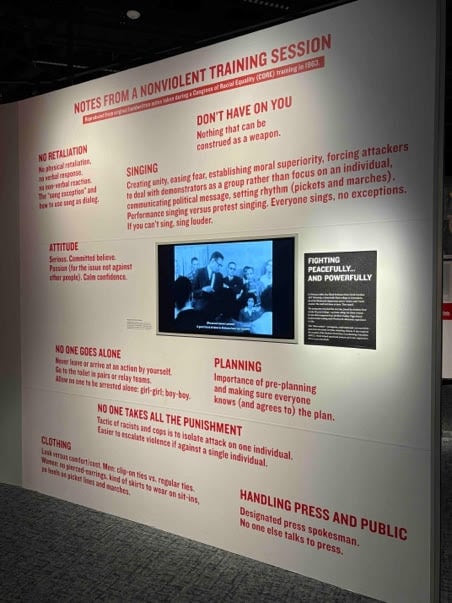
I was particularly intrigued by two items here. The first was the attitude the protesters were trained to adopt: “Serious. Committed. Believe. Passion (for the issue, not against other people). Calm confidence.” As much as anything, that reflects a profound and mature spirituality, what Rabbi Mordechai Yosef Leiner of Izhbitz referred to as the yishuv hada’at, or calm, settled mind, of the Hebrew midwives who defied Pharaoh’s decree.
The second thing that grabbed me was the emphasis on song: “Creating unity, easing fear, establishing moral superiority, forcing attackers to deal with demonstrators as a group rather than focus on an individual… Everyone sings, no exceptions. If you can’t sing, sing louder.” This reminded me of Moses’s words in Parashat Vayelekh: “And when many evils and troubles have come upon them, this song shall confront them as a witness, for it will live unforgotten in the mouths of their offspring” (Deuteronomy 31:21). Rebbe Nachman of Bratslav comments, “By means of this song one can awaken goodness from wherever one finds oneself, even at the end of these many generations, such that one can remember their inherent virtue and return to their deep spiritual roots.”
Another exhibit about Martin Luther King’s antipoverty work featured a quote from his 1964 Nobel Peace Prize lecture: “Ultimately a great nation is a compassionate nation.” That brought to mind another powerful teaching, from the early Hasidic master Rabbi Shmelke Halevi Horowitz of Nikolsburg (1726-1778). It comes on the verse, “Then YHVH your God will return your captivity and have compassion upon you…” (Deuteronomy 30:3). The rebbe comments, “A sign of a person’s teshuva (repentance/return) is whether they conduct themselves with the attribute of compassion (midat harachamim). For transgressions generate cruelty in a person’s heart, whereas it is written: “Then YHVH your God will return your captivity—and compassion will come upon you.”
I love that this teaching brings the question of teshuva out of the theological realm and into the profoundly personal. How do we know if we’ve done genuine teshuva, if we’ve really returned to the paths of peace that are the paths of Torah? One good indication is whether our hearts are soft, open, and compassionate, or hard, closed, and angry. If we’ve really done the work of teshuva, then we should be able to feel it in our hearts. If we can’t, then there is probably still more work to do.
In that spirit, one final item at the museum spoke to me on this visit. It was a video of President Lyndon Johnson’s 1965 speech to Congress advocating for passage of the Voting Rights Act. One of the most moving parts of that speech was when Johnson said this: “Their cause must be our cause, too. Because it is not just Negroes, but really it’s all of us who must overcome the crippling legacy of bigotry and injustice. And we shall overcome.” As the exhibit at the museum reminds viewers, Martin Luther King was said to have been moved to tears when he heard the President say these words.
“You stand this day, all of you, before YHVH your God,” says Moses, “your tribal heads, your elders, and your officials—the entire body of Israel—your children, your wives, even the stranger within your camp, from woodchopper to waterdrawer” (Deuteronomy 29:9-10). In other words, it takes all of us. No group of people—not African-Americans, not Jews, not Muslims, not anyone—should be made to sacrifice themselves for another. Rather, as the phrase goes, none of us is free until all of us is free.
It can sometimes feel like we’re a long way from that: When politicians call for Jews to sacrifice our own safety for the greater good, when our fellow Jews wantonly assault Palestinians in a warped and dangerous perversion of Torah, when we’re reminded of how long and how much the struggle for human dignity and equality can take.
Yet, as Rebbe Nachman teaches, it is precisely in such moments that we can turn to “this song”—the song of Torah, the song of our tradition, the song of our spiritual practice, to help us reconnect with our spiritual roots. That is the essence of teshuva, the essence of this season.
For Reflection & Conversation
-
-
- What do you make of Rabbi Shmelke of Nikolsburg’s teaching that a sign of teshuva is behaving with more compassion? Is that a helpful approach to the idea of spiritual returning and repentance? How, if at all, does it differ from other conceptions you’ve encountered?
-